


Born in Norfolk, Virginia, Peter Pryor is a multidisciplinary American artist whose practice encompasses mixed-media painting, film, performance, sound, and music recording. He studied at Pratt Institute, earning his BFA in 1981 and his MFA in 1993. Pryor began working in Williamsburg, Brooklyn, in 1979, becoming part of New York’s evolving creative community. For eight years, he also worked as a street artist in New York City, an experience that brought his art into direct contact with public space and the unpredictable rhythms of urban life. He now maintains a studio in Newburgh, New York, where he continues to develop his painting practice. Across different media, Pryor demonstrates a sustained interest in visual language, improvisation, repetition, and the transformation of familiar symbols into complex fields of association.
Pryor’s mixed-media paintings bring together botanical forms, geometric diagrams, numbers, stars, grids, written language, and densely rendered linear patterns. Rather than arranging these elements according to a conventional narrative, he allows them to coexist within active, layered compositions. Each symbol retains something of its original identity, yet its meaning changes through repetition and its relationship to the surrounding imagery.
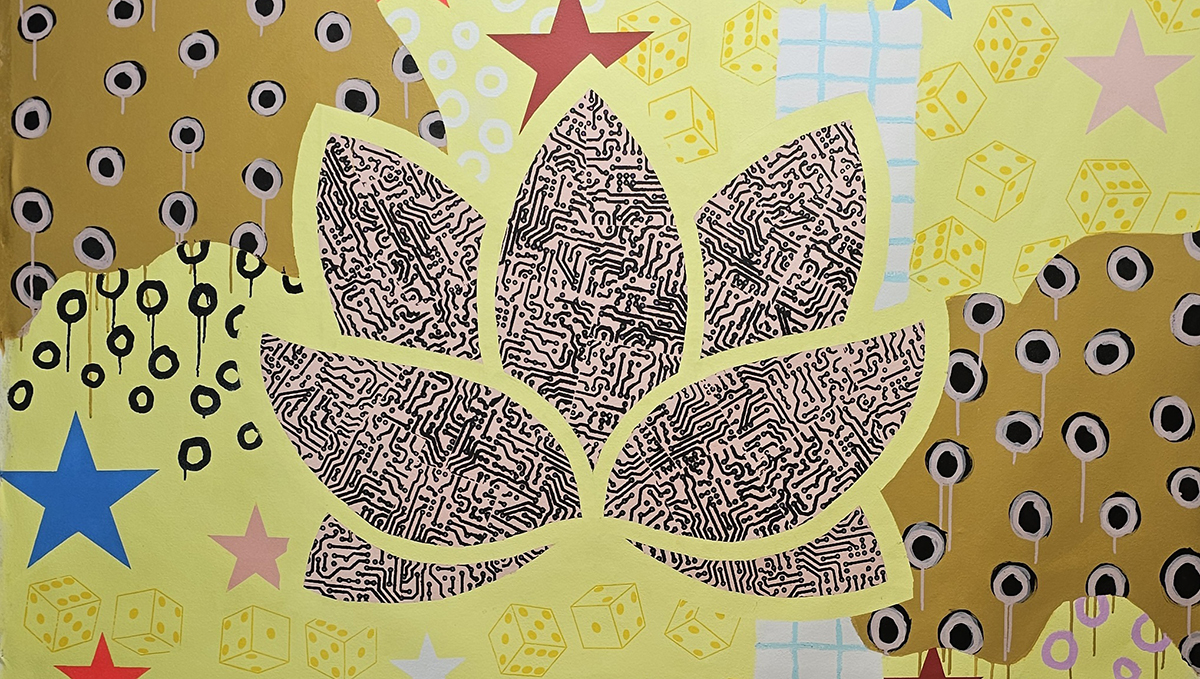
In one painting, a large flower-like form occupies the center of a luminous yellow-green field. Its petals are filled with intricate black lines resembling electronic circuitry, an urban map, or an imagined system of communication. The natural silhouette of the flower contrasts with its highly technological interior. This unexpected combination suggests an environment in which distinctions between nature and machinery have begun to dissolve. The flower may be organic in shape, but it appears to carry its own coded network.
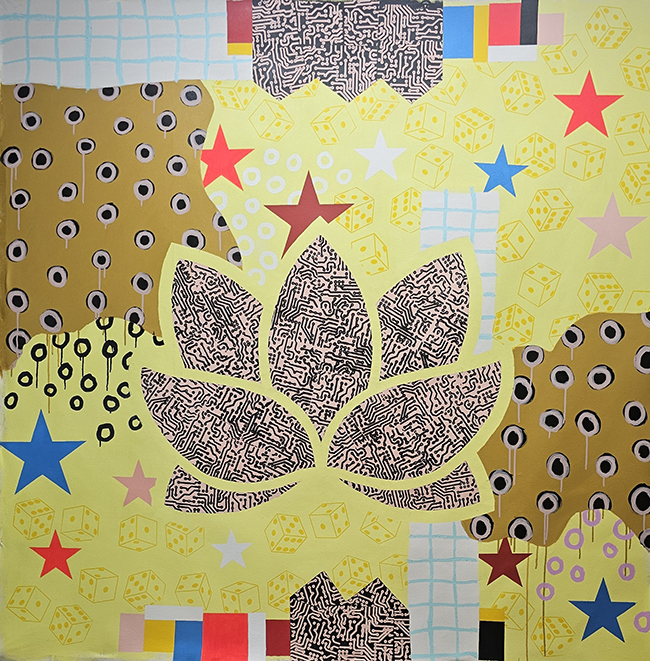
Around this central image, Pryor distributes stars, dice, circular marks, colored blocks, and pale blue grids. These repeated motifs give the painting a lively visual pulse. Dice introduce ideas of chance, probability, and uncontrollable outcomes, while the stars may evoke recognition, navigation, aspiration, or childhood imagery. The grids imply planning and order, but their irregular, hand-drawn quality prevents them from becoming rigid. Pryor’s systems remain deliberately imperfect and visibly human.
The painting is built from clearly separated areas that resemble pieces of fabric, sections of a city, fragments of memory, or pages collected from different visual archives. Brown passages covered with eye-like circles create a sense of observation. Elsewhere, geometric forms drift across open areas without following ordinary rules of scale or perspective. The composition feels simultaneously organized and unstable, as though it could continue expanding beyond the limits of the canvas.
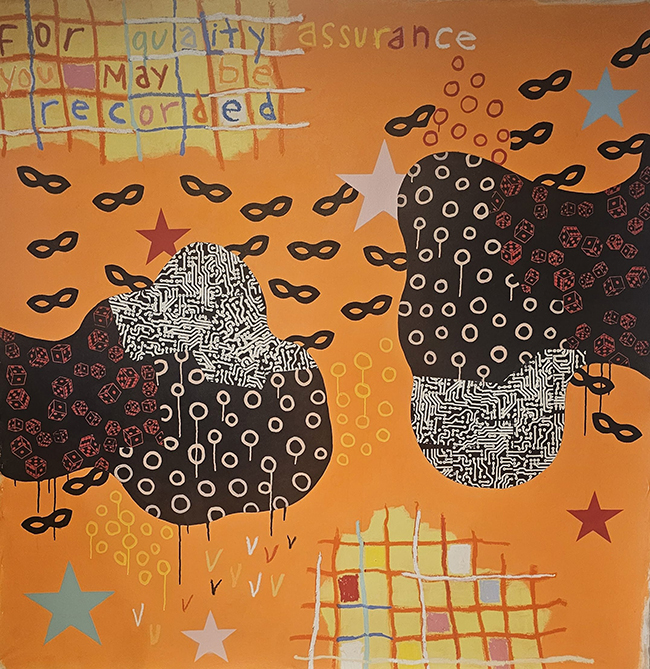
A second work is dominated by a vivid orange ground. Across it, three large irregular forms overlap and interact. Their surfaces contain changing combinations of circles, dice, linear networks, and small repeated symbols. These forms can be interpreted in many ways: as stones, islands, figures, thought clouds, or pieces of an invented landscape. Pryor avoids defining them too precisely, allowing viewers to form their own associations.
The orange background produces a sense of heat and movement, while black-and-white passages create areas of intense concentration. Blue, red, and pale pink stars provide points of contrast. Loose grids appear near the upper and lower edges of the composition, while a handwritten sentence is partially enclosed within the upper structure. The visible words, including “quality assurance” and “may be recorded,” bring an administrative or institutional voice into the painting. Removed from their original context, they become mysterious and slightly unsettling.
This inclusion of language connects the work to the visual experience of city life, where warnings, instructions, advertisements, notices, and incomplete messages constantly compete for attention. Pryor does not offer the sentence as a straightforward explanation. Instead, he treats it as another piece of visual material. Its meaning is interrupted by color, spacing, and the uneven grid surrounding it. Language becomes something seen as much as read.
There is also a musical quality to Pryor’s imagery. Repeated circles, dice, stars, loops, and lines behave like recurring notes or rhythmic phrases. Some patterns are tightly controlled, while others appear spontaneous. This relationship between structure and improvisation reflects his broader involvement with sound, performance, and recording. His paintings can be approached almost as visual compositions in which motifs enter, disappear, and return in altered forms.
Pryor’s history as a New York street artist may also be felt in his direct use of color, accessible symbols, layered surfaces, and energetic organization. The paintings contain the immediacy of public imagery, but they reward prolonged attention. What first appears playful gradually reveals a more complicated meditation on systems, technology, surveillance, chance, memory, and contemporary communication.
Through mixed media, Peter Pryor creates environments where the organic and mechanical, the personal and public, and the ordered and accidental remain in constant conversation. His paintings do not resolve these tensions. Instead, they transform them into vivid visual experiences filled with movement, ambiguity, and discovery.
