



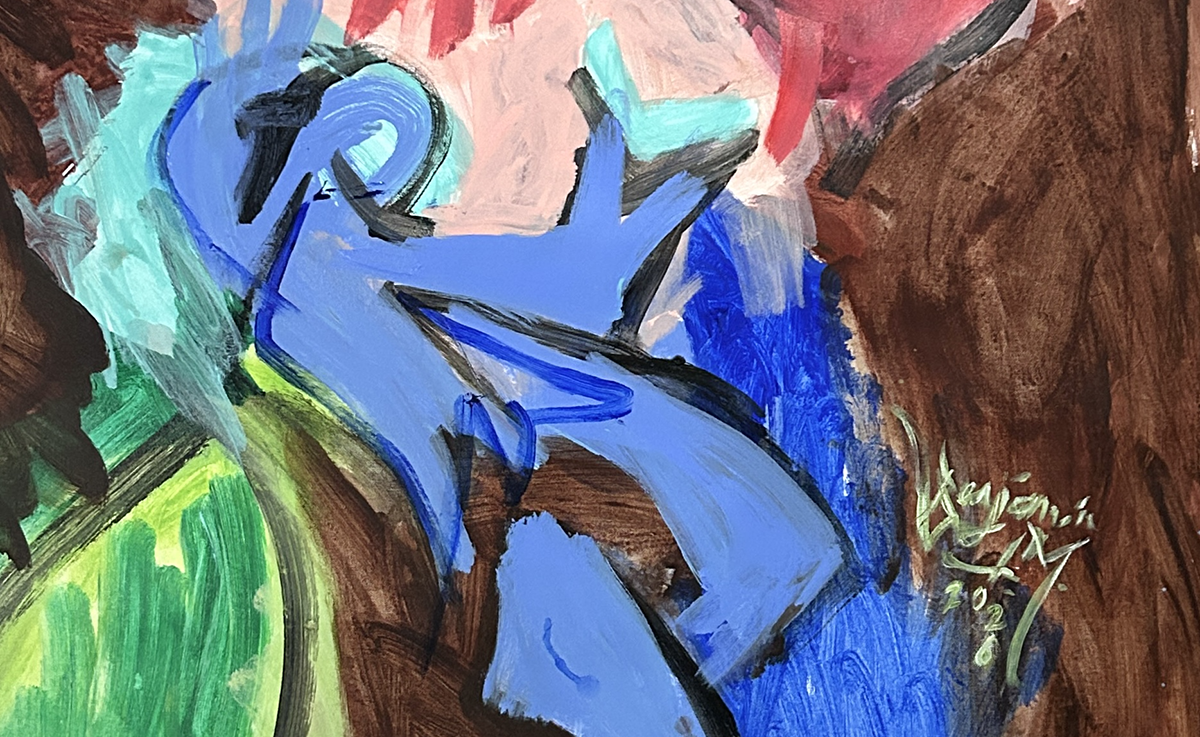
Benjamin L.M. approaches art as a source of power, clarity, form, and meaning. For him, painting is inseparable from life itself. It provides purpose while creating a space where struggle can be acknowledged and transformed into something hopeful. Central to his practice is the belief that light can overcome darkness, even when hardship remains real. He channels positive energy into expressive compositions intended to encourage viewers and guide them toward better emotional places. Language is equally important to his creative identity. As the author of five poetry books and the creator of two spoken-word recordings, Benjamin understands that words and titles can shape how an artwork is experienced. His paintings and their names function together as what he describes as “living power vehicles,” carrying messages of perseverance, possibility, and renewal. Through color, symbolism, and poetic imagination, his art seeks to make life feel brighter.
Benjamin L.M.
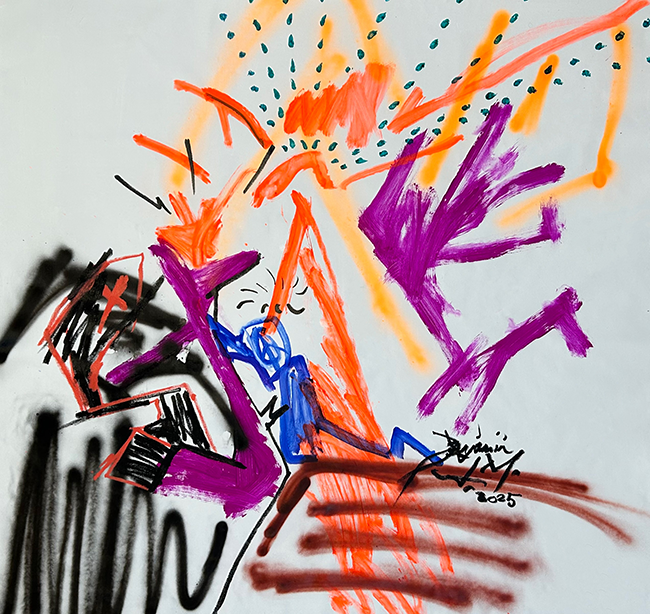
Jump For Joy As We Go To A New World Up Top
2025
Gouache, acrylic, spray paint & oil stick on canvas
51 x 53” (129 x 134cm)
$1600 US
Between Struggle and Illumination
Benjamin’s paintings are built from striking contrasts. Bright yellows, oranges, blues, greens, and reds meet darker passages of brown, black, and gray. These opposing colors reflect the emotional foundation of his practice: the continuing movement between difficulty and hope. Darkness is present, but it is rarely allowed to dominate. Instead, luminous color enters the composition with energy, suggesting that optimism can survive within confusion and uncertainty.
In the first featured painting, a brilliant yellow field surrounds two animated figures. On the left, a birdlike form rises vertically, its body assembled from black, brown, white, turquoise, blue, and orange strokes. Its feathers appear unsettled and active, as though stirred by wind or sudden motion. Opposite it is a radiant sunlike character with an expressive face, orange-red rays, and a swirling gray-white shape near its mouth.
The scene feels like a conversation between natural forces. Turquoise marks travel through the air and scatter across the ground like fragments of sound, rain, or energy. The sun’s face appears joyful, yet blue drops around it introduce emotional complexity. They may be read as tears, but they do not diminish its brightness. Benjamin seems to propose that happiness and sorrow are not always separate conditions. A person can experience difficulty and still retain warmth, humor, and a desire to move forward.
Loose brushwork gives the painting immediacy. Forms are recognizable without becoming rigidly realistic, allowing the image to operate more like a dream, poem, or visual fable. The open areas, shifting marks, and layered colors create movement across the surface. Rather than illustrating a single fixed story, the painting encourages viewers to develop their own interpretations.
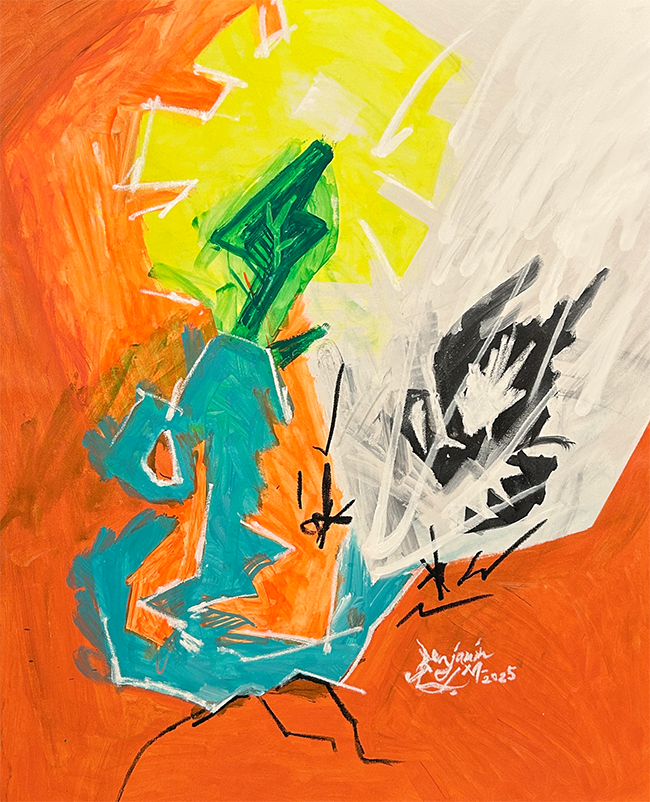
Benjamin L.M.
Release Hope With Miracle Belief2025
Gouache, acrylic, spray paint & oil stick on canvas
50 x 40″ (127 x 101cm)
$1500 USD
Symbols in Motion
The second work uses a different palette and emotional rhythm. Deep brown spreads across much of the composition, establishing a weightier atmosphere. Against this darkness, angular forms in blue, turquoise, red, and black gather near the upper center. These shapes suggest a flower, crown, mountain, burst of energy, or opening portal. Their meaning remains deliberately fluid.
A vivid green form curves upward from the lower left. It resembles a leaf, bird, flame, or vessel moving toward the central structure. Nearby, lavender arcs appear like clouds or rising waves. At the bottom, a black serpentine figure extends across a pale pink area. One section contains a small pink cross, adding another possible symbol of pain, faith, healing, or transformation.
Benjamin’s forms rarely settle into only one identity. This visual ambiguity gives his paintings their poetic character. Just as a poem can hold multiple meanings within a few words, these images invite different emotional and symbolic readings. A shape can appear playful at first and troubling later. A dark passage may suggest an obstacle, while a sudden area of blue or green provides release.
The scattered marks across the pale upper background strengthen the feeling of movement. They could represent rain, falling seeds, distant stars, or thoughts passing through the mind. Their repetition creates rhythm, connecting Benjamin’s visual practice to his work in poetry and spoken word. Colors and brushstrokes behave almost like syllables, pauses, and changes in tone.
The Power of Words and Titles
For Benjamin, the title of a painting is not simply a label added after the work is completed. It is part of the artwork’s power. His experience as a poet has taught him that a few carefully chosen words can redirect thought, awaken memory, or offer encouragement. A title can therefore become an entry point, guiding viewers toward the emotional purpose of the image without completely limiting interpretation.
This relationship between language and painting makes his practice distinctive. The artwork communicates first through color, form, and gesture, while the title adds another layer of meaning. Together, they become a unified message. Benjamin describes these combinations as vehicles capable of carrying people toward “better places.” This does not mean that his art ignores suffering. His statement that “the struggle is real” establishes an honest foundation. Hope matters precisely because darkness exists.
His positive energy is therefore not passive or superficial. It is active, deliberate, and hard-won. The vivid colors appear to push against darker forms, while expressive figures continue moving through unstable spaces. Light becomes an action rather than merely a condition.
Benjamin L.M.’s work ultimately presents creativity as a force for emotional survival and renewal. His paintings do not offer simple explanations. Instead, they create energetic spaces in which viewers can encounter struggle, humor, mystery, and possibility at the same time. Through his union of painting and poetry, Benjamin gives visual form to a clear conviction: art can make life better, and its energy can help carry others forward.
