


For nearly five decades, multidisciplinary artist Vandorn Hinnant has examined the relationship between consciousness, ancestral knowledge, intuition, and realities that lie beyond ordinary perception. His paintings, drawings, sculptures, and writings emerge from a sustained interest in spiritual experience and humanity’s long history of attempting to understand the unknown.
Stories involving ancestors, shamans, and non-physical beings appear throughout cultures and generations. Hinnant does not dismiss these accounts as folklore alone. Instead, he considers them evidence of an enduring human desire to comprehend dimensions of existence that cannot be accessed through the five senses.
He has referred to some of his images as “soul sketches” and “spirit whisperings.” These descriptions express his effort to make intangible experiences visible. In his practice, art becomes more than an aesthetic object. It functions as a psychological and spiritual tool for recording intuitive perceptions, energetic presences, and impressions received through inner awareness.
Organic forms, geometric structures, luminous shapes, and carefully placed lines come together as a personal visual language. Through these elements, Hinnant creates imagined spaces in which consciousness can travel, communicate, and exist independently of the physical body.
Giving Form to Spiritual Experience
The shaman serves as a significant symbolic presence within Hinnant’s work. In many ancient societies, shamans were believed to communicate with ancestors, spirits, and other non-physical entities. They occupied an intermediary position between everyday human experience and invisible realms.
Hinnant’s interpretation of this tradition raises a compelling question: Can the artist also act as an intermediary?
Through the creative process, an artist may receive an intuition, vision, or emotional impression that has no physical form. By translating that experience into an image, the artist gives it a material presence that can be encountered by others. Art therefore becomes a bridge between private perception and shared reality.
Hinnant does not present his paintings as scientific evidence, nor does he use them to promote a particular religious doctrine. His work instead opens a contemplative space where different possibilities may be explored. Viewers are encouraged to move beyond literal interpretation and consider whether knowledge can arise through intuition, memory, imagination, and spiritual sensitivity.
Stars, spheres, vessels, architectural forms, open landscapes, and slender connecting lines repeatedly appear throughout his compositions. These elements establish a symbolic vocabulary through which consciousness is portrayed as active and mobile. The soul may temporarily move beyond the body, yet a relationship between physical and non-physical existence remains intact.
Hinnant discovered an important historical connection to these ideas through the Guggenheim Museum’s 2018–2019 exhibition, Hilma af Klint: Paintings for the Future. Af Klint’s spiritually informed abstractions offered a meaningful parallel to his own investigations.
Encountering her work gave Hinnant a sense of recognition and belonging. It demonstrated that artists may create from experiences that are not fully understood by the culture surrounding them. In some cases, the significance of such work may not become apparent until many years later, when audiences develop new ways of seeing and interpreting it.
Shaman’s Dream: The Soul in Motion
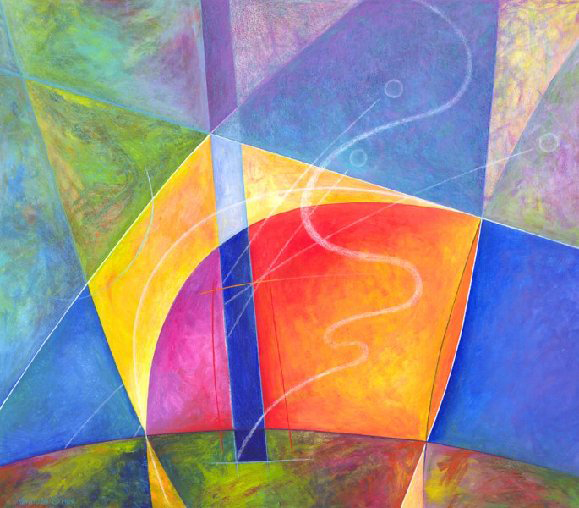
Created in 1989, Shaman’s Dream is an acrylic and Prismacolor pencil composition on a gessoed substrate measuring 21 by 24 inches. Its visual elements include a solitary dwelling, a gently curved horizon, three translucent spheres, and a series of delicate lines extending across the surrounding space.
While the composition initially appears abstract, its forms have been arranged as parts of a symbolic narrative.
The isolated structure represents both a physical shelter and a ceremonial location. A subtle stream of smoke rises from an opening in the building, suggesting that a ritual, meditation, or transformation is unfolding within it. Beneath the structure, the curved horizon establishes the surface of the earth, grounding the dwelling within the physical world.
Above this landscape, three transparent spheres drift through a vast, undefined atmosphere. According to Hinnant, these spheres represent the souls of three shamans. Their bodies remain inside the dwelling while their consciousness travels through a higher, non-physical dimension.
Each sphere is joined to the structure by a thin line. These connections operate as energetic cords between the traveling consciousness and the body it has temporarily left behind. The shamans are free to move beyond physical boundaries, but they retain a pathway that allows them to return to embodied life.
Hinnant avoids depicting the shamans as recognizable human figures. Instead, he represents their presence through transparency, radiance, and spatial movement. Their individual appearances are no longer important. What remains is consciousness itself, visualized as luminous energy traveling through an invisible realm.
The painting resonates with spiritual traditions that describe journeys beyond the body, communication with ancestors, and movement between different states of existence. Rather than illustrating one specific cultural account, Hinnant constructs an open symbolic environment capable of holding many interpretations.
Shaman’s Dream also reflects his continuing investigation of what he calls the “eye of the soul.” From his earliest deliberate experiments with mark-making, Hinnant has attempted to record forms perceived through inward vision rather than physical observation.
In this context, a drawing or painting is not simply invented. It becomes evidence of an internal encounter. Every mark contributes to a visual record of something felt, sensed, or witnessed within consciousness, even when that experience cannot be confirmed through ordinary sight.
Mother Ship: Returning to an Earlier Vision
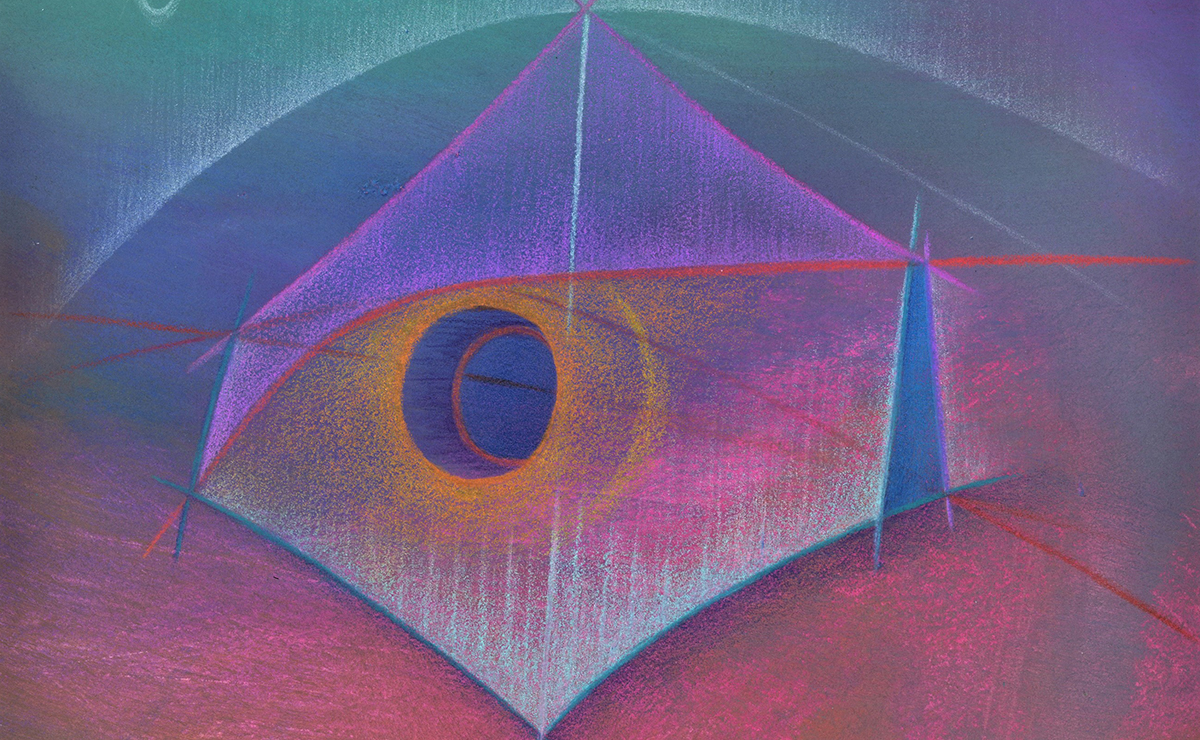
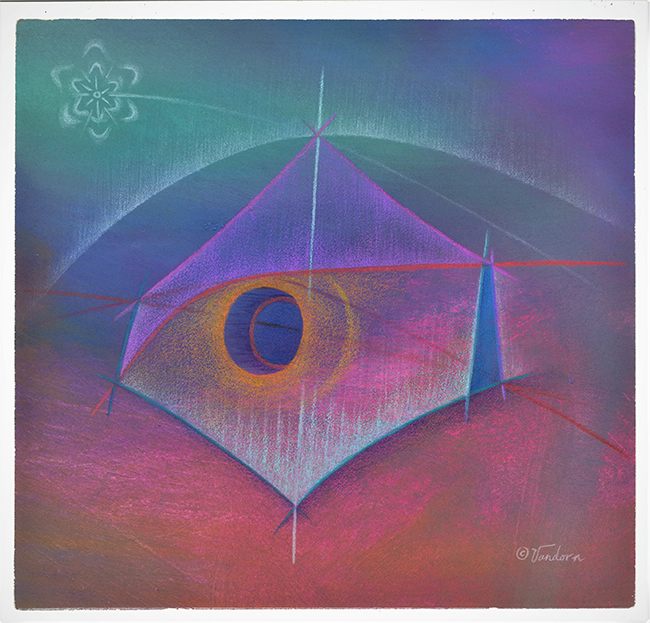
Mother Ship, dated 1991/2023, was made with acrylic paint and Prismacolor pencils on cotton rag paper. Measuring approximately 9.6 by 10.125 inches, the work depicts a mysterious vessel moving through an unfamiliar terrain under the guidance of a sentient navigator.
A six-pointed star floats above the vessel. A narrow stream of light connects the star to the structure below, creating a relationship similar to the energetic cords in Shaman’s Dream. Hinnant proposes that the star may represent the navigator’s soul existing temporarily outside the physical body.
Although this consciousness has traveled beyond its embodied form, it continues to direct the vessel through the unknown environment. The soul and body occupy different spaces, yet they remain connected and participate in the same journey.
Circular openings along the vessel give it the appearance of a constructed vehicle. However, the surrounding landscape provides no recognizable indication of place or historical period. The scene might belong to a distant civilization, an imagined future, a forgotten ancestral memory, or another dimension altogether.
This absence of a fixed time and location is essential to the composition. Hinnant’s imagery often brings together references that feel both ancient and futuristic. His works suggest that spiritual consciousness does not necessarily follow a linear understanding of time. Memory, intuition, possibility, and otherworldly experience can coexist within a single visual field.
The development of Mother Ship also illustrates the extended lifespan of Hinnant’s creative ideas. He completed the original black-and-white study in 1991 but did not transform it into its full-color form until 2023. The image remained with him for more than thirty years before reaching its later stage.
Other drawings and three-dimensional paper studies continue to exist within his archive. Some may eventually become paintings, sculptures, or more permanent works when the appropriate moment arrives. His process suggests that an image does not lose its relevance simply because it remains unfinished. It can continue developing quietly across decades.
Art as a Passage Between Realities
Together, Shaman’s Dream and Mother Ship reveal the consistency of Hinnant’s artistic inquiry. Although completed during different periods, both works visualize consciousness as something capable of extending beyond the physical body.
The dwelling and vessel operate as containers for embodied existence, while spheres, stars, illuminated paths, and connecting lines describe the movement of the soul. These symbols allow Hinnant to approach spiritual ideas without relying on conventional religious imagery or literal human representation.
His compositions occupy a meeting point between abstraction and narrative. They do not explain every element or offer a single conclusion. Instead, they encourage viewers to remain receptive to uncertainty and to contemplate realities that may exist beyond physical observation.
Through decades of artistic exploration, Hinnant has developed a practice in which mark-making becomes a method of inquiry. His works connect ancestral memory with future possibility, material form with intuitive perception, and the visible world with dimensions that remain unseen.
In Hinnant’s art, the image becomes both a record and a vessel: a record of an inwardly perceived experience and a vessel capable of carrying that experience into the consciousness of another person.
