


Julian Jollon is an American artist whose creative practice is inseparable from his personal journey. Formally educated in Fine Arts, Photography, and Painting, he stepped away from art for fifteen years as illness, recovery, and professional responsibilities redirected his life. A liver transplant profoundly altered his relationship with time, mortality, and renewal, while his work in Hospital Epidemiology brought him close to the fragile boundaries between vulnerability and survival. When Jollon eventually returned to creating, he carried with him a transformed understanding of art’s purpose. His photographs and paintings are not merely objects of self-expression, but offerings shaped by gratitude, spiritual inquiry, and lived experience. Drawing upon mythology, nature, and the endurance of the human spirit, Jollon explores creation as something that moves through the artist rather than belonging to him. Each image becomes an act of release: a visual testimony intended to be shared.
Us and Them
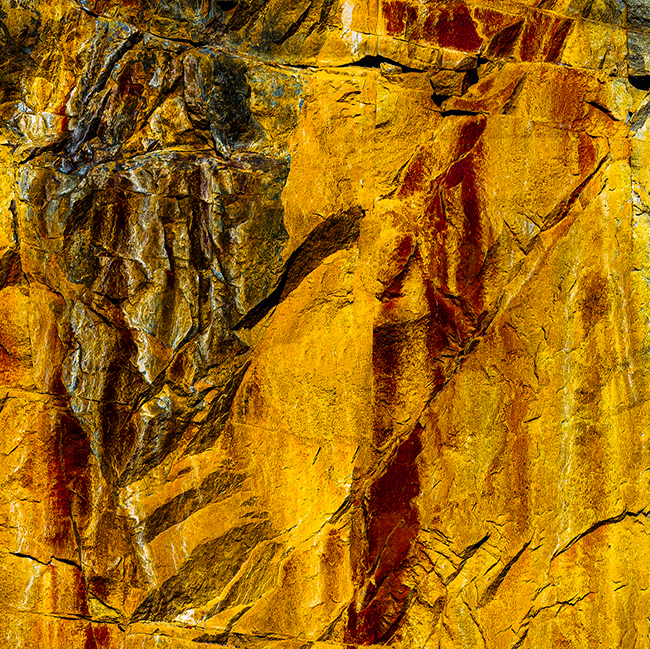
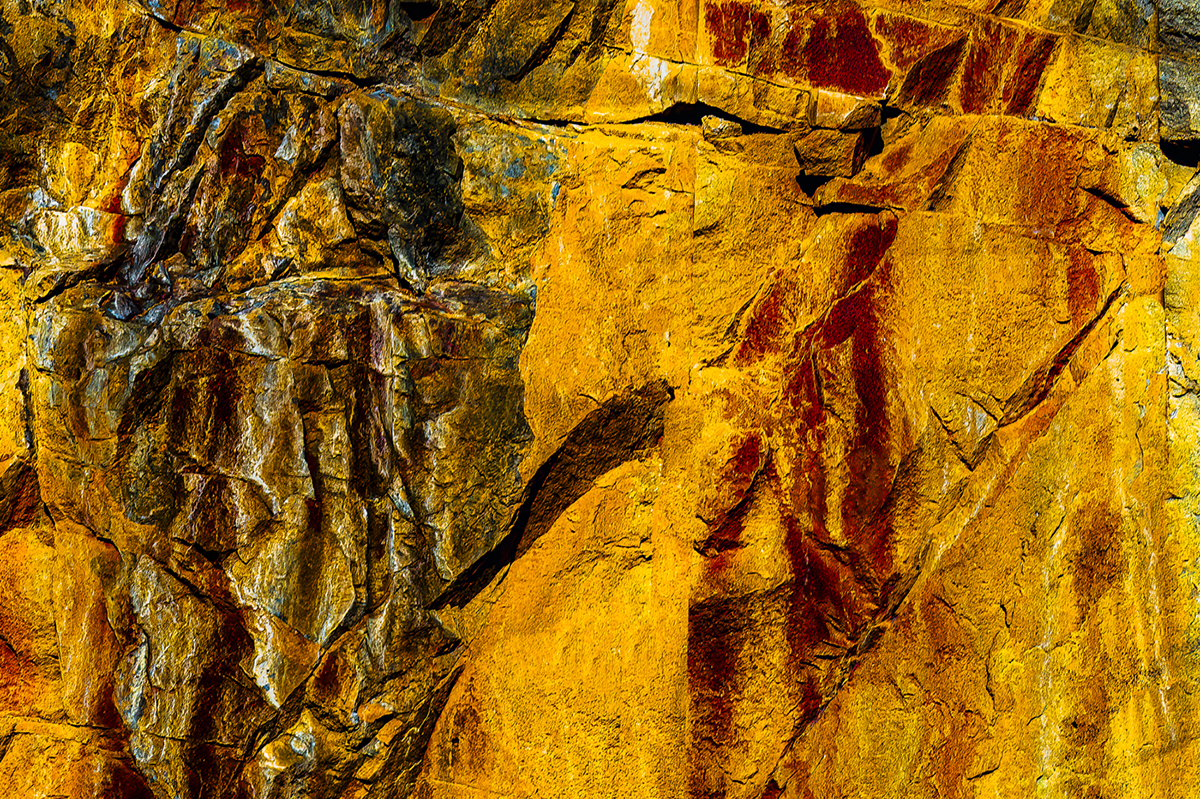
In Us and Them, Jollon transforms the rugged surface of a rock cliff into a meditation on companionship, destiny, and the mysterious forces that bring two lives together. The image is filled with intense shades of gold, amber, rust, and deep brown. Its weathered formations appear ancient and monumental, yet within the stone, the suggestion of human presence begins to emerge. Two kindred spirits seem to rise toward one another, meeting near the top of an implied staircase and joining in an open embrace.
Their forms are not sharply defined. Instead, they remain embedded within the cliff, suspended between recognizable figures and natural formations. This ambiguity is essential to the image’s power. Jollon does not tell viewers exactly what they are seeing. He allows the eye and imagination to collaborate, slowly discovering faces, bodies, pathways, and gestures among the fractures and ridges. The longer one looks, the more the cliff seems to contain its own hidden history.
The meeting may be accidental, or it may have been written into the structure of existence long before either spirit began its ascent. Jollon leaves that question unresolved. Considering the billions of stars in the universe and the billions of people living on Earth, the possibility that two deeply compatible souls will encounter one another at precisely the right moment can feel almost miraculous. Every life is shaped by countless variables: birthplace, time, movement, choice, loss, and circumstance. For two paths to intersect with genuine emotional or spiritual recognition requires an extraordinary alignment.
Yet Us and Them suggests that chance and destiny may not be opposites. A meeting can occur unexpectedly and still feel inevitable. The importance lies less in how the encounter happened than in what it awakened. At the point where the two forms appear to meet, individual boundaries soften. Stone, body, landscape, and spirit merge into a single visual rhythm. Their embrace becomes a moment of mutual recognition, as though each has finally discovered something familiar within the other.
The artwork also recalls Indigenous traditions in which geography and the cosmos are understood as living presences connected to human stories. Across many such traditions, mountains, rivers, stars, and planets are not passive scenery. They participate in memory, identity, and relationship. Celestial bodies may become lovers pursuing one another across the sky, while the sun, moon, and morning star may assume human form to search the earth for connection and adventure. Through this perspective, Jollon’s cliff becomes more than a geological structure. It acts as a witness, holding the memory of the meeting within its surface.
The upward movement within the composition reinforces this spiritual dimension. The implied staircase can be read as a passage from one state of being into another. Its ascent suggests effort, patience, and transformation. Each spirit has traveled independently, shaped by experiences invisible to the other, before arriving at a shared threshold where stone appears to open toward the sky. Their meeting becomes both physical and metaphysical: a convergence between earthly existence and something larger than it.
Jollon’s saturated treatment of color further separates the image from straightforward landscape photography. The glowing gold suggests illumination, sacredness, and revelation, while the red and darkened crevices introduce emotional intensity. Light passes unevenly across the cliff, emphasizing some forms while concealing others. This visual tension mirrors the uncertainty at the heart of human relationships. We never fully know whether another person has entered our life through coincidence, choice, or an unseen pattern.
Ultimately, Us and Them reflects on the rare experience of being deeply understood. Words become secondary when two people recognize in one another a shared emotional frequency. Such a connection may be brief when measured against the age of the universe, yet its influence can extend far beyond the moment itself. The figures in Jollon’s image may eventually disappear back into the cliff, but their encounter remains inscribed in stone.
Through this union of landscape, symbolism, and spiritual reflection, Jollon invites viewers to contemplate the people whose presence has altered their own direction. The universe may never reveal whether these meetings are random or preordained. What remains certain is their transformative power. In Us and Them, two spirits find one another at the boundary between earth and sky, and for one luminous moment, the ancient landscape appears to listen.
