



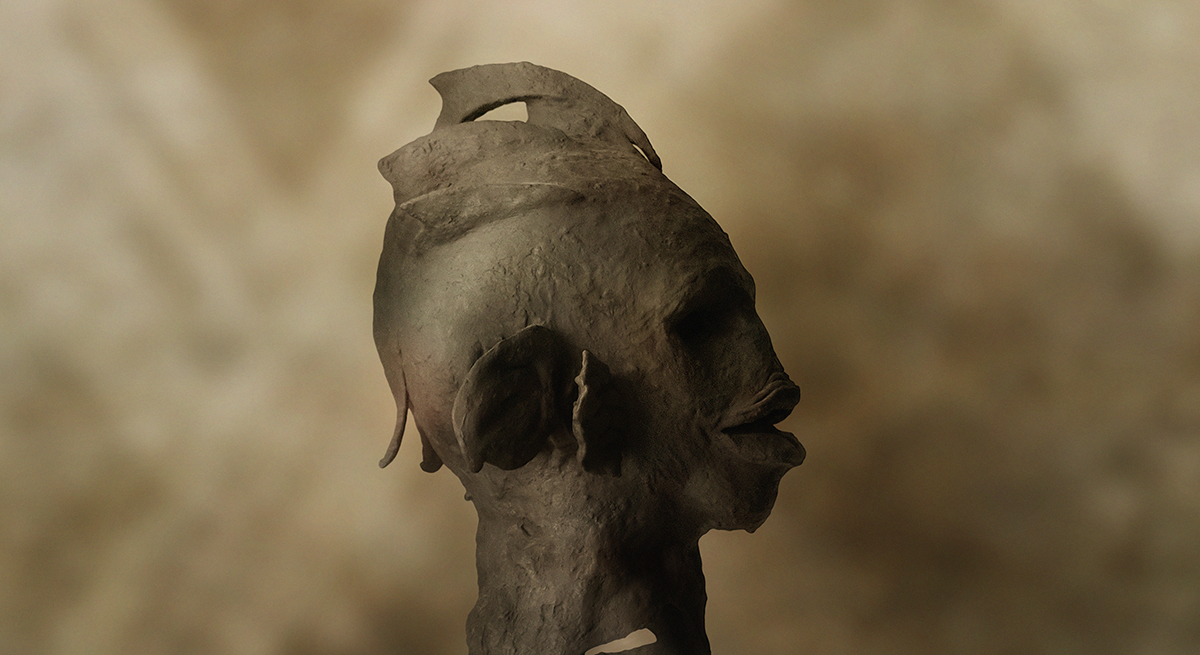
Born in Montreal in 1964, Adamo Macri studied commercial art, photography, drawing, fine arts, and art history at Dawson College. His education gave him several ways to develop an idea, and he has continued to work across sculpture, photography, video, painting, and drawing. The choice of medium changes, but certain questions remain close to the center of his practice. How much can a face reveal? What happens to identity when the body is disguised or altered? Macri’s figures often occupy a space between the human and the unfamiliar, inviting viewers to look closely while withholding a clear explanation. A surface may appear worn or damaged, suggesting a history that cannot be fully recovered. In his work, transformation is both physical and psychological. The viewer encounters a figure, then begins to wonder what experiences, fears, or memories might have shaped its appearance.
Interlope Ruse (2024)
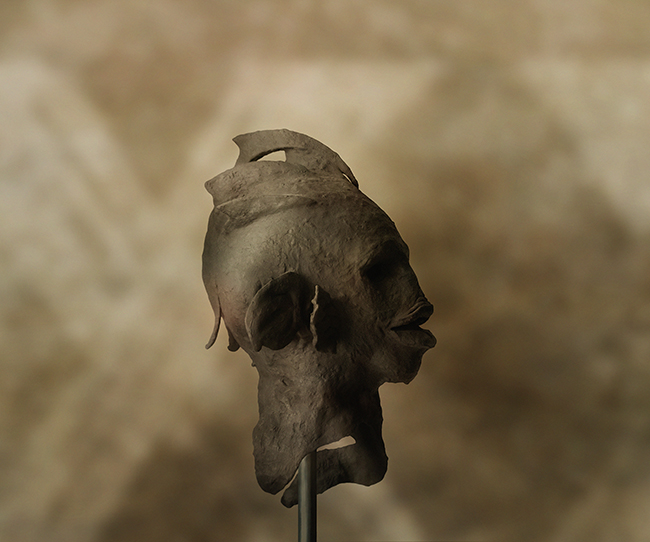
A helmet covers much of the figure in Interlope Ruse, yet it offers little sense of protection. Its aged, fractured appearance makes it seem as vulnerable to time as the face beneath it. The hollow gaze and guarded profile suggest someone watching from behind a barrier, aware of an outside threat but unwilling to reveal a response. Macri gives the portrait the presence of an excavated object. Earthy color and worn details invite the viewer to imagine where it has been, although the work supplies no definite place or period.
That uncertainty is central to its effect. At first, the helmet suggests a soldier, guardian, or survivor. The longer one looks, the less securely any of those identities fits. The figure could be hiding, preparing to confront something, or emerging after an encounter that has already changed it. Even its apparent age is difficult to place. It resembles a remnant of an ancient world while carrying concerns that feel immediate: damaged environments, altered bodies, and the need to protect oneself from forces that are hard to see.
Interlope Ruse belongs to Macri’s Jahrfish project, in which the fish recurs as a way to consider mutation, contamination, and the effects of human intervention. In this work, the reference to aquatic life does not settle into a simple illustration. It is absorbed into a hybrid figure whose origins remain uncertain. Human, animal, and invented qualities seem to overlap. The portrait appears to have been shaped by its surroundings, as though the environment has left marks on its body. Its condition raises a question that runs through the series: when a living form changes under pressure, where does adaptation end and damage begin?
The title deepens that ambiguity. An interloper enters a place where they may not be welcome; a ruse conceals an intention. Together, the words make the figure’s position difficult to judge. Is it an intruder wearing a disguise, or a vulnerable being that has learned to hide? Could the apparent threat lie outside the portrait, in the world that produced it? Macri leaves those possibilities open. The work draws the viewer into an uneasy act of interpretation, where each attempt to assign a role reveals another way to read the image.
Its weathered surface also matters. Cracks and worn passages give the figure a history without describing that history outright. The viewer may read the marks as evidence of conflict, exposure, or slow erosion. They could equally suggest a body in the midst of becoming something else. What looks ancient may be the remains of a future imagined through ecological change. By refusing a clear timeline, Macri allows the portrait to move between relic and warning.
There is a quiet intimacy beneath the work’s unsettling appearance. Despite the helmet and altered features, the figure faces us as a portrait. Its gaze creates the familiar expectation that a face might disclose a feeling or a personal story. Here, that exchange remains incomplete. We can see signs of endurance, but we cannot know what has been endured. The distance between recognition and understanding gives Interlope Ruse much of its emotional force.
Within the larger Jahrfish project, the work offers no single account of transformation. It presents change as something that can be imposed, resisted, or used for survival. The figure seems to carry traces of all three possibilities. Macri asks us to stay with that uncertainty and consider what the visible surface can tell us about an altered life—and what it continues to keep hidden.
