



Deborah K. Tash was born in 1949 and raised in the Bay Area. She’s both a poet and visual artist, working at the intersection of identity, history, and the natural world. Her art is shaped by a personal blend of cultures—Mexican on her mother’s side, and Celtic on her father’s—and she refers to herself as a Mestiza, embracing the layered meanings that come with that identity. Color and texture are her first languages. Tash works in both writing and visual art to explore the presence of nature, spirit, and memory in human life. Her practice connects the personal with the mythic, the mundane with the symbolic. It’s not just about what’s seen—it’s about what hovers just behind it. Her pieces often carry the weight of other realms, real and imagined, making them feel like quiet conversations with something older than memory.

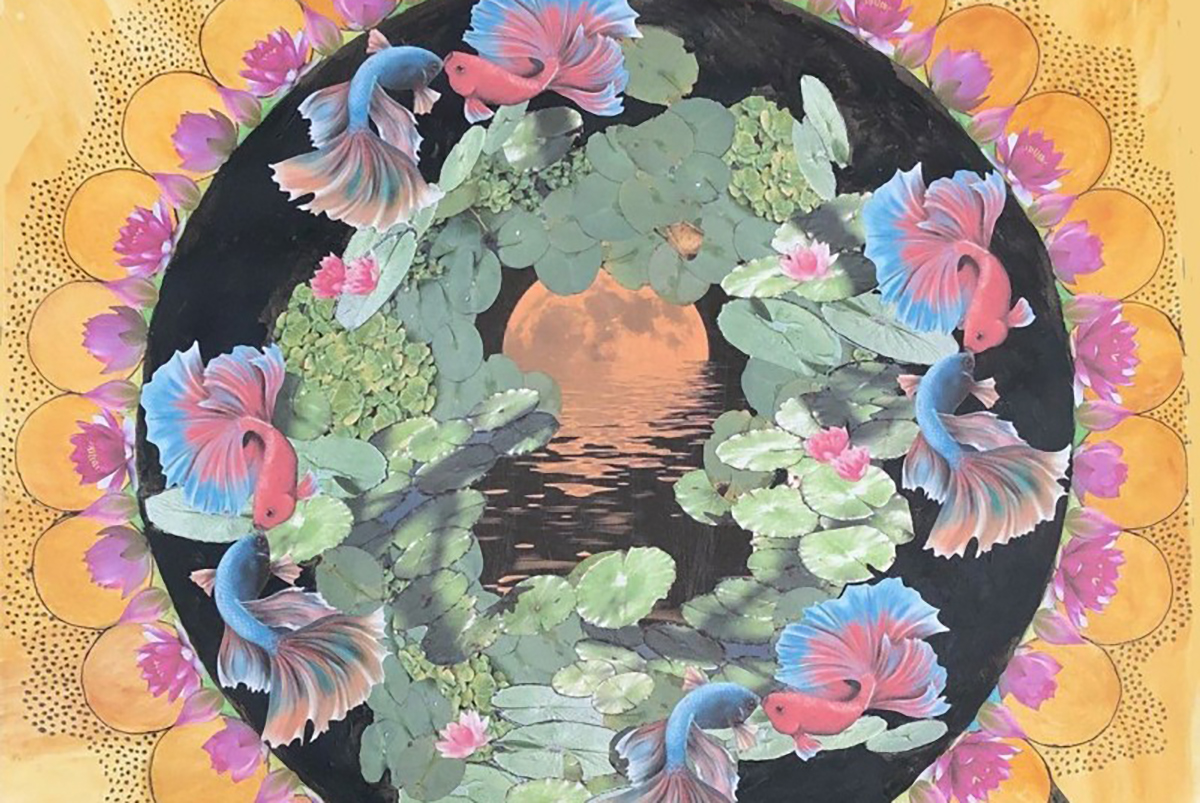
Deborah K. Tash’s Totem Series pulls from deep wells of cultural memory and personal connection. One of the works in this series, Mestiza Moon Shield VI, is both grounded and dreamlike. It’s a collage watercolor that places a circular shield—reminiscent of a Native American drum—at its center. The shield becomes a container, a surface, and a portal.
The composition is built around this focal shape. A full orange moon glows against water, its reflection shimmering below. The surface is dotted with lily pads and swimming Betta fish. The background is black, not as absence, but as space. In that darkness, everything stands out. The light in the painting seems to radiate outward from the center, as if the shield is emanating something beyond its physical material.
Around the shield, lily blossoms sit on disks of orange. There’s a pulse to their placement—orderly but not rigid. They spin, hum, or orbit. The shield is fringed and adorned with black feathers. Even the feathers aren’t still. Betta fish appear on them too, floating as if caught mid-motion in a slow underwater dance. The symmetry and layering give the work a ceremonial rhythm, like a song without sound.
Tash’s use of collage and watercolor isn’t just technique—it’s part of how she speaks. The transparency of watercolor allows layers to breathe through each other. The addition of collage brings in the tactile—paper, texture, edges. She’s building with both memory and material.
This piece is about more than aesthetics. It reads like a personal emblem. The shield may be armor, but it’s also offering. The moon may represent time, change, or ancestral pull. The fish, fluid and decorative, speak to adaptability and mystery. There’s a gentle protection in the way the imagery is arranged. Everything feels chosen. Nothing is random.
Tash doesn’t separate human life from the natural world or spiritual experience. In this work, the water and the animals are not background—they’re participants. And the circular form isn’t just a compositional choice—it echoes drums, shields, moons, eyes. Things that see, protect, reflect, and gather.
Though it leans into the symbolic, Mestiza Moon Shield VI doesn’t feel heavy-handed. It’s quiet. You look at it, and it invites you to stay a little longer. The energy is slow and steady. It’s not a work that shouts. It trusts the viewer to pay attention.
In the context of the Totem Series, this piece holds a balance between personal identity and collective memory. Totems aren’t just objects—they’re markers of lineage, spirit, and story. Deborah K. Tash uses this format to blend her Celtic and Mexican heritage into visual stories that feel both grounded and ungraspable. She’s not trying to resolve where she comes from. She’s honoring that it’s complex.
Her style resists quick reading. She creates work that feels intimate without being confessional. There’s always something hidden just beneath the surface—another layer, another voice, another root. In a world that pushes toward simplification, Tash offers layers. Her work doesn’t tell you what to think. It gives you space to feel, remember, or even just rest for a moment in color and shape.
In Mestiza Moon Shield VI, you’re not just looking at a painting. You’re being invited into a kind of quiet ceremony—a visual offering from someone who has spent decades listening closely to the past and translating what she hears.
