


Based in Milan, German artist Cordula Heuer creates abstract oil paintings that examine the shifting relationship between structure and spontaneity. After moving away from figurative art, she embraced abstraction as a more direct way of exploring perception, emotion, and the physical language of paint. Working with brushes and palette knives, Heuer constructs heavily layered surfaces in which colors, marks, and textures appear to conceal and reveal one another. Her paintings do not offer conventional stories or fixed conclusions. Instead, they create spaces for reflection, allowing viewers to form personal associations through prolonged observation. Order and disruption coexist throughout her practice: controlled lines meet scraped passages, while dense areas of pigment are interrupted by flashes of openness. Through this continual tension, Heuer transforms the canvas into both a material object and a psychological field, one that reflects the instability, pressure, and unexpected clarity of contemporary experience.
Present-Day: A Surface Shaped by Conflict and Hope
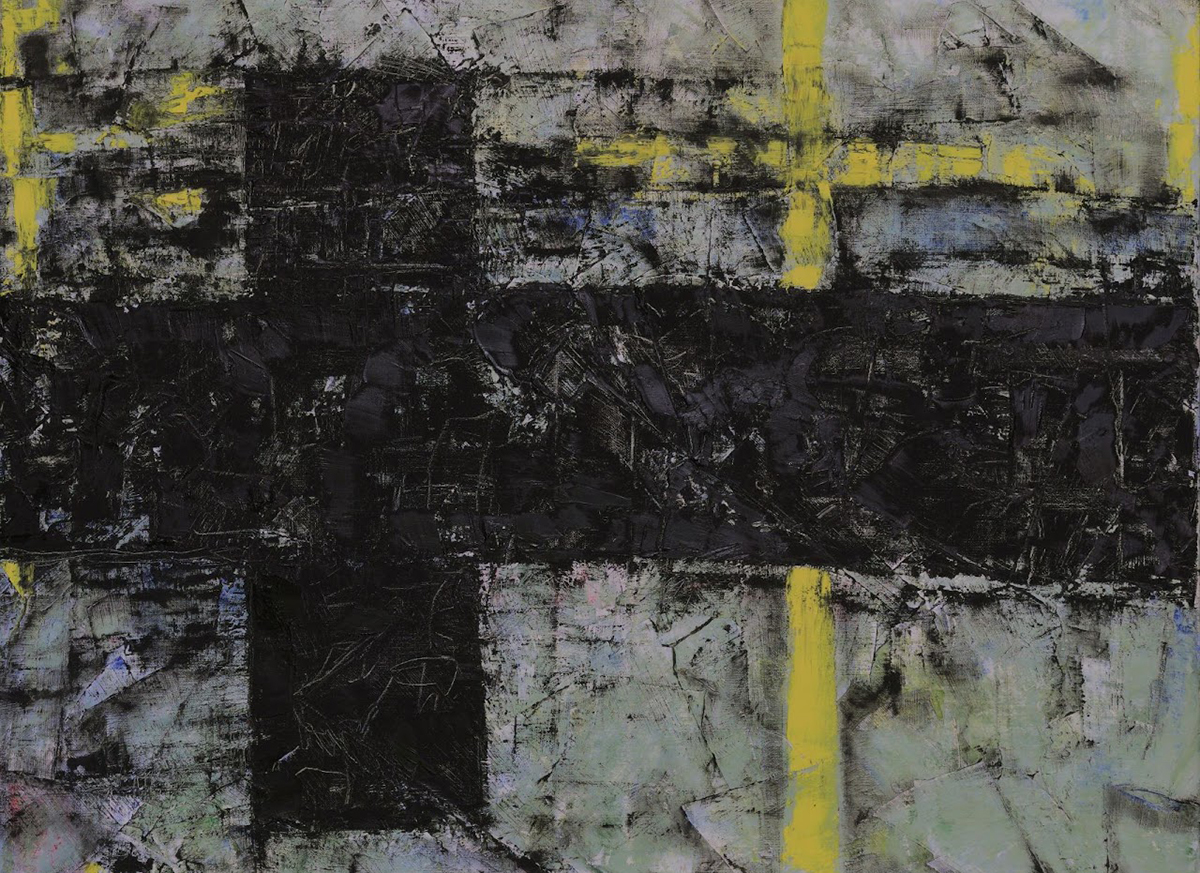
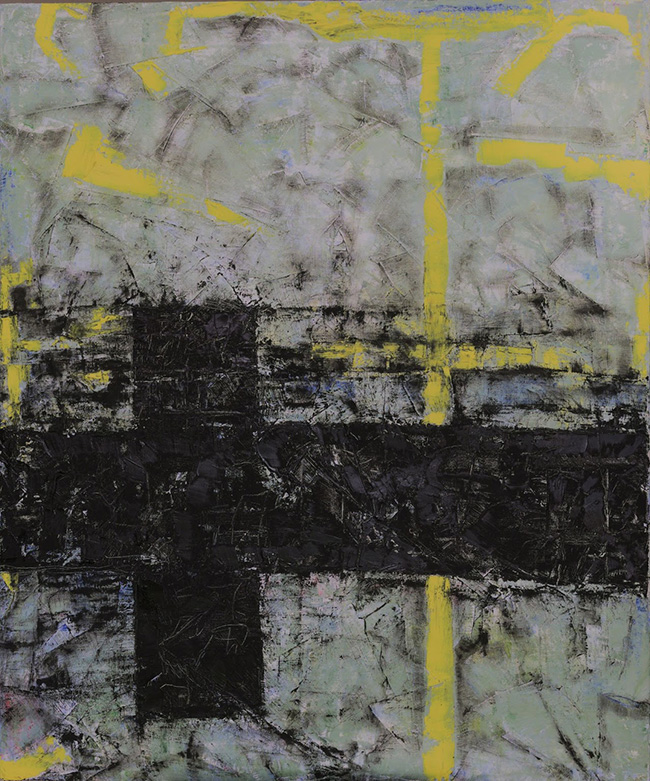
Created in 2026, Present-Day is a large oil painting measuring 120 by 100 centimeters. Made with a combination of palette knife and brush techniques, the work carries a strong physical presence. Its surface is built from muted gray, black, white, and pale blue passages, interrupted by vivid bands of yellow. These contrasting elements create an image that feels fractured yet deliberately held together.
The painting draws inspiration from approaches associated with postwar abstraction, including the forceful linear compositions of Franz Kline and Gerhard Richter’s experimental use of the squeegee. Heuer does not imitate either artist. Instead, she develops a personal visual language from the broader possibilities they opened: gesture as structure, erasure as creation, and paint as a record of movement.
At first glance, the composition appears divided by broad black forms. A dark horizontal band crosses the center, while a heavier vertical section descends into the lower half of the canvas. These forms suggest a barrier, framework, or architectural system. Their visual weight establishes an undeniable sense of order, but the order is neither clean nor stable. Scratches, irregular edges, and partially covered marks disturb the geometry, preventing it from becoming absolute.
This tension reflects one of the painting’s central ideas: the contrast between rigid social structures and brief moments of hope, enlightenment, or clarity. The dark sections can be read as systems that organize daily life, including expectations, institutions, routines, and pressures. Yet Heuer does not assign them one specific meaning. Because the painting remains abstract, its forms operate like a mirror. Each viewer may recognize a different emotional or social reality within them.
The yellow passages play an essential role in this open interpretation. They move around and through the gray field, sometimes appearing as broad pathways and elsewhere as incomplete fragments. Their brightness introduces energy into an otherwise restrained palette. Yellow might suggest warning, illumination, optimism, or urgency. Its meaning changes according to its surroundings. Against black, it becomes sharp and confrontational; against gray, it appears like light breaking through a clouded atmosphere.
Rather than presenting hope as something gentle or effortless, Heuer depicts it as an active force. The yellow must navigate an environment marked by obstruction and uncertainty. It is interrupted, covered, and redirected, yet it continues across the surface. This persistence gives the painting a subtle emotional momentum. Clarity may be temporary, but it is never entirely absent.
The material construction of Present-Day deepens this sense of time and experience. Heuer applies oil paint in built-up layers, then scrapes, scores, and works back into them. Some marks remain exposed, while others survive only as traces beneath later applications. The canvas becomes a living surface shaped by accumulation and revision. It does not simply depict the passage of time; it physically contains it.
The palette knife is particularly important to this process. Unlike a brush, which can produce fluid and continuous gestures, the knife pushes, removes, compresses, and fractures the paint. Its action leaves behind ridges and abrupt transitions. These details allow the viewer to sense the artist’s decisions: where she applied pressure, where she changed direction, and where she allowed an earlier layer to remain visible.
Spontaneity is therefore balanced by careful construction. Although the painting contains raw, immediate gestures, its visual hierarchy feels intentional. The large black bands anchor the composition, while the yellow forms direct the eye through areas of gray turbulence. The quieter passages do not function as empty background. They contain their own complex network of lines, veils, and abrasions, suggesting the constant activity beneath apparently ordinary experience.
The title Present-Day places the work firmly within contemporary life. It does not refer to a single event, location, or political situation. Instead, it evokes the broader condition of living in a time defined by uncertainty, competing structures, and continual streams of information. The textured gray areas resemble the background noise of existence: unfinished thoughts, changing circumstances, and realities that resist easy interpretation.
Within this atmosphere, the painting does not provide a solution. Its strength lies in its refusal to simplify. Chaos and control, darkness and illumination, restriction and possibility remain visible at the same time. The composition holds these opposing forces together without resolving their conflict.
Through Present-Day, Cordula Heuer creates an image that is both immediate and contemplative. Its gestures communicate urgency, while its layered surface rewards slower observation. The painting asks viewers to consider how they move through the structures surrounding them and where they locate moments of openness within those structures. In doing so, it becomes more than an abstract composition. It becomes a reflection on the emotional texture of the present itself.
