



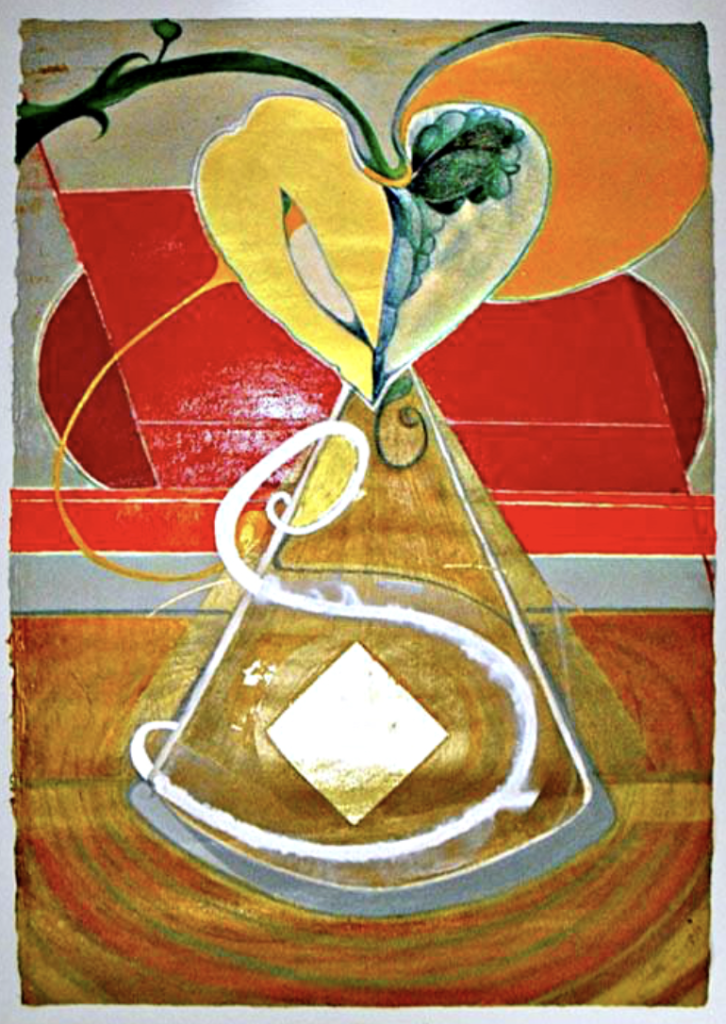
Alexandra Jicol is an artist whose practice explores the emotional, spiritual, and symbolic dimensions of human experience. Rather than simply recording the visible world, she looks beyond appearances to uncover the histories, memories, and energies held within people and places. Her distinctive visual language has developed through years of experimentation and a sustained commitment to expressing complex emotions through color, form, material, and gesture. Jicol often draws inspiration from culturally significant locations, allowing their traditions and atmosphere to guide her creative process. Her work crosses conventional boundaries, combining personal interpretation with historical research and symbolic imagery. Each composition becomes a layered encounter between the physical and the unseen. In Sacred Symbols, Purity and Wisdom / Kyoto 2, she transforms her experience at an ancient Japanese shrine into a vivid meditation on purification, nature, memory, and the enduring relationship between art and time.
Encountering the Spirit of Kamigamo Shrine
Jicol created Sacred Symbols, Purity and Wisdom / Kyoto 2 following an extraordinary artistic experience in Kyoto, Japan. In 2013, she was invited to participate in a project at Kamigamo Shrine, one of the country’s oldest and most historically important Shinto sanctuaries.
The invitation gave her access to parts of the shrine that are generally closed to visitors. During this encounter, she learned about its architecture, mythology, ceremonies, history, and spiritual traditions. Instead of being asked to document the site literally, she was given complete artistic freedom to interpret what she experienced.
This freedom speaks directly to Jicol’s creative philosophy. She is interested in discovering the character of a place rather than reproducing its outward appearance. For her, a meaningful location contains many realities at once: its visible structures, the events that occurred there, the rituals still performed, and the emotions carried by generations of visitors.
Kamigamo Shrine offered an especially rich collection of symbols. Jicol became fascinated by the Tatesuna, two carefully formed cones of purified white sand. Connected to the sacred mountain in the shrine’s mythology, they evoke purification, divine presence, and communication between the material and spiritual worlds.
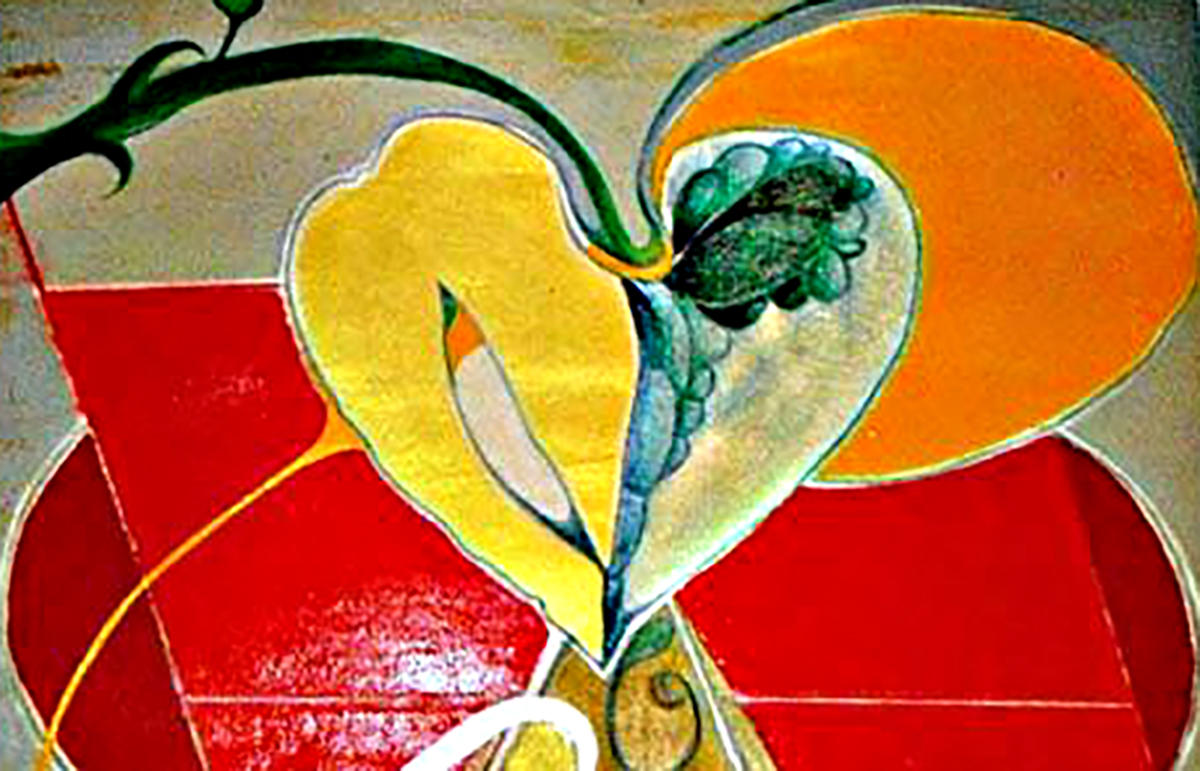
At the center of the composition is the Futaba Aoi, the two-leaf wild hollyhock and sacred crest of Kamigamo Shrine. Rendered in yellow, green, and grey, this important symbol connects the artwork directly to the shrine’s spiritual identity and centuries-old traditions. Surrounding areas of white, gold, brown, and grey create a layered sense of movement and atmosphere, while the intense orange form above contributes warmth and energy to the composition.
The shrine is dedicated to Kamo Wake-ikazuchi no Ōkami, a deity associated with thunder and the forces of nature. Jicol responds to this connection through vibrant contrasts and energetic movement. Strong fields of red and orange generate warmth and intensity, while green, gold, and white introduce associations with growth, wisdom, light, and purity. Curving lines soften the geometry, creating a visual conversation between natural movement and architectural order.
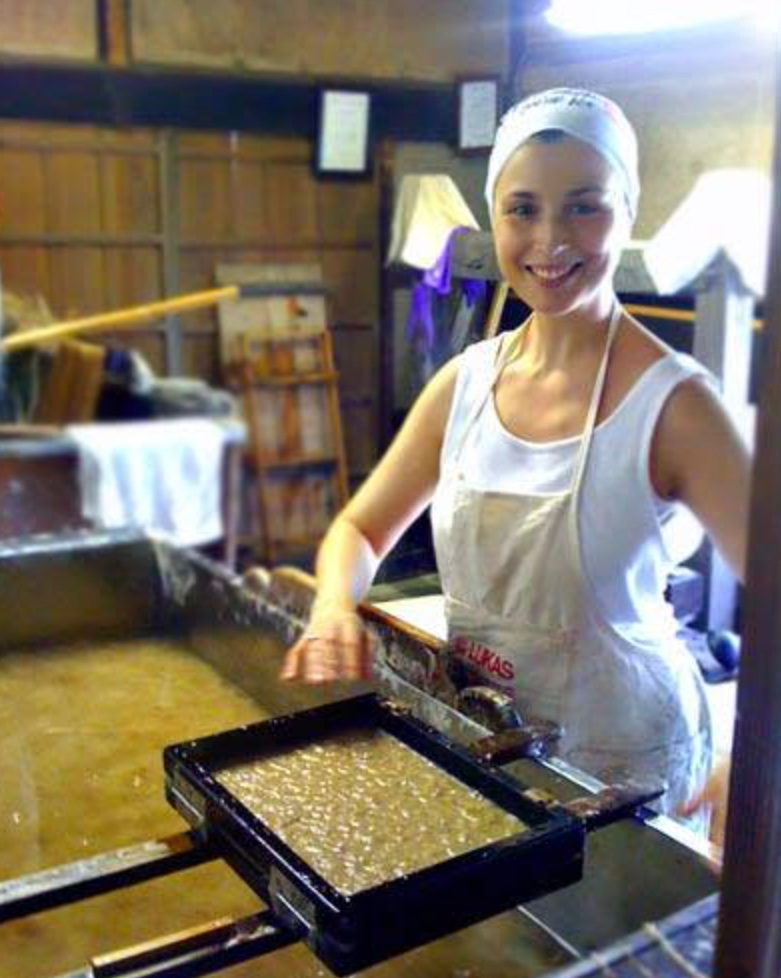
The physical construction of the work is equally important. Jicol used handmade Japanese washi created by a family of papermakers living in the mountains. She stayed with the family and learned about the traditional production process, observing the patience, skill, natural materials, and inherited knowledge required to make each sheet.
As a result, the washi is not merely a background. It carries its own cultural history and becomes an active part of the artwork. Its irregular edges and tactile surface preserve the presence of the human hand, reinforcing the connection between contemporary expression and centuries-old craftsmanship.
Working with water-soluble crayons, oil sticks, gold leaf, and heavy-body acrylic, Jicol developed the image through as many as 25 compositional layers. Every layer introduces another trace of gesture, color, time, and memory. This method reflects the experience of Kamigamo Shrine itself, where mythology, architecture, ritual, nature, and human history coexist.
The finished work was displayed in a purified area of the shrine that opens only on special occasions. For Jicol, seeing her creation inside such a spiritually and historically significant setting prompted a profound reflection on art’s relationship with time. A contemporary work made during one individual lifetime briefly entered a place shaped by many centuries.
Sacred Symbols, Purity and Wisdom / Kyoto 2 is therefore more than a representation of a sacred site. It is a personal translation of an encounter. Through layered materials and symbolic forms, Jicol brings together what she observed, learned, and felt, transforming those experiences into an independent visual world.
The work expresses her belief that reality offers an endless source of creative interpretation. Art can preserve the memory of a moment while extending it beyond its original place and time. In Jicol’s hands, the soul of Kamigamo Shrine becomes a contemporary meditation on purity, wisdom, history, and the lasting power of artistic expression.
