


Born in Siena, Italy, Luciano Caggianello is an artist and designer whose creative career has developed across a wide range of disciplines, including advertising, illustration, graphic design, industrial design, and automotive design. This multidisciplinary background has given him a distinctive visual language that combines refined technical precision with conceptual depth. While working professionally in design, Caggianello simultaneously pursued an independent artistic practice, gradually developing a body of work that investigates themes of identity, perception, memory, and the human condition. His continuous artistic research has led to numerous exhibitions throughout Italy and internationally, establishing him as an artist whose work bridges contemporary aesthetics and philosophical reflection. Now based in Turin, where he lives and works, Caggianello continues to challenge conventional visual narratives through sculptures, paintings, and mixed-media works that invite viewers to engage with ideas extending far beyond the physical object. His art is not simply intended to be observed but contemplated, encouraging a dialogue between material beauty and deeper existential questions.
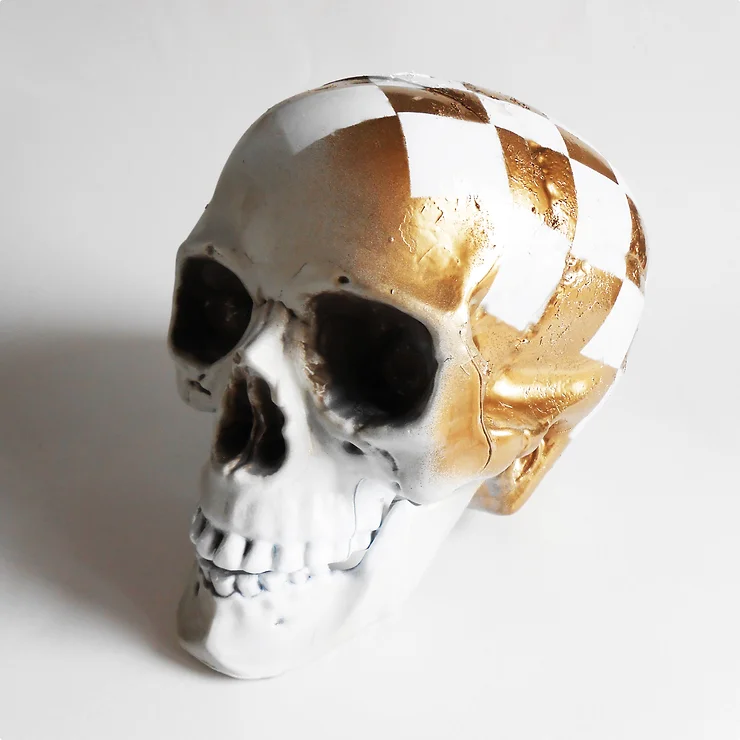
WHEN LIFE RUNS FAST (QUANDO LA VITA CORRE VELOCE)
At first glance, When Life Runs Fast presents an image immediately recognizable to viewers: a human skull. Throughout art history, the skull has served as one of the most enduring symbols of mortality, reminding us of the inevitable passage of time and the fragility of life. Luciano Caggianello embraces this familiar iconography but transforms it into something distinctly contemporary. Rather than presenting death as darkness or decay, he introduces brilliant white surfaces intersected by shimmering gold geometric forms. The result is both elegant and unsettling—a sculpture that balances beauty with reflection.
The title itself offers an important key to understanding the work. When Life Runs Fast speaks not only about mortality but about the accelerating pace of modern existence. Contemporary society is defined by constant movement, endless communication, and relentless productivity. Days become weeks, weeks become years, and many people find themselves moving so quickly that they rarely pause to consider the deeper meaning of their lives. Caggianello’s sculpture quietly interrupts that momentum. It asks viewers to stop, look carefully, and confront the reality that time continues moving whether we acknowledge it or not.
The skull, stripped of personal identity, becomes universal. It belongs to no specific individual and therefore represents everyone. By removing characteristics such as age, gender, or ethnicity, Caggianello creates a symbol through which viewers can recognize themselves. The work shifts from being an object depicting death to a meditation on shared human experience.
Equally significant is the artist’s use of gold. Throughout history, gold has symbolized permanence, value, divinity, and spiritual enlightenment. Here, however, it functions in a more complex manner. Rather than completely covering the skull, the gold appears fragmented, almost as if pieces of precious material have been layered over an otherwise ordinary surface. This visual tension suggests that beneath the speed and distractions of everyday life lies something more enduring—our search for meaning, purpose, and permanence.
The alternating white and gold forms also introduce an intriguing visual rhythm. The sharp geometric divisions resemble fractured pathways or intersecting directions, hinting at the countless choices individuals make throughout life. Every decision, every experience, and every passing moment contributes to the person we become. Yet despite these variations, the underlying form remains unchanged. The skull reminds us that beneath the complexity of modern existence, human mortality remains the one constant shared by everyone.
Caggianello’s background in industrial and automotive design is evident in the sculpture’s clean surfaces and carefully balanced composition. Every curve appears deliberate, while the geometric patterning introduces an architectural precision that contrasts with the organic anatomy of the skull. This dialogue between natural form and constructed design reflects one of the defining characteristics of contemporary life itself—the constant interaction between humanity and the manufactured world.
The restrained color palette further strengthens the conceptual impact. White often suggests purity, clarity, or silence, while gold introduces richness and transcendence. Black shadows within the eye sockets create visual depth, drawing viewers into spaces that remain unknowable. Together, these elements establish a balance between light and darkness, certainty and mystery, presence and absence.
Importantly, When Life Runs Fast does not present a pessimistic vision. Although rooted in the symbolism of mortality, the sculpture ultimately encourages awareness rather than fear. It reminds viewers that recognizing the finite nature of life can inspire greater appreciation of the present. The work suggests that slowing down, reflecting, and becoming conscious of time may be among the most meaningful responses to an increasingly accelerated world.
Rather than offering definitive answers, Luciano Caggianello invites contemplation. His sculpture operates simultaneously as an aesthetic object, a philosophical statement, and a psychological mirror. Each viewer brings personal experiences, anxieties, ambitions, and memories to the encounter, allowing the work to generate different interpretations while maintaining its universal resonance.
In When Life Runs Fast, Luciano Caggianello demonstrates how a timeless symbol can be reimagined for contemporary audiences. Through the elegant integration of minimalist design, precious materials, and conceptual clarity, the sculpture becomes more than a representation of mortality. It evolves into a thoughtful reflection on time, human existence, and the importance of pausing amid the relentless pace of modern life. It is precisely this balance between visual sophistication and intellectual depth that gives the work its lasting emotional and philosophical power.
