



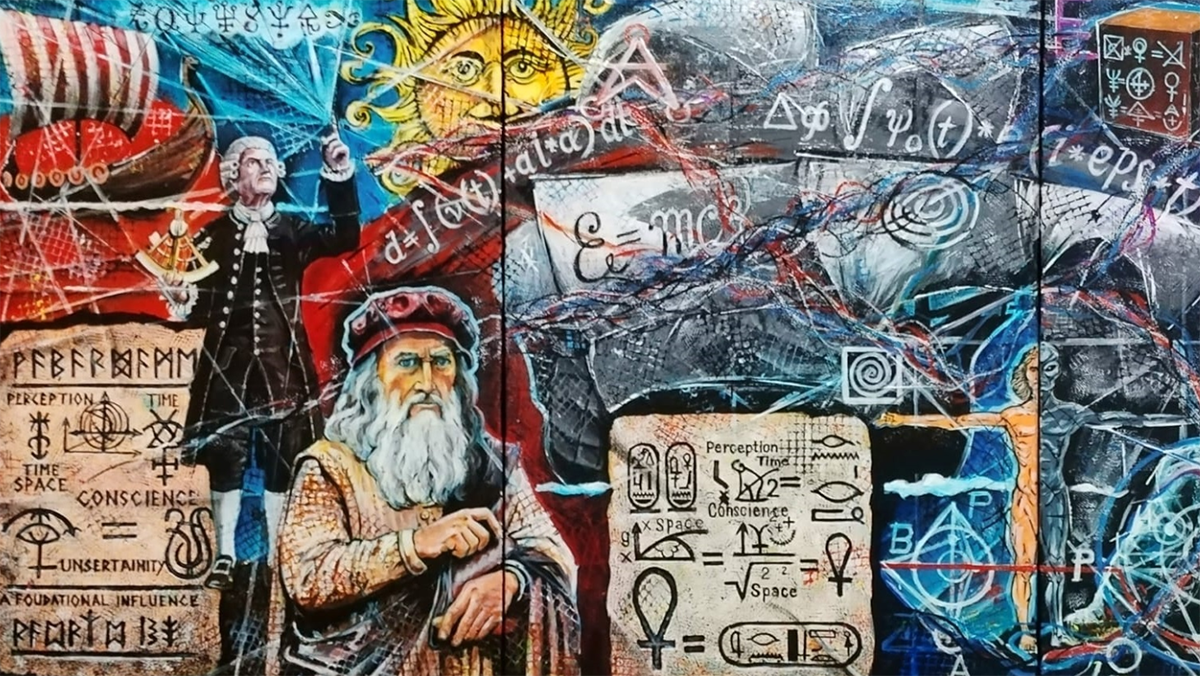
Albert Deak creates art that reaches beyond visible reality to explore the forces, emotions, and mysteries beneath it. Trained in ceramics at a respected Eastern European university of art and design in 1989, Deak developed an early sensitivity to material, structure, and physical form. His practice later expanded into graphic art, painting, and digital media, allowing him to approach visual expression from multiple perspectives.
Inspired by Jackson Pollock’s expressive freedom, Gerhard Richter’s ambiguity, and Wassily Kandinsky’s spiritual understanding of color and form, Deak has developed an abstract language distinctly his own. Science, philosophy, and imagination intersect throughout his work, yet he does not follow a fixed formula. Each composition evolves as an individual investigation—a process of translating experiences that resist ordinary description. His art embraces uncertainty, inviting viewers to encounter emotional, cosmic, and metaphysical dimensions that cannot be fully expressed through words.
Space-Time: A Journey Through Energy, Matter, and Infinity
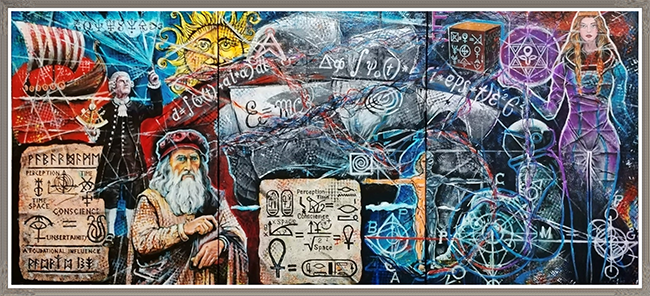
In Space-Time, Albert Deak transforms the immense and elusive structure of the universe into a vivid abstract environment. Created in acrylic on canvas, the work measures 180 × 84 centimeters and consists of three individual panels, each measuring 84 × 60 centimeters. Its triptych format gives the composition a broad, cinematic presence while dividing the visual field into interconnected stages. Each panel appears complete in itself, yet all three contribute to a larger meditation on energy, movement, time, and existence.
The title immediately places the work within both scientific and philosophical territory. Space-time is not presented as a measurable diagram or a literal interpretation of physics. Instead, Deak approaches it as an experiential concept—something dynamic, mysterious, and inseparable from human perception. The painting suggests a universe that is continuously shifting, expanding, and reorganizing itself. Forms appear to emerge, collide, dissolve, and return in altered states, creating the impression that matter and energy are caught in an endless process of transformation.
The three-panel structure plays an essential role in this effect. A triptych naturally introduces sequence, but Space-Timedoes not offer a conventional beginning, middle, and end. The viewer may enter through any panel and move in either direction. This openness challenges linear ideas of time. Past, present, and future seem capable of existing simultaneously, connected by rhythms that extend across the boundaries separating the canvases.
These divisions also create productive tension. Each gap briefly interrupts the visual movement, reminding the viewer that perception is always partial. We encounter fragments of reality and attempt to understand the greater structure linking them. In this sense, the spaces between the panels become as meaningful as the painted surfaces. They suggest pauses, thresholds, or invisible dimensions that cannot be directly observed.
Color functions as more than decoration within the work. Deak uses chromatic tension to establish atmosphere, depth, and emotional intensity. Contrasting passages may evoke heat and cold, expansion and compression, or illumination emerging from darkness. The relationships among colors create an internal energy that feels simultaneously physical and psychological. Rather than describing a recognizable place, the palette allows the viewer to sense a realm governed by forces beyond ordinary scale.
The abstract forms can be read in many ways. They may recall distant galaxies, molecular structures, fields of radiation, or maps of phenomena that science has not yet fully explained. At other moments, they appear almost biological, as though the boundaries between the cosmic and the cellular have disappeared. This ambiguity is central to the painting’s strength. Deak does not dictate a single interpretation; he creates conditions in which multiple associations can coexist.
The influence of Pollock, Richter, and Kandinsky can be felt in Deak’s freedom of movement, layered uncertainty, and belief in abstraction as a vehicle for spiritual or emotional experience. Nevertheless, Space-Time is not an imitation of those artists. Deak draws upon their expanded possibilities while pursuing his own interest in the relationship between knowledge and imagination. Scientific concepts provide a point of departure, but the work ultimately enters territory that calculation alone cannot reach.
There is also a deeply human dimension within this cosmic imagery. To contemplate space-time is to confront the scale and brevity of individual existence. The painting can inspire wonder, but it may also produce unease. Its restless movement suggests that nothing remains completely stable, while its expansive composition hints at realities extending far beyond human understanding. The viewer is positioned between intimacy and infinity—physically close to the painted surface yet imaginatively transported into an immeasurable field.
Space-Time succeeds because it does not attempt to resolve these contradictions. Instead, Deak allows uncertainty to remain active. The work becomes a visual portal through which science, philosophy, emotion, and imagination meet without collapsing into a single explanation. Through its triptych structure, energetic forms, and charged relationships of color, the painting asks viewers to experience the universe not as a distant subject, but as a living mystery in which they are already participating.
