



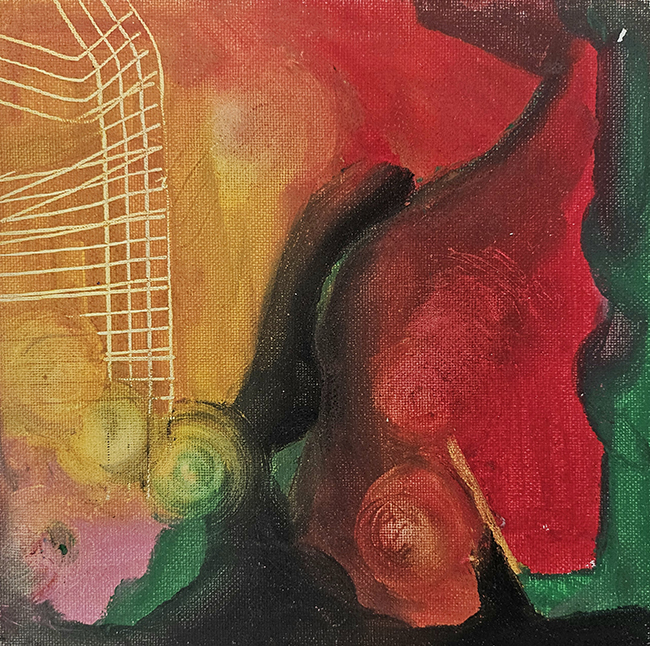
Mike Garibay creates expressive artwork shaped by bold color, instinctive gestures, and a strong sense of movement. Working with oil paint and oil pastels, he produces both large-scale canvases and smaller pieces on canvas and panels. Although his abstract forms may initially seem spontaneous, their careful arrangement creates balance, rhythm, and energy throughout each composition.
His artistic practice moves between abstraction and representation. In contrast to the freedom of his abstract work, Garibay’s detailed portraits reveal his ability to work with precision, observation, and control. He also brings his visual language to mural-scale projects, using color and form to reshape architectural environments.
For Garibay, creating art is an emotional and intuitive experience. He does not begin with a fixed narrative. Instead, he responds to the materials as the work develops, allowing gestures, colors, and changing forms to guide each piece toward its own character and identity.
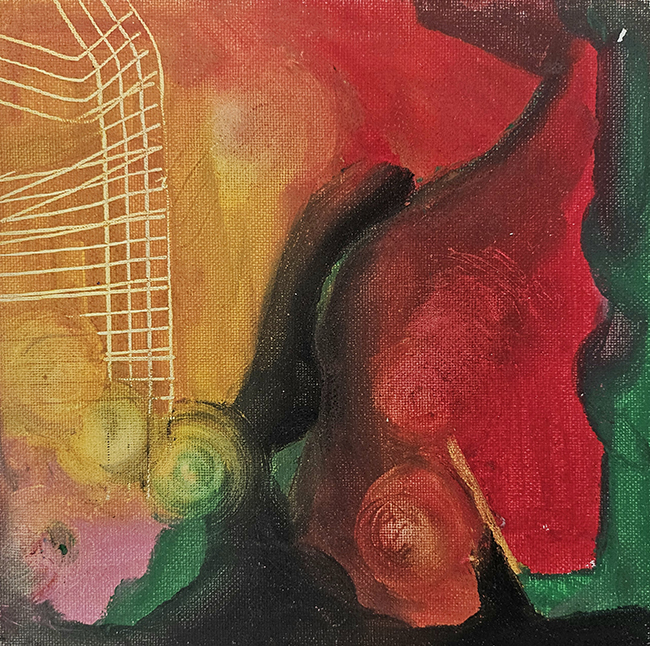
Mike Garibay’s floral painting brings together expressive color, organic shapes, and contrasting lines in a work that feels both spontaneous and carefully organized. Created with oil pastel on canvas, the piece depicts flower-like forms without presenting them as a traditional botanical arrangement. Instead, Garibay transforms familiar elements from nature into an abstract visual environment filled with warmth, movement, and emotional intensity.
The composition is dominated by deep reds, glowing oranges, golden yellows, and rich greens. These colors overlap and flow into one another, creating an atmosphere that feels alive and continually changing. A broad area of red occupies much of the upper and right portions of the artwork, immediately drawing the eye. Darker passages of black and brown move through the center, forming strong divisions while also connecting the surrounding colors. Green sections emerge near the edges and lower portion of the image, bringing a cooler contrast to the heated reds and oranges.
Several rounded forms resemble flowers viewed from different perspectives. Some appear as soft circles, while others contain spiraling marks that suggest petals curling inward. These shapes are recognizable enough to recall blossoms, yet they remain open to interpretation. They could also be understood as fruit, seeds, cells, or small worlds growing within a larger landscape. This ambiguity gives the artwork its imaginative quality and encourages viewers to form their own associations.
The lower section contains a cluster of circular shapes in yellow, green, pink, orange, and red. Their placement creates a loose garden-like arrangement, although the forms do not follow the order of a conventional still life. They appear to emerge from the surrounding color fields, as if they are growing, floating, or shifting across the surface. Their different sizes and tones establish a visual rhythm that leads the eye from one area to another.
One of the most distinctive features is the network of thin golden lines extending across the upper-left section. The lines intersect to create a loose grid or web that contrasts with the softer organic forms elsewhere in the composition. This geometric structure introduces a feeling of tension and provides another layer of movement. It may suggest a trellis supporting climbing plants, a woven textile, or an architectural framework placed against a natural setting. Its precise linear quality balances the freedom of the surrounding shapes.
Texture also plays an important role in the artwork. The visible canvas surface and layered oil pastel marks give the colors a tactile presence. Certain areas appear softly blended, while others retain direct, energetic gestures. This variation allows the viewer to sense the physical process behind the composition. Garibay’s hand remains visible through the changing pressure, density, and direction of each mark.
Rather than describing a particular bouquet or species of flower, Garibay uses floral imagery as a starting point for exploring color, sensation, and memory. The work captures the emotional experience of encountering flowers—their brightness, fragility, abundance, and connection to growth—without relying on realistic detail. Its forms seem to exist between observation and imagination.
The composition rewards extended viewing because new relationships continue to emerge among its colors and shapes. What first appears impulsive gradually reveals balance and structure. The dark central forms anchor the image, the circular elements establish rhythm, and the golden grid provides contrast and direction. Together, these elements create an artwork that feels energetic, intimate, and richly layered.
A limited edition of 100 prints, signed by Mike Garibay, is available on museum-quality paper in a 24 × 24-inch format. This square presentation preserves the composition’s concentrated energy while allowing its textures, color transitions, and expressive details to remain central to the viewing experience.
