



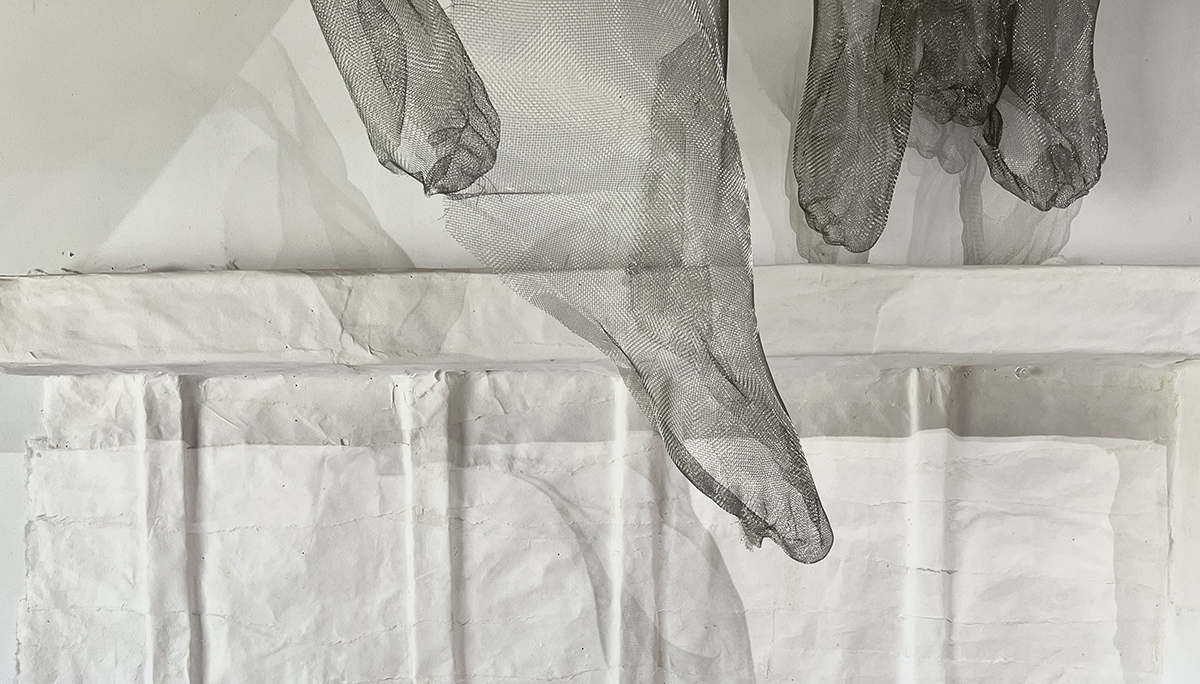
Caroline Kampfraath doesn’t shy away from complexity. A Dutch artist working in three dimensions, she uses materials like metal cans, old bottles, handmade paper, and casts of human forms to build a visual language that speaks through texture and object. Her art feels both immediate and distant—rooted in memory, emotion, and the physical world, but also stretching toward something symbolic. Her works are layered, literally and conceptually, touching on personal history, environmental awareness, cultural contact, and human vulnerability. Nothing is random. Each object she chooses has a reason to be there, even if that reason isn’t explained directly. The viewer has to feel it. What Kampfraath builds isn’t just sculpture—it’s a kind of embodied storytelling, where form meets feeling, and where experience becomes something you can almost touch.
Come Forward in Dense Waves
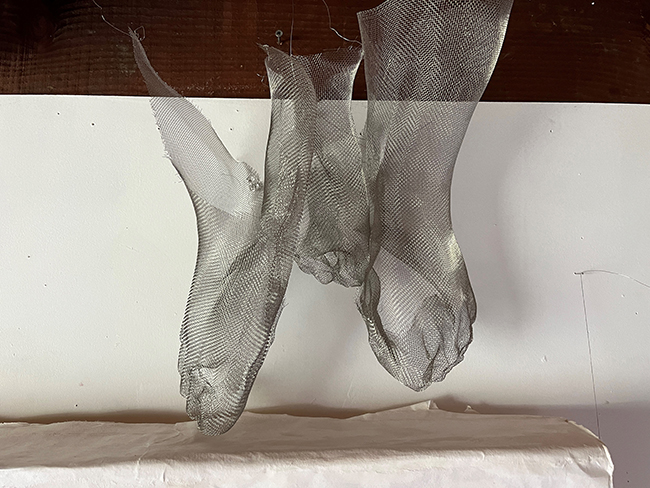
Kampfraath’s project Come Forward in Dense Waves begins with a personal history that’s complicated—shaped by war, family memory, and a distant country that she hadn’t yet visited.
She had grown up with stories about Japan that came filtered through her family’s wartime experience. Her grandfather had been in Nagasaki during World War II—he painted what he saw there, both its quiet beauty and the horror that followed the bomb. Her family had been detained in camps in Indonesia under Japanese occupation. For her, Japan wasn’t neutral. It wasn’t just another country on a map. It was emotionally loaded, even before she stepped foot on its soil.
But she did go. And instead of staying inside inherited narratives, she opened herself to the now—to the real, present-day Japan, and to her own impressions of it. She wasn’t there to judge. She was there to understand something, maybe not in words but through form, texture, and repetition.
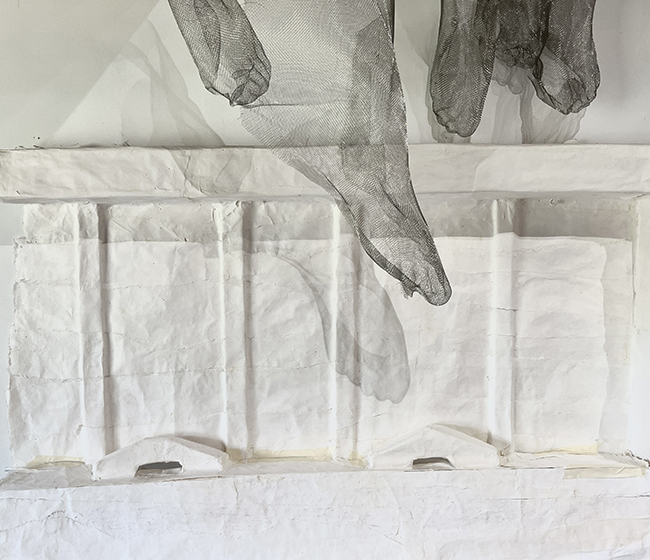
During her time in Japan, something specific caught her attention: rooftiles. The shapes, the way they were made, the surface detail—they stayed with her. She started creating her own version, handmade paper rooftiles, four a day. She used flower paste as glue. This wasn’t about production. It was rhythm, a process of grounding. As she worked, things inside her settled. Thoughts shifted. Emotions began to take shape.
In repetition, she found clarity. In making, she found space for reflection.
The past didn’t disappear. It became part of something wider. Through the act of making, she began to understand more about the way cultural dominance and trauma had touched her family. But she also started to see something more universal.
We all need the same things: a roof, food, the ability to express ourselves, to connect with culture. Those basic needs are shared across borders, across time. And for them to be respected, there has to be mutual recognition. Without that, history repeats itself in different clothes.
Come Forward in Dense Waves isn’t just about Kampfraath’s family or about Japan. It’s about how a personal story can slowly shift into something broader. It’s about how travel, when done with openness, can break cycles of resentment. And it’s about how making art can carry you from darkness to something quieter, lighter.
The sculpture that emerged from this journey isn’t a didactic piece. It doesn’t tell you what to think. But it holds the process. You can feel the repetition, the care, the transformation. You can feel the search for something steady in the middle of conflicting feelings.
The title, Come Forward in Dense Waves, is a quote from The Pillow Book, a Japanese text written in the year 1002. It’s an old phrase, but it holds the right weight. Emotions come forward like waves—dense, layered, often hard to sort through. But still, they come forward.
Kampfraath’s piece is both personal and shared. It’s about memory, but also about what happens when we let go of a script and start seeing with our own eyes. It’s about art as a method of repair—not fixing the past, but understanding it differently.
She doesn’t offer resolution. She offers presence. Through material, rhythm, and reflection, she invites others to consider their own layered histories—and how those might shift, slowly, in contact with something unfamiliar.
