



Steven Siegel is an American artist born in 1953 whose multidisciplinary practice encompasses public art, sculpture, installation, collage, and film. He is particularly recognized for creating large-scale, site-responsive works from repurposed preconsumer and postconsumer materials. Instead of treating discarded objects as useless remnants, Siegel organizes them into complex structures that reveal their physical character and accumulated histories. His approach draws upon ideas associated with geology and evolutionary biology, especially layering, compression, adaptation, and gradual transformation. Many of his sculptures appear to have formed through natural processes, even though they are assembled from materials produced and discarded by human society. By bringing environmental systems and patterns of consumption into the same visual field, Siegel encourages viewers to reconsider what waste represents. His work demonstrates that discarded matter can carry evidence of human behavior while continuing to evolve through artistic reuse.
Biography: A Material Record of Human Experience
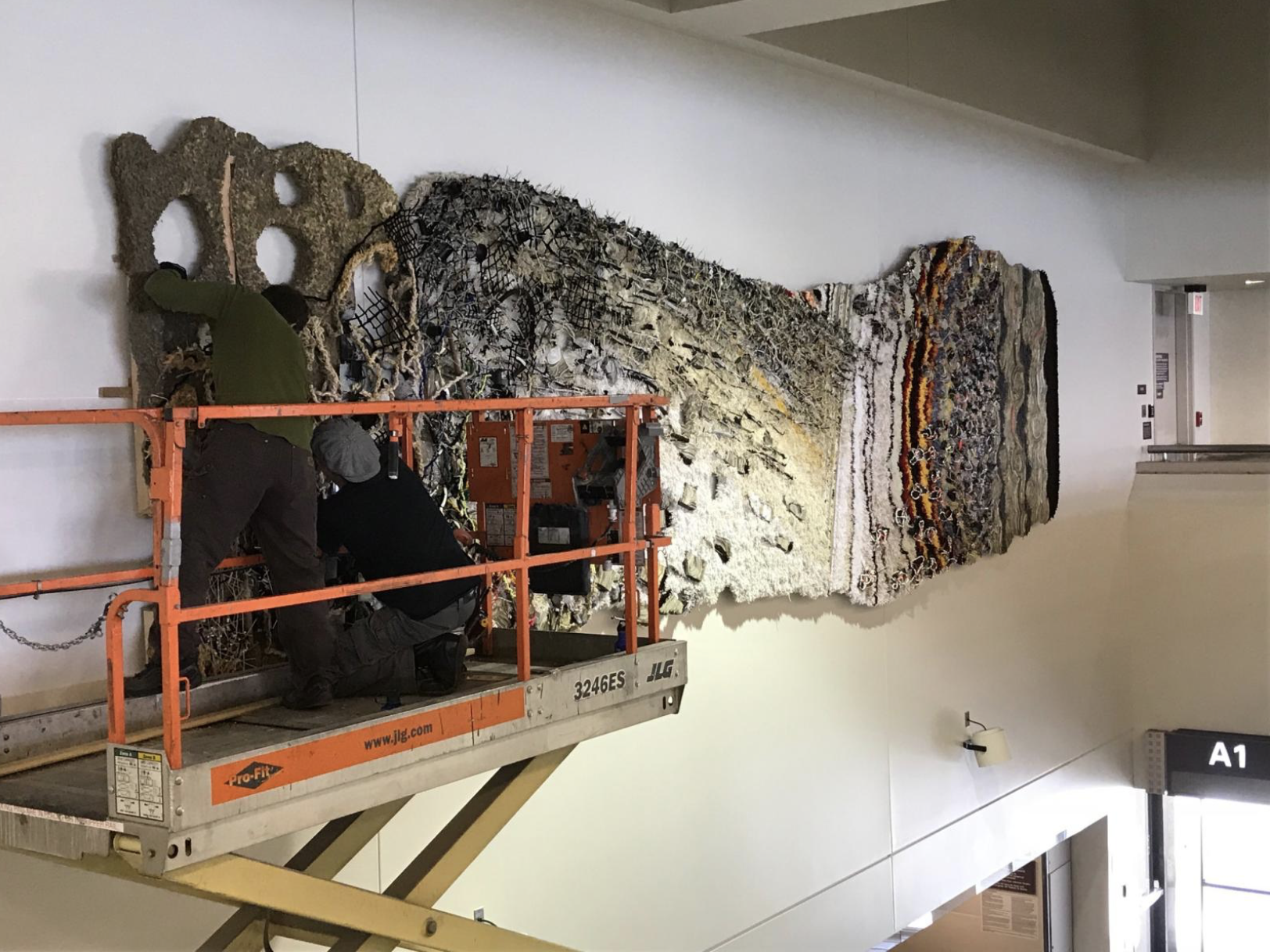
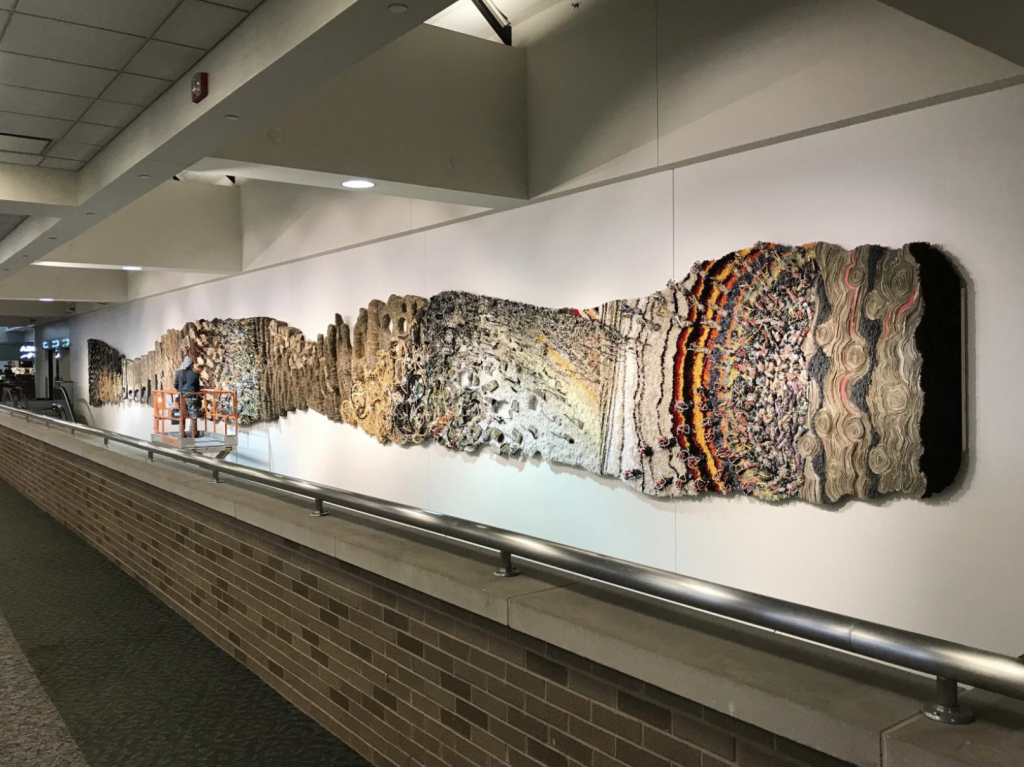
Installed at Albany International Airport in 2018, Biography is an expansive wall-based artwork that unfolds across the architecture like a monumental timeline. Its long, irregular form is made up of numerous sections, each distinguished by its own colors, textures, patterns, and density. Although the work is presented against a clean white wall, its rough surfaces and uneven edges resist the orderliness of the airport environment. It appears simultaneously constructed and organic, as though a fragment of the earth has been uncovered inside the terminal.
The title Biography offers an important way to understand the installation. A biography ordinarily recounts a life through experiences, changes, and defining moments. Siegel’s work suggests that materials can perform a similar function. Every layer carries evidence of a previous existence, even when its exact origin is no longer immediately recognizable. Fragments that might once have been overlooked or discarded are gathered into a larger structure, allowing them to become part of a collective history.
Seen from a distance, the installation resembles a cross-section of rock or sediment. Its bands appear to record different periods, recalling the way geological formations preserve traces of environmental change over thousands of years. Yet these layers are shaped by human consumption rather than natural forces alone. The work creates a connection between geological time and the much faster cycle through which people acquire, use, and discard material goods.
Up close, Biography becomes a dense landscape of detail. Some areas appear soft and fibrous, while others are tangled, coarse, or heavily compressed. Neutral passages of gray, beige, black, and white are interrupted by vivid bands of red, yellow, orange, and dark blue. These shifts give the installation a visual rhythm. The eye travels through quieter sections before encountering sudden bursts of color and activity, much as a personal history moves between ordinary periods and moments of intensity.
The changing surfaces also prevent the work from becoming predictable. Certain sections contain circular patterns that resemble the rings of a tree, suggesting growth, age, and accumulated experience. Other areas appear woven or knotted, evoking nets, roots, nests, or interconnected pathways. Open spaces and perforations contrast with thick, crowded passages. Together, these elements create a work that feels less like a conventional sculpture and more like a living archive.
Its location inside an airport adds another dimension to its meaning. Airports are transitional spaces filled with continuous movement. Travelers arrive, depart, wait, and briefly cross paths with strangers. Personal stories intersect for only a short time before separating again. Within this setting, Biography becomes a quiet counterpoint to speed and impermanence. Its immense accumulation of materials asks people to pause and consider what remains after movement has passed.
The horizontal structure may also be read as a journey. It does not follow a smooth or uniform path; instead, it expands, narrows, rises, and falls. These irregular changes resemble the unpredictable course of a human life. The installation’s many individual components retain their differences, yet they are held together as one continuous body. In this way, Siegel presents identity not as something simple or fixed, but as an accumulation of experiences, relationships, environments, and remembered moments.
Environmental concerns are embedded throughout the work without turning it into a direct statement or instruction. By placing recycled materials in a highly visible public setting, Siegel changes the way they are perceived. What might ordinarily be dismissed as waste becomes visually compelling and worthy of extended attention. The transformation encourages viewers to reconsider the assumed boundary between what is valuable and what has been abandoned.
Biography ultimately reflects both individual and shared histories. Its physical layers can be understood as records of personal memory, but they also point toward a broader portrait of contemporary society. The things people discard reveal habits, priorities, and systems of consumption. By preserving these remnants within an artwork, Siegel turns them into evidence of a particular place and time.
Through its scale, complexity, and tactile presence, Biography demonstrates Steven Siegel’s ability to unite environmental awareness with poetic interpretation. The installation does not conceal the worn and fragmented nature of its materials. Instead, it makes those qualities central to the work. In doing so, Siegel shows that what has been used, damaged, or forgotten may still carry meaning. Like a life story, the artwork is built layer by layer, with every fragment contributing to the identity of the whole.
