


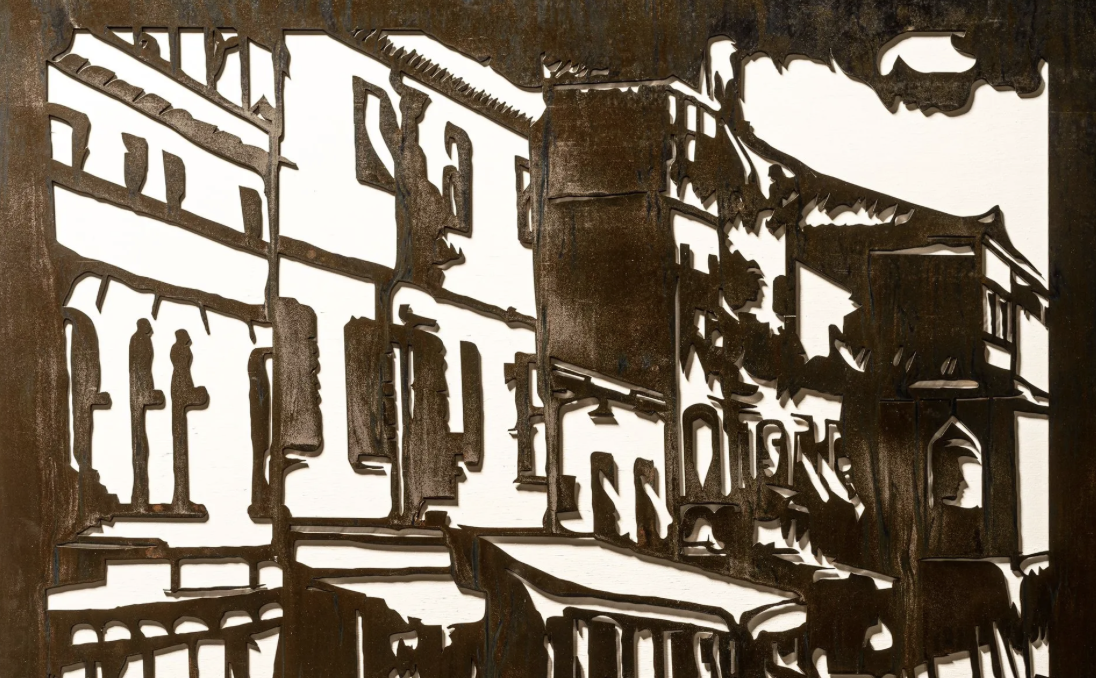
Giovanni Piovan-Lumier is an Italian contemporary artist born in 2003 whose emerging practice moves freely between sculpture, painting, and experimental approaches to materials. Metals and light hold a central place in his work, allowing him to explore the relationship between physical substance, surrounding space, and human perception. Although still at an early stage in his career, Piovan-Lumier has already developed experience across public art, site-specific installations, and commissioned projects for private clients and institutions. His work has been presented in Rome, Jesolo, and Grottaferrata, as well as in a collateral exhibition held in connection with the 2026 Venice Art Biennale. Across these different settings, he demonstrates an interest in transforming durable materials into visually expressive surfaces. His works balance control and unpredictability, revealing an artist who understands that metal, pigment, corrosion, and illumination are not simply technical elements but active participants in the creation of meaning.
Piovan-Lumier’s works reveal a practice shaped by contrast. Hard industrial materials coexist with vulnerable human figures, while controlled forms are interrupted by stains, scratches, openings, and irregular marks. His art does not attempt to hide the physical history of a surface. Instead, weathering, oxidation, and material resistance become part of its visual language.
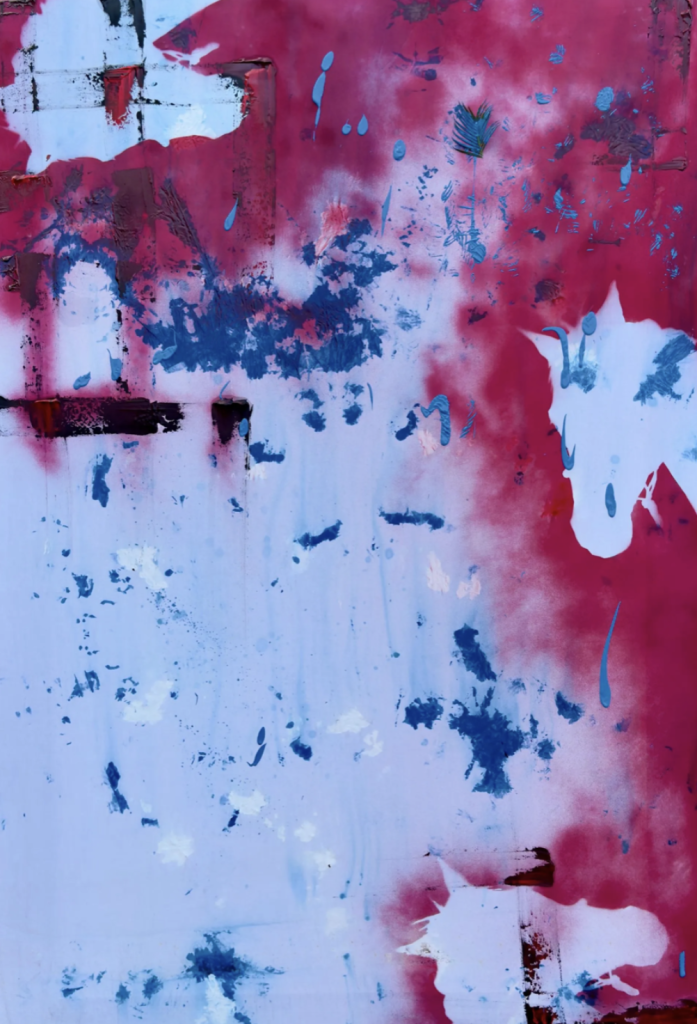
One of the presented works is dominated by expansive fields of crimson, pale blue, white, and deep blue. It initially appears spontaneous, as though color has spread across the surface through a combination of intention and accident. The composition does not provide a single point of entry. The eye travels between dense accumulations of pigment and quieter, more open areas.
The upper portion contains architectural suggestions. Blocks, edges, and vertical forms appear briefly before dissolving into the surrounding color. These fragments might recall walls, ruins, windows, or an incomplete cityscape, but they remain deliberately uncertain. Rather than describing a specific location, they create the feeling of a place being remembered, reconstructed, or slowly erased.
Small blue forms are scattered across the composition like drops of water, seeds, leaves, or suspended signs. Some possess a botanical quality, particularly the slender central form resembling a young plant. This fragile motif introduces a suggestion of growth within an otherwise turbulent environment. Its delicacy contrasts with the force of the larger red and white passages, giving the painting an emotional tension between vulnerability and persistence.
The pale-blue area extending through much of the lower half offers visual breathing room, yet its surface remains active. Dark marks, blurred imprints, and scattered traces prevent it from becoming empty. These details resemble fragments left after an event: evidence without a complete explanation. The painting can therefore be understood as a landscape of memory in which impressions survive even after recognizable forms have disappeared.
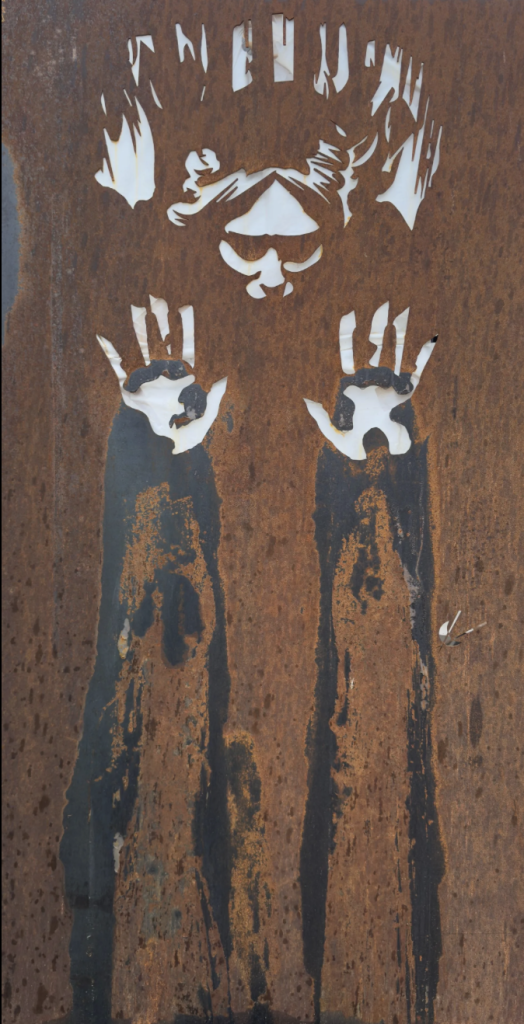
The second work presents a different relationship between image and material. A human figure is cut into or revealed through a tall sheet of oxidized metal. The warm brown surface bears the marks of corrosion, immediately establishing a sense of age and exposure. Rust is not treated as damage that must be concealed. It becomes a color, texture, and record of time.
The figure appears with raised hands and a partially obscured face. Its expression and gesture remain open to interpretation. The hands might signal surrender, protection, communication, or resistance. They establish an immediate psychological connection because they seem to press against the metal surface as if it were a barrier separating the figure from the viewer.
Open areas within the steel allow light and the surrounding environment to participate in the image. As conditions change, the figure may appear brighter, darker, clearer, or more elusive. This interaction reflects Piovan-Lumier’s broader interest in light as a material rather than simple illumination. Light completes the artwork, entering its openings and altering its presence according to place and time.
Dark vertical marks extend downward from the hands and body like shadows, stains, or elongated limbs. They create a feeling of gravity, as though the figure is being pulled toward the earth. At the same time, the open silhouette gives it an immaterial quality. The person is both present and absent, physically defined by metal yet visually created through emptiness.
Together, these works demonstrate Piovan-Lumier’s ability to approach similar concerns through different formal languages. The painted composition develops through layered color, scattered traces, and atmospheric ambiguity. The metal work depends on weight, corrosion, absence, and the changing effects of light. One feels expansive and fluid, while the other is direct and physically imposing.
What connects them is an interest in transformation. Pigment shifts into landscape, stains become memories, rust becomes history, and empty space becomes a human body. Piovan-Lumier allows materials to retain their natural character while guiding them toward new emotional and symbolic possibilities. His work suggests that meaning is not imposed upon matter from the outside. It emerges through a conversation between the artist, the material, the environment, and the viewer.
