


Lori Goldberg is a Canadian artist based in Vancouver, British Columbia, whose practice has developed over more than forty years of sustained exploration and experimentation. Internationally recognized and the recipient of multiple awards, Goldberg has built a body of work that examines the relationship between industrial development and the natural world through richly layered abstraction. Her paintings often move beyond direct representation, creating spaces where memory, landscape, and imagination converge. Held in significant collections and represented by galleries in Beijing and Barcelona, her work reflects a long-standing engagement with the changing environments that surround us. Through color, gesture, and complex spatial arrangements, Goldberg invites viewers into immersive visual experiences that consider both the fragility and resilience of nature. Her paintings do not simply depict places; they evoke states of transition, where organic forms, shifting atmospheres, and traces of human influence coexist in a delicate balance.
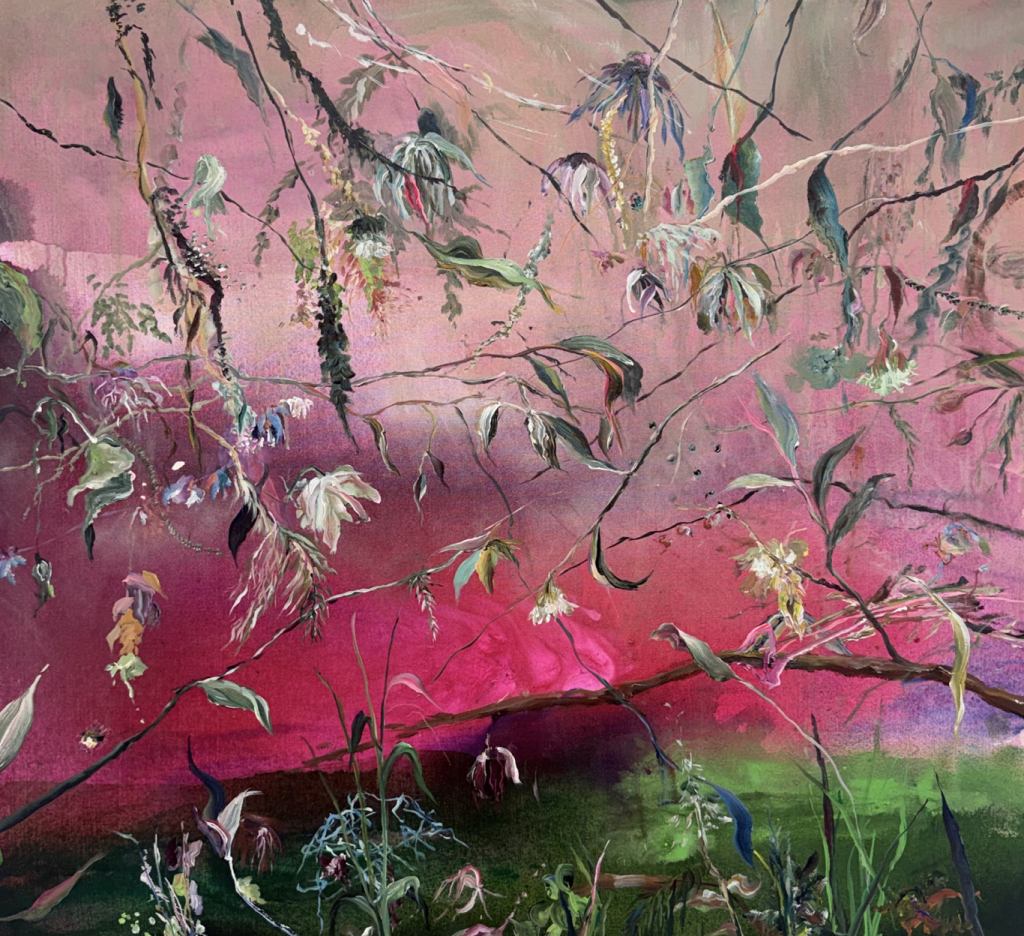
Rewinding, acrylic on canvas, 48” x 48”, 2026
The Living Landscape of Lori Goldberg
Lori Goldberg’s paintings occupy a fascinating space between observation and invention. At first glance, her works appear rooted in the natural world, filled with branches, flowers, leaves, and atmospheric environments. Yet the longer one spends with them, the more apparent it becomes that these are not traditional landscapes. Instead, they are emotional and psychological environments where nature becomes a vehicle for exploring change, memory, and transformation.
The three works presented here offer a compelling introduction to Goldberg’s visual language. While each painting possesses its own distinct atmosphere, together they reveal an artist deeply invested in the complexities of ecological systems and the subtle ways in which environments evolve over time.
In the first painting, delicate botanical forms stretch across a luminous field of pink, magenta, and green. Flowers hang and drift through space as though suspended between growth and decay. Branches weave across the composition like lines of thought, connecting disparate elements into a fragile network. The background glows with unexpected intensity, transforming the scene into something dreamlike rather than descriptive.
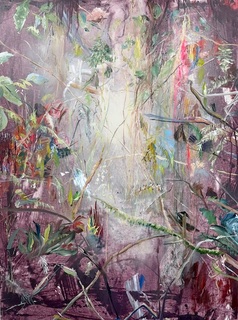
Where the Light Gets In, acrylic on canvas , 48” x 36”, 2025
What makes this work particularly engaging is the tension between beauty and impermanence. The flowers appear both vibrant and fading, suggesting a moment caught between flourishing and disappearance. Goldberg resists the temptation to idealize nature. Instead, she presents it as a constantly shifting process, full of cycles that include growth, decline, renewal, and transformation.
The painting’s structure reflects this idea. Rather than relying on a fixed horizon or conventional perspective, the composition unfolds across multiple spatial layers. Elements drift forward and recede simultaneously, creating a sense of movement that mirrors the instability of natural systems themselves. The viewer is invited to wander through the painting rather than simply observe it.
The second work introduces a dramatically different atmosphere. Here, an intense burst of white light dominates the center of the composition, radiating outward through a dense network of organic forms. Branches, leaves, and fragments of vegetation emerge from a field of muted violets, pinks, and earth tones.
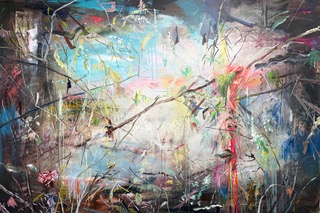
Rupture and Renewal, Acrylic on canvas, 40” x 60” , 2025
This painting feels almost spiritual in its construction. The central luminosity acts as both a visual anchor and a mystery. It could be interpreted as sunlight breaking through foliage, an opening within the landscape, or even a symbolic representation of revelation and renewal. Goldberg leaves these possibilities unresolved, allowing viewers to bring their own interpretations to the experience.
The surrounding vegetation appears in constant motion. Brushstrokes overlap and intertwine, creating an energetic surface that feels alive. There is a sense that the painting records not a specific location but an accumulation of experiences within nature. Layers of paint suggest histories beneath the surface, as though memories of previous landscapes remain embedded within the work.
This layering is a recurring strength throughout Goldberg’s practice. Her paintings often feel archaeological, revealing traces of earlier gestures and decisions. Every mark contributes to a larger visual conversation, producing works that reward prolonged viewing.
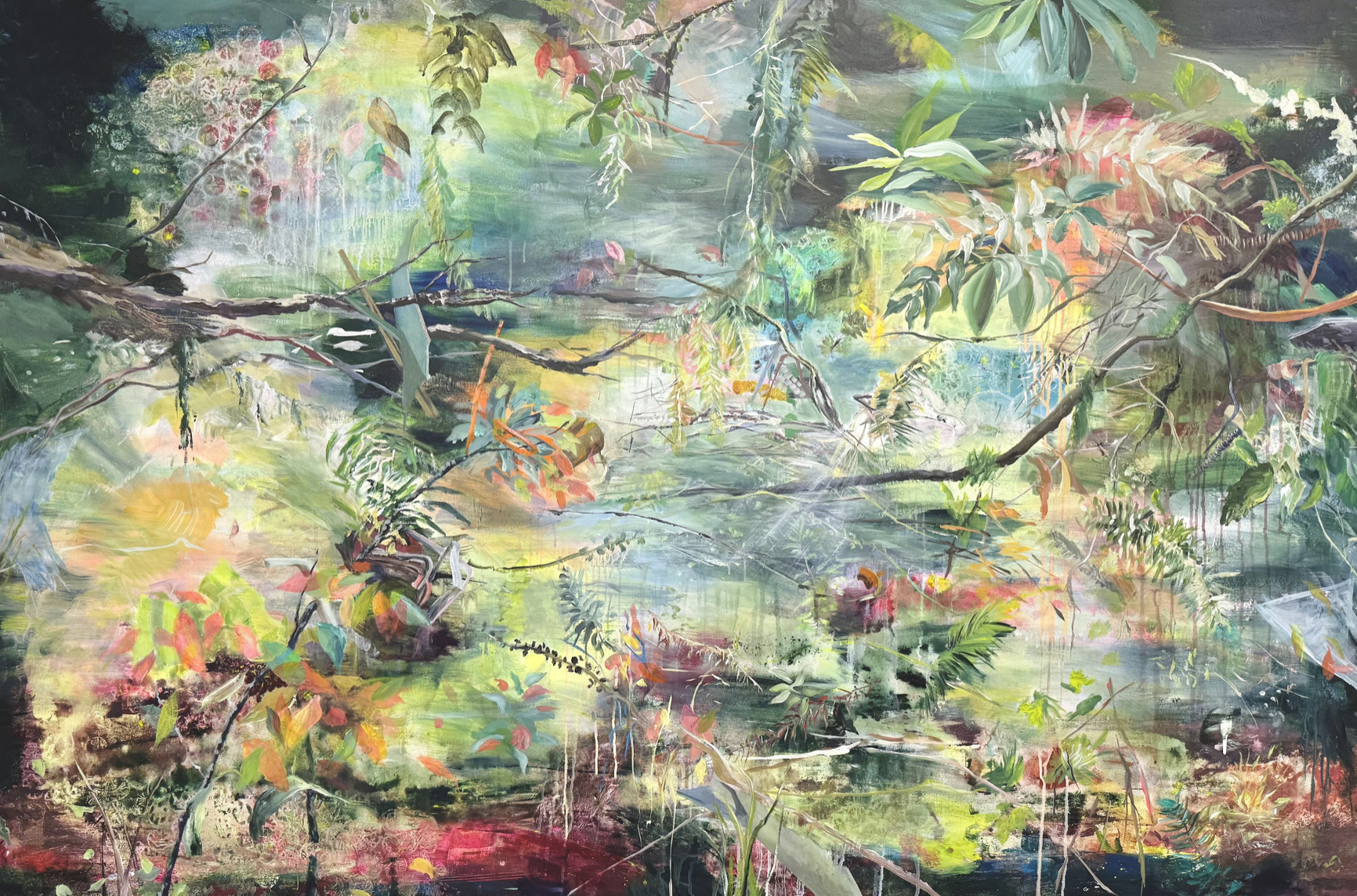
The third painting expands the scale of the environment. Water-like reflections, floating vegetation, and luminous passages of color create a landscape that feels both familiar and imagined. Greens, blues, yellows, and soft pinks blend together in a dynamic network of forms that suggest wetlands, forests, and waterways simultaneously.
Unlike traditional landscape painting, which often seeks clarity and order, Goldberg embraces complexity. Branches intersect, reflections dissolve, and boundaries become fluid. The result is a visual ecosystem where everything appears interconnected.
This interconnectedness reflects one of the central themes running through her work. Nature is not presented as a collection of isolated objects but as a living system of relationships. Plants, water, light, and atmosphere interact continuously, creating environments that are both fragile and resilient.
Color plays a vital role in communicating this idea. Goldberg uses color not merely to describe surfaces but to create mood and structure. Vibrant accents emerge unexpectedly among softer passages, generating rhythms that guide the eye through the composition. These shifts in color often evoke changing weather, seasonal transitions, or fleeting moments of illumination.
Another distinguishing feature of Goldberg’s paintings is their balance between control and spontaneity. Careful observation is evident in the rendering of botanical forms, yet there is also a willingness to allow accidents, drips, and intuitive gestures to shape the final image. This balance gives the work a sense of vitality and openness.
Ultimately, Lori Goldberg’s paintings encourage viewers to reconsider their relationship with the natural world. Rather than offering straightforward depictions of landscape, she creates immersive environments that reflect the complexity of ecological and emotional experience. Her works remind us that nature is never static. It is constantly changing, adapting, and renewing itself.
Through layered abstraction, luminous color, and intricate networks of organic forms, Goldberg transforms the landscape into a place of reflection and discovery. Her paintings invite us to slow down, look closely, and appreciate the interconnected forces that shape both the environments around us and the inner landscapes we carry within ourselves.
Contact: Lori Goldberg ( lorigoldberg.art@gmail.com )
