



Bernard C. Meyers has spent decades immersed in the world of abstract contemporary art. With an MFA from the Rochester Institute of Technology, his work often blurs the lines between photographic realism and abstract expressionism. His style reflects a constant drive to experiment and innovate, using techniques that blend traditional printmaking with modern approaches.

Born in 1955, Meyers has built a career around exploring the interplay of light, texture, and form. His work has appeared in galleries, museums, and institutional spaces across the United States. It’s not about sticking to one medium or style for Meyers—he thrives on the creative tension between different influences and techniques. This willingness to adapt and evolve has shaped his approach, making his art feel fresh and relevant even after decades of practice.
His approach to abstraction doesn’t abandon reality altogether. Instead, Meyers often finds inspiration in the textures and surfaces of the physical world. His interest in how things age, break down, and transform over time is evident in much of his work. He’s not just making art; he’s investigating how layers of experience and memory overlap to create something new.
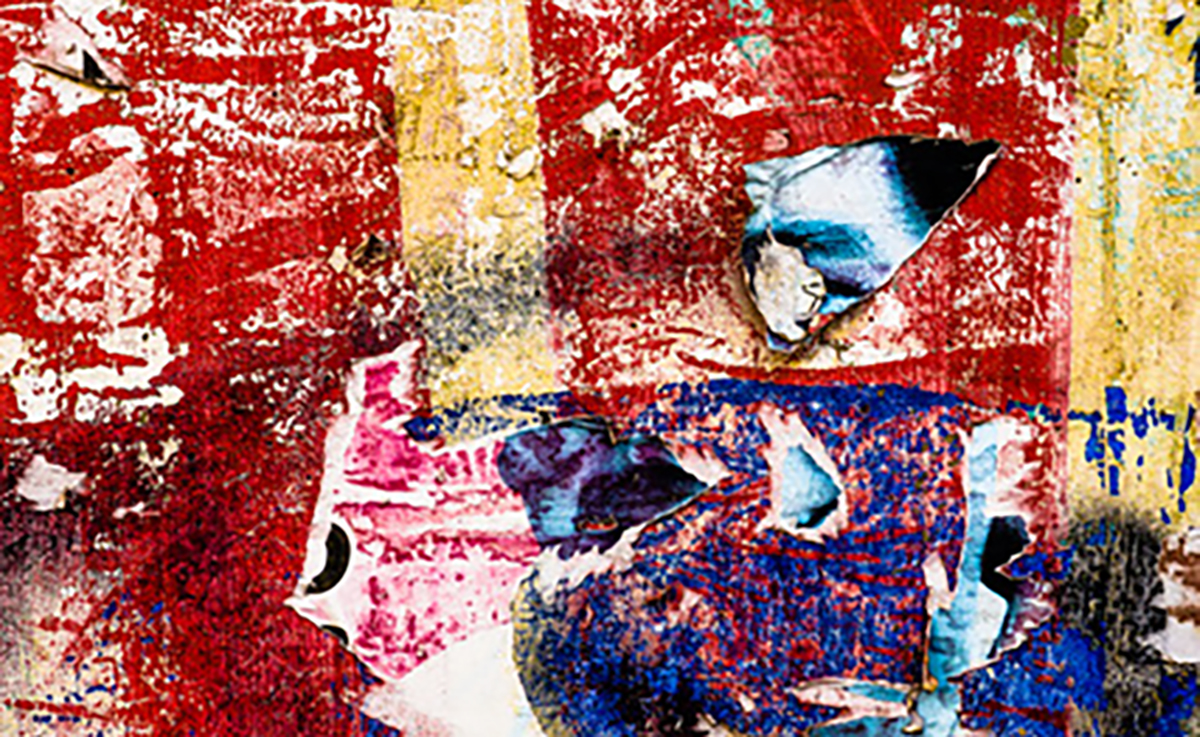
One of Meyers’ ongoing series, Palimpsest, captures this concept with raw precision. Inspired by the walls of Cusco and Puno in Peru, the series reflects his fascination with urban decay and resilience. Walking through these cities, Meyers observed walls marked by countless layers of paint, posters, and graffiti. To him, these walls were like living documents—palimpsests of human activity and time.
He describes seeing “the brash, the faded, the layers and inklings of all unwilling to be denied, silent screams for recognition.” It’s this sense of life and struggle, of stories trying to surface from beneath the grime, that Meyers captures so well. His process involves not only observing but also interpreting, translating these visual experiences into works that reflect a complex relationship between the past and present.
Meyers refers to the series as a “codex of time,” where the layering of urban surfaces becomes a metaphor for history itself. Each layer of paint, poster, or scribble is a fragment of a story, one that has been built up, torn away, and then built upon again. It’s an ongoing dialogue between what once was and what currently exists.
The theme of Palimpsest also hints at the human condition. As Meyers explains, he sees cautionary tales of poverty, promotion, politics, and people etched into the walls. His work acknowledges the grit and grime of urban life but also the resilience and creativity that persist despite hardship. There’s an element of social commentary here, but it’s not heavy-handed. Instead, Meyers invites viewers to draw their own conclusions, to see the beauty and complexity in what might initially appear damaged or decayed.
In Palimpsest, light plays an essential role. Meyers is drawn to “the unseen light amongst the dirty shadows.” This duality is central to his work—finding brightness where others see only darkness. His process is about bringing those hidden details to the surface, highlighting the moments of beauty that often go unnoticed.
The series is more than just a documentation of urban textures. It’s about memory and transformation, about how the past leaves its mark on the present. Meyers’ approach feels both deliberate and intuitive, allowing him to respond to the world around him in a way that feels authentic. His work speaks to the layers of experience we all carry, the moments that shape us even when we try to leave them behind.
Meyers’ work continues to evolve, but his focus remains consistent. He’s fascinated by how things change over time, how layers of meaning can build up and then be worn away. His art is about more than aesthetics—it’s about engaging with the world on a deeper level, using abstraction to reveal something real.
Through Palimpsest, Meyers offers viewers a chance to see beauty where others might see only decay. It’s a reminder that art doesn’t always have to be polished or pristine. Sometimes, the most powerful stories are the ones etched into rough, weathered surfaces, waiting for someone to notice them.
