



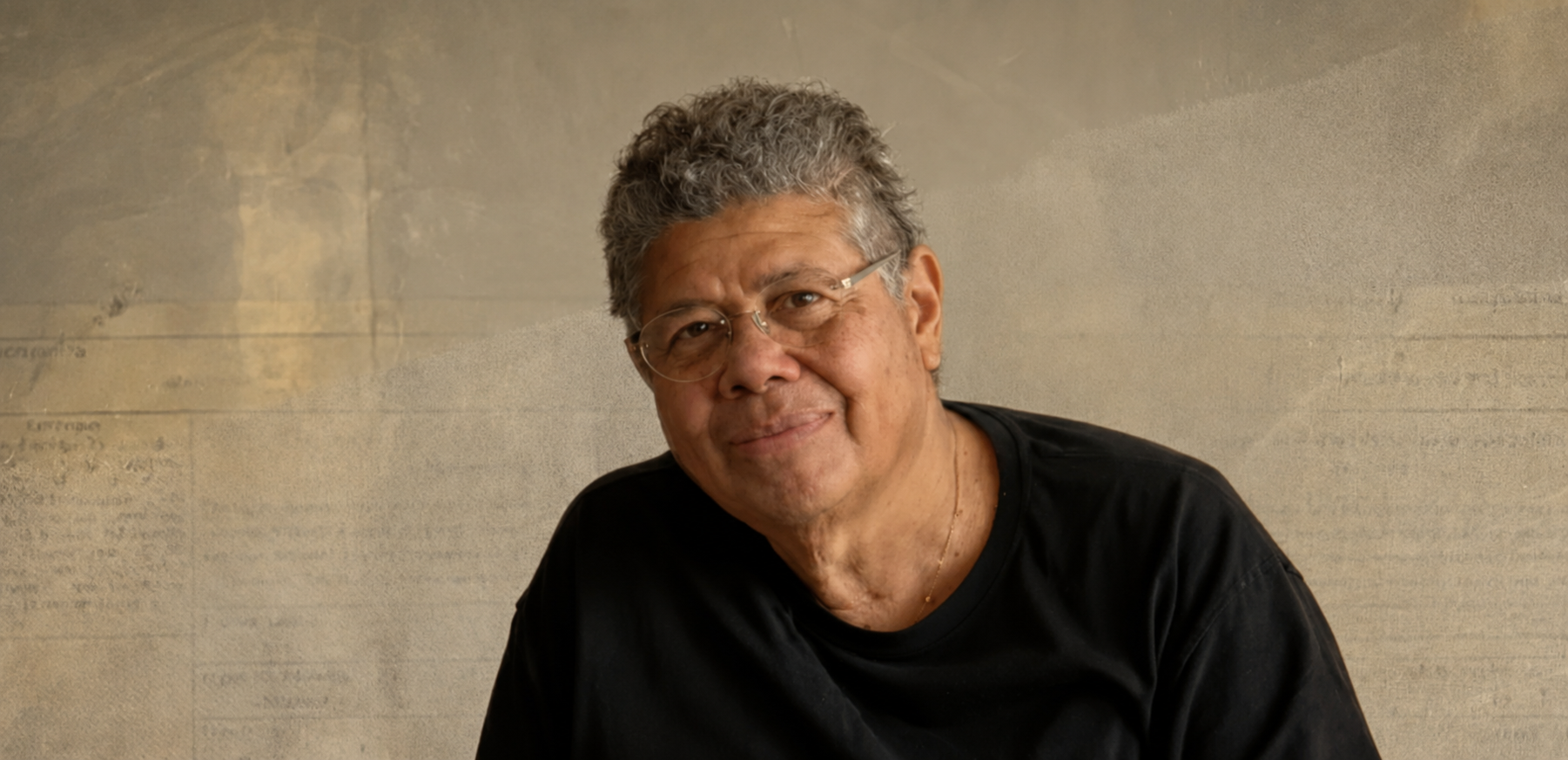
Barbara Walker is a Jamaican-German artist born in Georgetown, Guyana, in 1954, when the country was still known as British Guiana. Her personal history connects two traumatic inheritances. Her Jamaican ancestors were enslaved people brought from West Africa to the Caribbean, while many members of her German family were killed during the Holocaust. Her mother survived by escaping to the United Kingdom through the Kindertransport. After spending many years in Jamaica, where she operated an eco-boutique hotel, Walker returned to Germany in 2018 and renewed her focus on an artistic practice that has remained important to her since childhood. Her work examines the lasting effects of enslavement and the Shoah, finding connections between histories that are often discussed separately. Through this deeply personal perspective, Walker considers ancestry, displacement, survival, and the emotional complexities of carrying both Jamaican and German identities.
Testimonial II: Fragments of Personal and Collective History
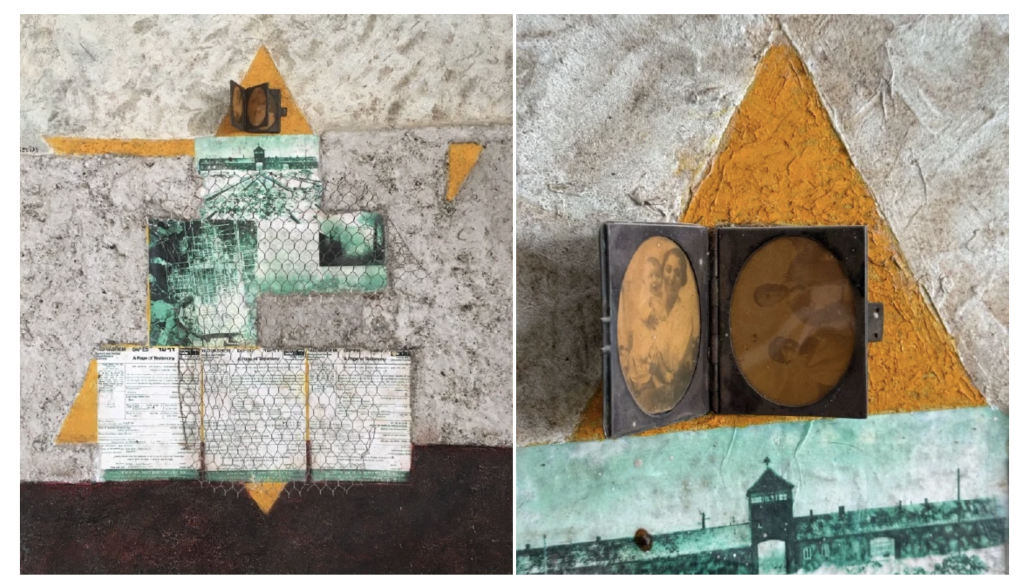
Created in 2008, Testimonial II is a mixed-media work on hardboard that confronts the viewer with a carefully constructed field of images, documents, textures, and symbolic forms. Rather than presenting history as a clear and continuous account, Walker builds the composition from fragments. These elements appear preserved yet damaged, as though they have survived a long and difficult journey before reaching the present.
The work is dominated by a distressed gray surface that resembles aged concrete, worn plaster, or an eroded wall. Its roughness gives the piece a physical sense of time. Marks, discolorations, and uneven textures suggest that the surface has absorbed the pressure of past events. It does not function simply as a background. Instead, it becomes part of the work’s meaning, evoking places where experiences have been recorded, concealed, and gradually uncovered.
Across this surface, Walker introduces photographs and documentary materials in muted green and turquoise tones. An image of a concentration camp appears within the composition, immediately connecting the work to the history of the Holocaust. Nearby documents resemble official forms or records, suggesting the administrative systems through which individual lives were classified and controlled. Such materials can appear impersonal, yet within Walker’s work they become evidence of human experience. They represent people whose identities risk being reduced to names, numbers, categories, and dates.
A layer of wire mesh stretches across parts of the imagery. This barrier creates a strong visual association with confinement, imprisonment, and enforced separation. The viewer can see what lies behind it, but access remains restricted. In this way, the mesh may also suggest the psychological distance between later generations and the events experienced by their ancestors. History is visible, but it can never be entered or completely understood by those who did not live through it.
Orange triangular forms provide the work’s strongest areas of color. Their sharp geometry interrupts the weathered gray field and creates a visual structure connecting the different fragments. The triangle carries painful historical associations, particularly in relation to the system of identifying prisoners in Nazi concentration camps. In Testimonial II, however, Walker does not offer a single, fixed interpretation. Repetition transforms the shape into a broader sign of warning, vulnerability, categorization, and remembrance.
Near the upper section of the work is a small hinged object containing oval photographic images. It resembles a miniature frame, personal locket, or private memorial. Its modest size requires close attention, encouraging the viewer to move from the broader historical references toward something intimate and human. These indistinct portraits resist complete recognition, yet their presence affirms that historical tragedy is made up of individual lives and family relationships.
The title Testimonial II reinforces the idea of witnessing. A testimonial is both a personal account and a form of evidence. Walker’s artwork performs both functions, although it does not depend on a conventional narrative. Materials, photographs, barriers, and damaged surfaces speak in place of a linear written statement. Their fragmentation reflects the way inherited trauma often reaches later generations through incomplete stories, missing relatives, surviving objects, and silences within families.
Walker’s dual ancestry gives this investigation an especially complex dimension. Her practice places the histories of African enslavement and the Shoah in conversation without treating them as interchangeable. Instead, she considers how both continue to shape identity long after the original events. Her position as a descendant of these histories allows her to explore how collective trauma becomes part of private memory and how a person may carry several cultural inheritances simultaneously.
Ultimately, Testimonial II is an act of remembrance built from what remains. Its materials appear scarred yet enduring, conveying both vulnerability and survival. Walker does not attempt to resolve the painful histories within the work. She creates a place where they can be acknowledged, examined, and carried forward. Through its restrained colors, layered construction, and archival imagery, the piece asks viewers to look beyond historical categories and recognize the human lives contained within them.
