



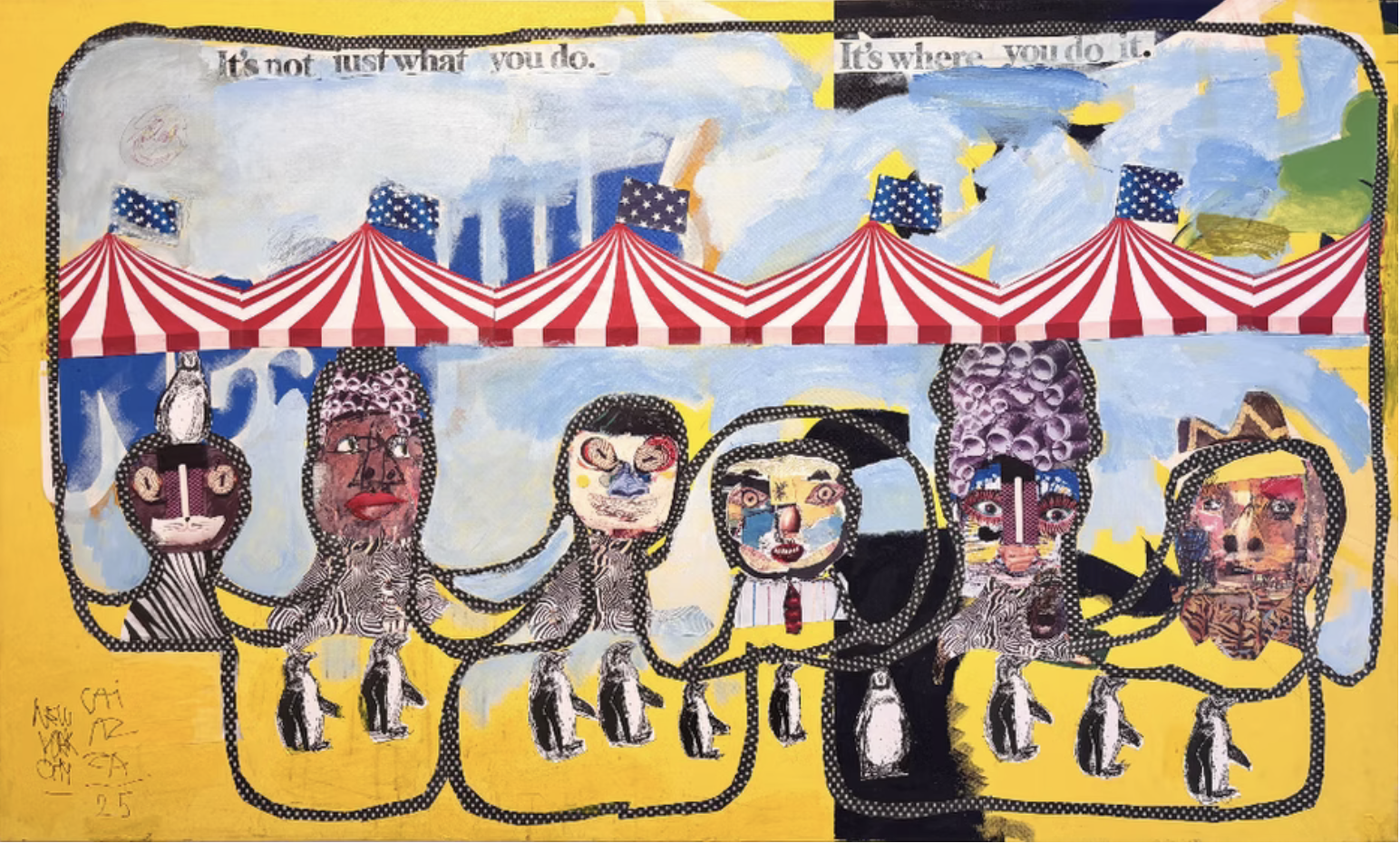
Born in December 1972, Alejandro Caiazza is a New York City-based Brut and Neo-Expressionist artist whose work embraces instinct, emotion, and the unpredictable nature of human experience. Influenced by outsider art, primitive art, Art Brut, and Neo-Expressionism, he has developed a visual language that is intentionally direct and deeply personal. Rather than pursuing polished realism or conventional beauty, Caiazza creates paintings that celebrate spontaneity, imperfection, and emotional honesty. His subjects move freely between the sacred and the everyday, touching on politics, sexuality, violence, humor, animals, and the emotional extremes of love, anguish, madness, and mortality. Each painting reflects both his inner world and the cultures he has encountered throughout his life, transforming lived experiences into vivid visual narratives. Today, his work is exhibited at respected galleries including Van Der Plas Gallery in New York City, Creativebloch Art Gallery in Brooklyn, Betsy Frank Gallery in Palm Beach, Time To Be Happy in SoHo, and other exhibition spaces, where his distinctive voice continues to engage audiences through bold imagery and fearless storytelling.
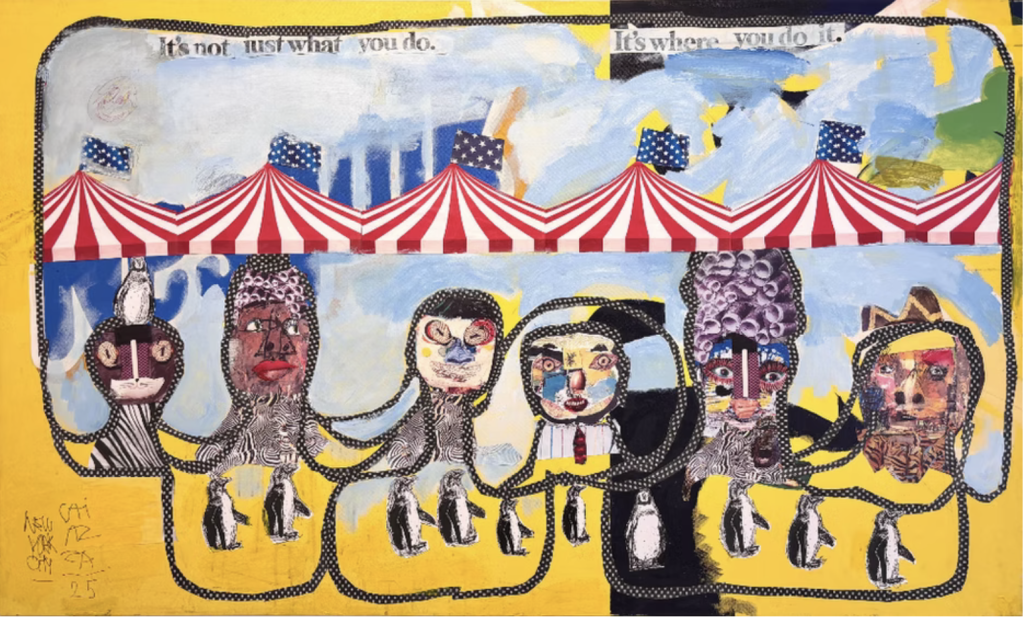
One of Caiazza’s paintings immediately captures attention through its energetic composition, bright palette, and unconventional cast of figures. At first glance, the work appears playful, almost cartoon-like, yet the longer one looks, the more layered and thought-provoking it becomes. Across the upper portion of the canvas stretches a row of circus tents decorated with red-and-white stripes and American flag motifs. Above them, fragments of printed text read, “It’s not just what you do. It’s where you do it.” The familiar slogan introduces ideas of place, identity, and performance while leaving its meaning deliberately open. Rather than explaining the message, Caiazza allows the text to function as another visual element within a larger conversation.
Beneath the tents stands a procession of unusual figures connected by looping black lines that resemble ropes, cords, or pathways. Each character possesses a distinct personality. Their faces are assembled from expressive shapes, mismatched features, bold colors, and simplified forms that recall children’s drawings, tribal masks, and outsider art traditions. Instead of pursuing anatomical accuracy, Caiazza emphasizes individuality and emotional presence. Every face appears to tell a different story, encouraging viewers to imagine the personalities, histories, and relationships hidden behind these expressive portraits.
The painting demonstrates Caiazza’s appreciation for Art Brut through its freedom from conventional artistic rules. The figures feel instinctive rather than carefully calculated, allowing emotion to take priority over perfection. Thick outlines, rough textures, and intentionally uneven forms give the work a sense of authenticity. The composition celebrates direct expression, reminding viewers that emotional truth can be more powerful than technical precision.
Color also plays an important role in shaping the painting’s atmosphere. A vivid yellow background energizes the entire composition, creating warmth while intensifying the contrast between the colorful figures and the black connecting lines. Soft blue passages suggest open skies, balancing the more intense reds, blacks, and patterned surfaces throughout the work. Rather than blending colors smoothly, Caiazza layers them boldly, allowing each hue to retain its own visual strength. This approach contributes to the painting’s lively rhythm and reinforces its expressive character.
The repeated circus tents introduce another compelling layer of interpretation. A circus is often associated with entertainment, spectacle, and public performance, but it can also symbolize illusion, social roles, and carefully constructed appearances. Positioned above the procession of characters, the tents may suggest that modern life itself resembles a performance where individuals present different versions of themselves depending on circumstance. The American flag details further invite reflections on culture, politics, and national identity without reducing the work to a single political statement. Caiazza presents symbols that remain open, allowing viewers to engage according to their own experiences.
The black looping lines connecting the figures create visual unity while suggesting invisible relationships between individuals. They resemble networks, family ties, emotional bonds, or even the complicated systems that connect societies. These flowing lines guide the eye across the painting, transforming separate portraits into a shared narrative. No figure exists entirely alone; each becomes part of a larger human story.
Small penguin-like forms hanging beneath several figures introduce moments of humor and surprise. Their repeated appearance softens the painting’s intensity while adding an element of playful absurdity. This balance between seriousness and wit is characteristic of Caiazza’s work, where difficult themes often coexist with imagination and unexpected visual jokes.
Ultimately, this painting reflects Alejandro Caiazza’s commitment to creating art that resists easy interpretation. It invites viewers to observe, question, and form their own connections rather than offering fixed conclusions. Through expressive faces, symbolic imagery, vibrant color, and instinctive composition, he transforms the canvas into a space where emotion, culture, memory, and imagination intersect. The result is a work that feels both deeply personal and universally relatable, demonstrating how expressive painting can continue to speak powerfully about the complexity of contemporary human experience.
