


Thomas Riesner has spent decades creating art that emerges from intuition rather than calculation. Born in 1971 in Leipzig, Germany, where he continues to live and work, Riesner is a self-taught artist whose creative journey began in 1990. Working primarily with acrylics, ink, and drypoint etching, he has developed a visual language that sits between abstraction and representation. He describes his approach as “abstract figuration,” a style that allows recognizable forms to appear and dissolve within energetic fields of color, texture, and gesture.
Although his work is often associated with Outsider Art, Riesner’s paintings resist simple categorization. His images are spontaneous, emotionally charged, and guided by instinct. Rather than constructing carefully planned compositions, he allows forms to emerge organically through the process of making. This direct and unfiltered approach gives his work a sense of immediacy, as though each piece captures a fleeting psychological state before it disappears. Over the years, Riesner has participated in various exhibitions and received recognition through cover art competitions for Thieme Verlag in both 2007 and 2015. Yet his artistic practice remains deeply personal, rooted in curiosity, emotion, and the desire to give visual form to experiences that are difficult to express through words.
The works presented here reveal an artist who embraces uncertainty and transforms it into imagery that is both unsettling and strangely engaging.
At first glance, Riesner’s figures appear almost childlike. Large eyes, simplified bodies, and loose, expressive marks create characters that seem suspended between innocence and anxiety. Yet beneath this apparent simplicity lies a rich emotional complexity. These figures are not portraits of specific individuals. Instead, they function as psychological symbols, embodying feelings of vulnerability, isolation, fear, confusion, and resilience.
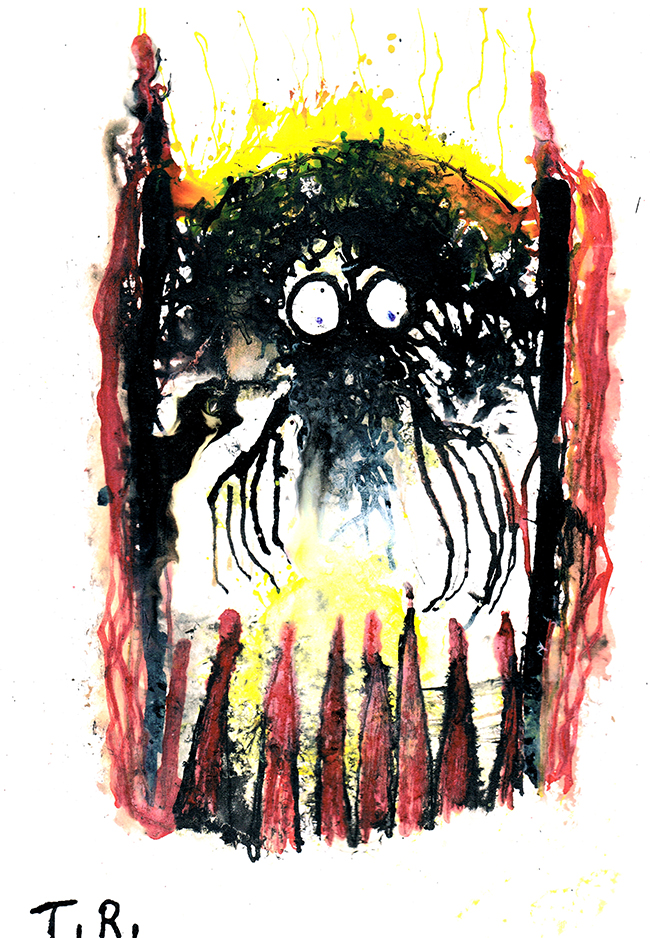
In Planet is Burning 3, a dark creature-like form occupies the center of the composition, framed by vertical red structures and crowned by an explosive halo of yellow. The figure’s wide eyes immediately draw attention, conveying surprise, alarm, or perhaps helplessness. The title suggests environmental or existential concerns, yet the image avoids direct narrative. Instead, Riesner creates a visual atmosphere where emotion becomes the primary subject. The contrast between black, red, and yellow intensifies the tension, while the spontaneous drips and splashes reinforce a sense of instability.
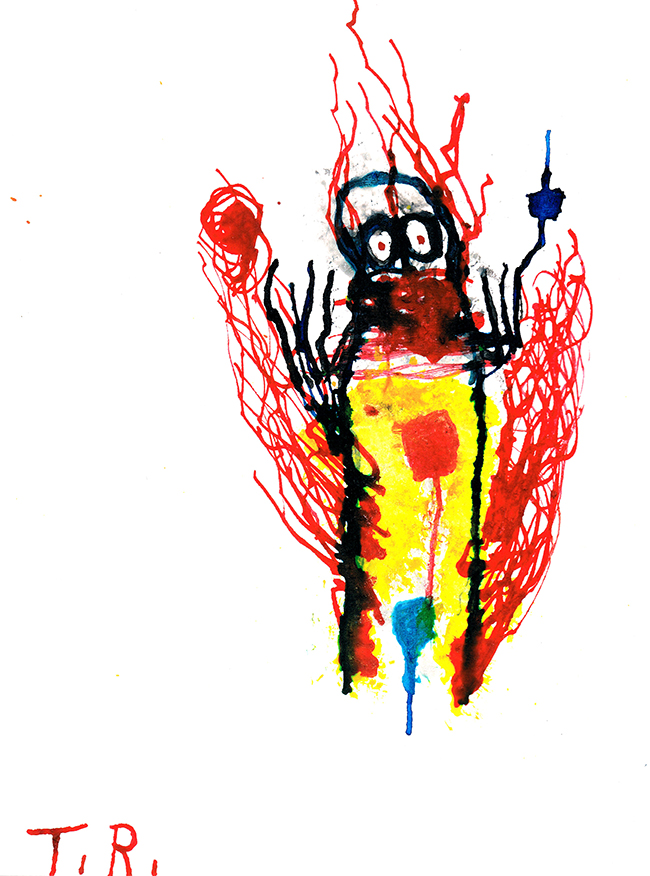
A similar emotional charge appears in Soulache 2. Here, a solitary figure stands within a chaotic network of red lines that seem to vibrate around its body. The bright yellow center contrasts sharply with the surrounding darkness, creating an impression of inner energy struggling against external pressure. Riesner’s use of ink allows lines to move freely across the surface, producing a feeling of urgency. The image appears less like a depiction of physical reality and more like a visualization of an emotional condition.
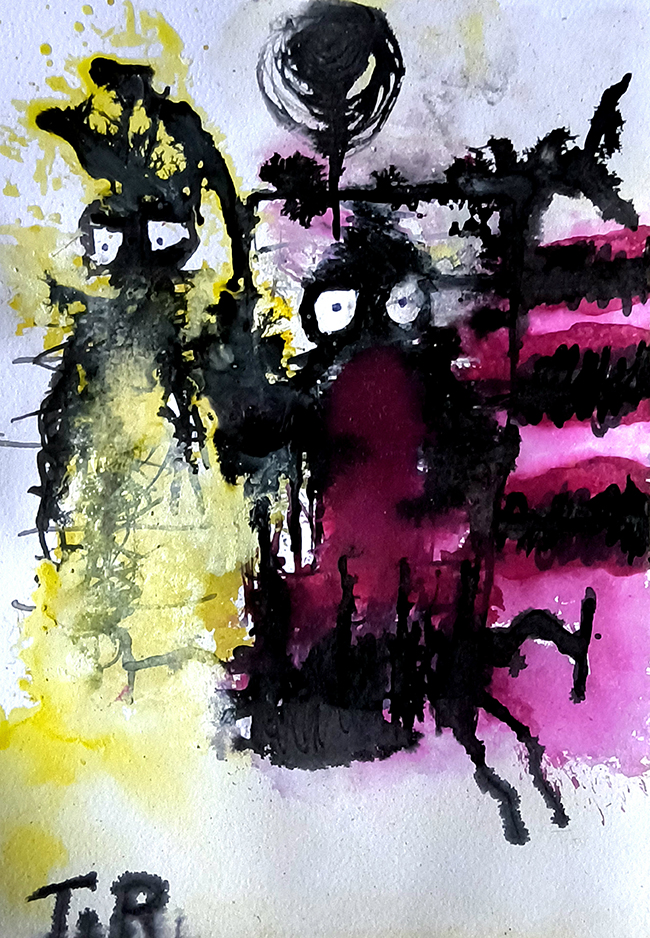
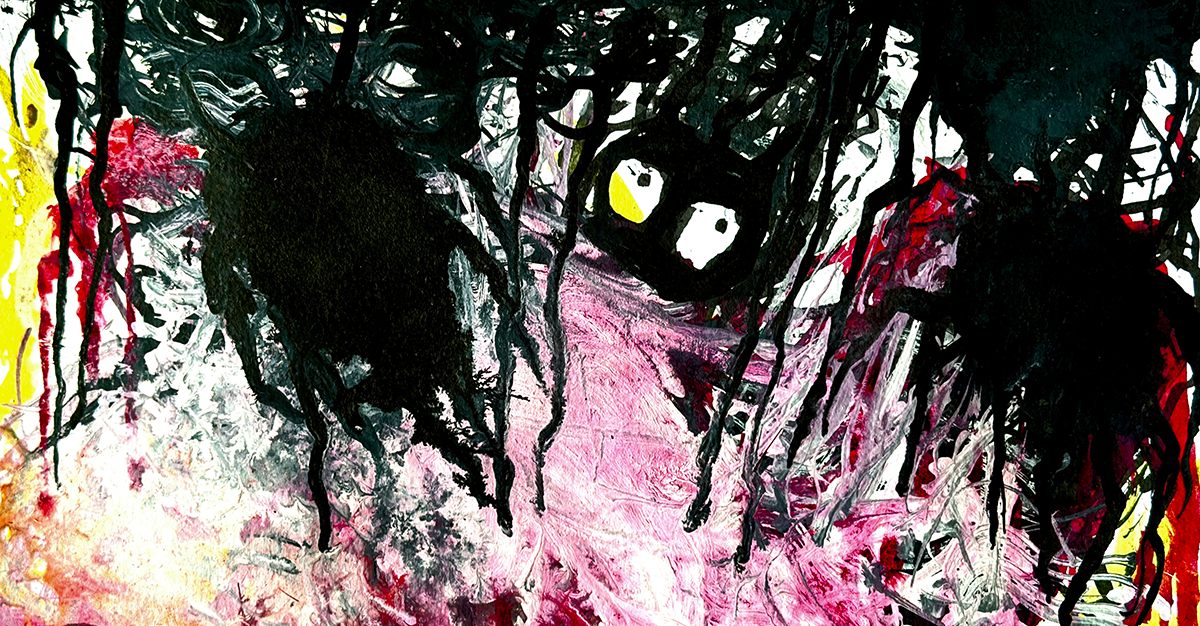
The work Tired of Life introduces multiple figures sharing the same pictorial space. Their exaggerated eyes and loosely defined forms create an uneasy dialogue between companionship and loneliness. Despite standing together, the figures appear emotionally disconnected. The composition combines dark blacks, acidic yellows, and vivid pinks, producing an atmosphere that feels both playful and unsettling. This tension between humor and discomfort is one of the recurring qualities in Riesner’s work. His characters can appear awkward, fragile, or even absurd, yet they remain deeply human in their emotional presence.
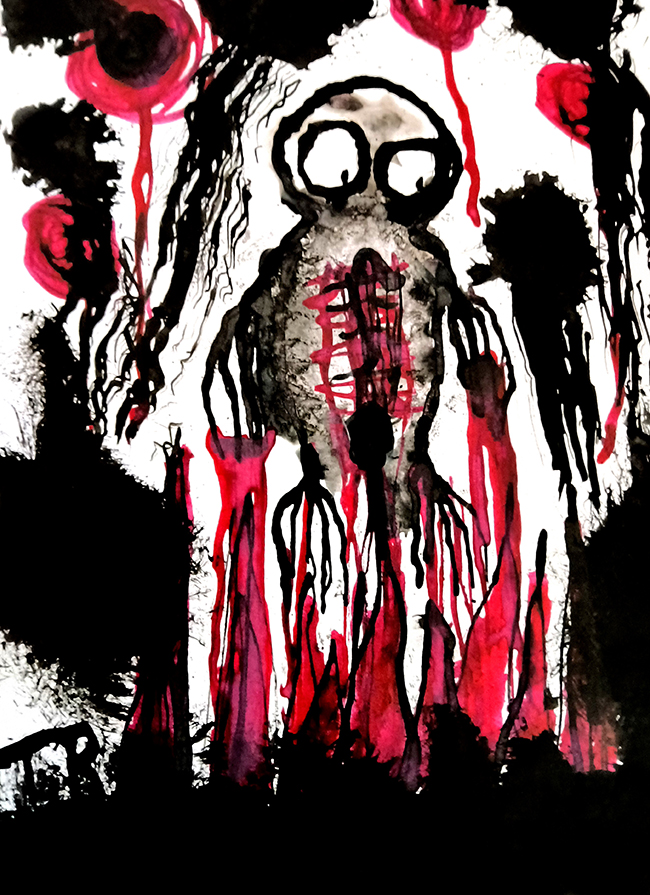
In Threatens Me 2, Riesner intensifies this emotional drama. A skeletal figure emerges from a field of black and red forms, surrounded by dripping marks and floating circular shapes. The image evokes feelings of danger and exposure without depicting a specific threat. The figure’s oversized eyes become a focal point, expressing apprehension while also inviting empathy. The work demonstrates Riesner’s ability to communicate psychological states through minimal means. A few lines, a handful of colors, and a loosely defined form become enough to convey complex emotions.
Perhaps one of the most intriguing works is Apprehensively. Unlike the more centrally positioned figures in the other pieces, this composition hides its character within a dense field of black marks and layered textures. The figure appears partially concealed, peering outward through a chaotic environment. This sense of concealment reinforces the title and introduces themes of uncertainty and anticipation. The painting feels less like an image to be observed and more like a moment to be experienced.
Throughout these works, Riesner demonstrates a remarkable trust in spontaneity. His paintings do not seek technical perfection or polished realism. Instead, they embrace raw expression. Ink drips freely. Colors bleed into one another. Lines wander unpredictably across the page. These elements are not accidents to be corrected but essential parts of the creative process.
What makes Riesner’s work compelling is its ability to balance darkness with accessibility. While the themes often touch upon anxiety, fear, and emotional struggle, the imagery remains open and inviting. The large-eyed figures possess a certain vulnerability that encourages connection rather than distance. Viewers may see fragments of themselves within these strange creatures and invented personalities.
For more than three decades, Thomas Riesner has continued to explore the space between abstraction and figuration, instinct and intention, darkness and humor. His art does not provide clear answers or fixed interpretations. Instead, it offers a visual landscape where emotions can take shape, transform, and coexist. Through spontaneous marks, expressive color, and deeply intuitive imagery, Riesner creates works that remind us that even our most difficult feelings can become sources of creativity, reflection, and understanding.
