



Moroccan visual artist Salah Noctis creates psychologically charged images that explore identity, memory, and the hidden processes of personal transformation. Working through dark symbolism and cinematic surrealism, he constructs unsettling worlds in which familiar spaces become stages for internal conflict. His figures often appear masked, faceless, isolated, or physically altered, suggesting identities that are unstable and continually being reshaped. Rather than presenting direct explanations, Noctis allows silence and ambiguity to carry meaning. Each scene feels like a fragment from a dream, a forgotten memory, or a film whose larger story remains unknown. Vulnerability, fear, alienation, and self-examination converge throughout his work, encouraging viewers to look beyond surface appearances. Through dramatic contrasts and symbolic narratives, Noctis transforms psychological tension into timeless visual storytelling, revealing how darkness can become a space for contemplation, recognition, and emotional truth.
Theatre of the Unconscious
The drawings of Salah Noctis unfold in stark monochrome, where black, white, and grey establish an atmosphere of uncertainty. His interiors, figures, curtains, and shadowed backgrounds possess the visual intensity of scenes extracted from an expressionist film. Although each work appears to contain an unfolding event, its precise beginning and conclusion remain concealed. The viewer enters somewhere in the middle, encountering a moment that feels significant without being fully explained.
This ambiguity is central to Noctis’s visual language. He does not offer a straightforward narrative or a fixed interpretation. Instead, he introduces symbols that activate the viewer’s imagination. Covered faces, detached heads, distorted bodies, masks, birds, curtains, and enclosed rooms appear as elements within a private psychological vocabulary. They may evoke repression, judgment, mortality, or the fragmentation of identity. Yet their meaning remains fluid, changing according to the memories and fears each viewer brings to the image.
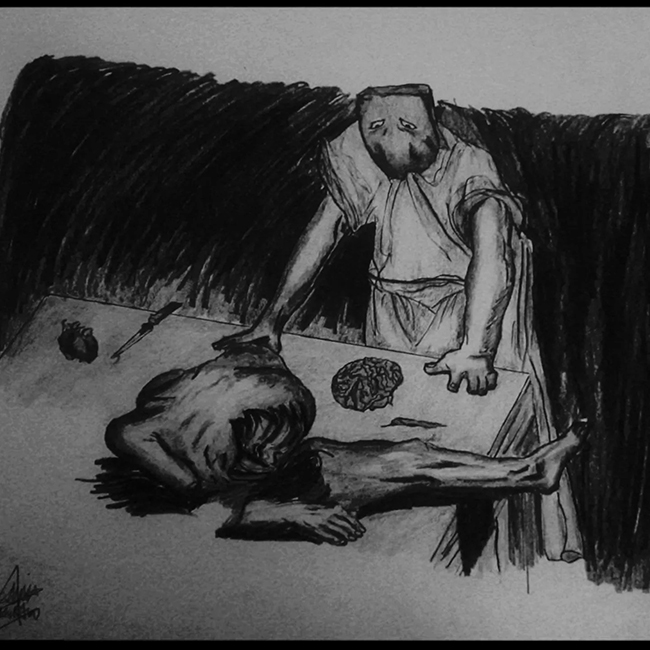
In one particularly disturbing scene, a motionless figure lies across a table while another stands over the body. A brain rests nearby like an object removed for examination. The image resembles an impossible medical procedure, but its emotional effect extends beyond physical violence. It can be interpreted as a symbolic investigation of the mind: an attempt to locate the source of thought, pain, memory, or consciousness. The figure performing the examination has a concealed or distorted face, complicating any clear distinction between healer and aggressor. The work suggests that confronting one’s inner life can feel both necessary and threatening.
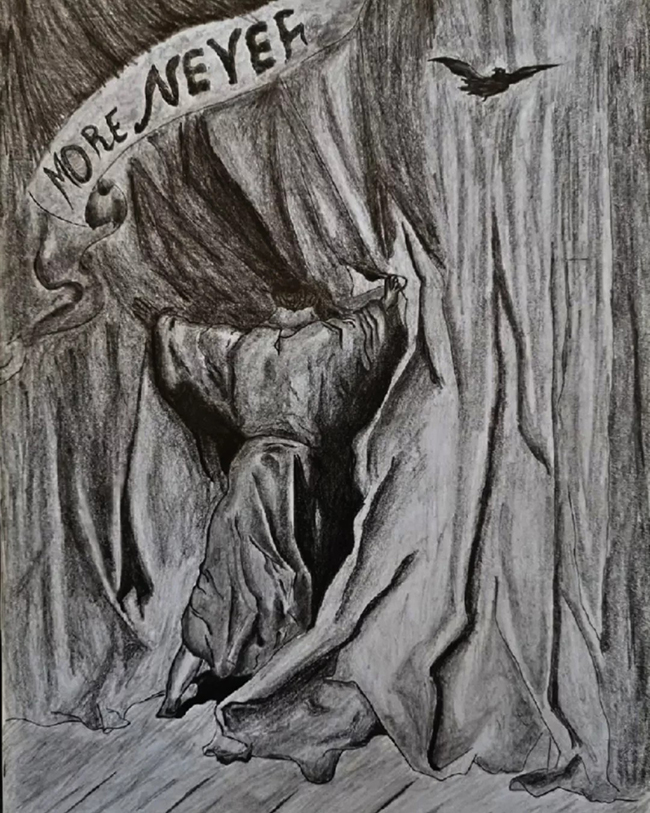
Another drawing presents a suspended figure among heavy curtains. Above, a banner carries the words “MORE NEVER,” while a dark bird moves through the upper space. The theatrical drapery makes the scene feel staged, as though the figure is trapped inside a performance that cannot end. The reversed or disrupted phrase intensifies the dreamlike unease. Language no longer communicates clearly; it becomes another uncertain symbol. Meanwhile, the bird may signify escape, death, freedom, or an unreachable world beyond confinement.
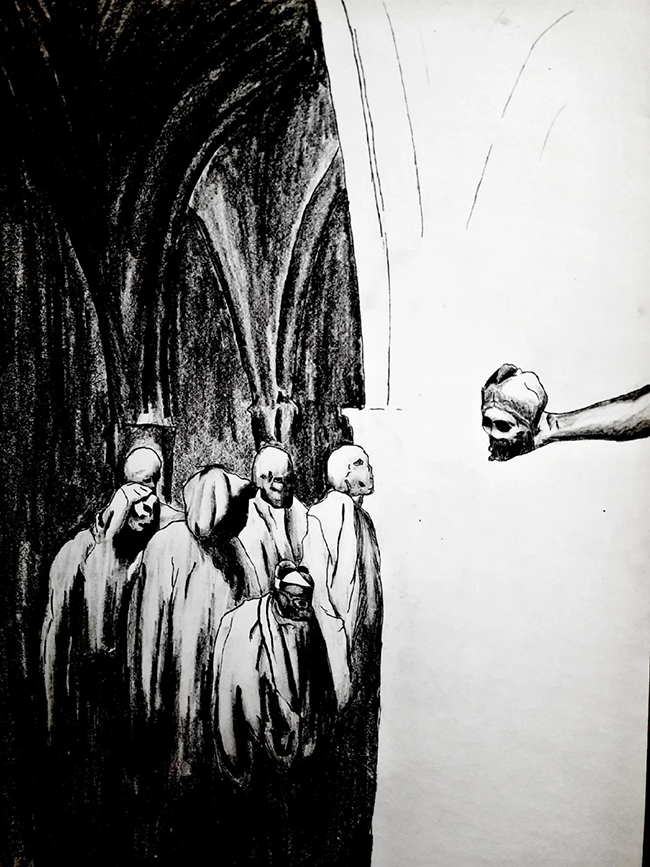
Curtains and doorways repeatedly function as psychological boundaries in Noctis’s compositions. They divide exposure from concealment and consciousness from the unknown. In one image, a group of robed, obscured figures gathers in a dense area of darkness while an arm extends from a nearly empty white space, holding a severed head. The contrast is striking. On one side, collective anonymity dominates; on the other, a single disembodied identity is presented for inspection. The image raises questions about belonging and exclusion. Does the head represent a sacrifice, an accusation, or a self separated from the crowd? No definitive answer is provided.
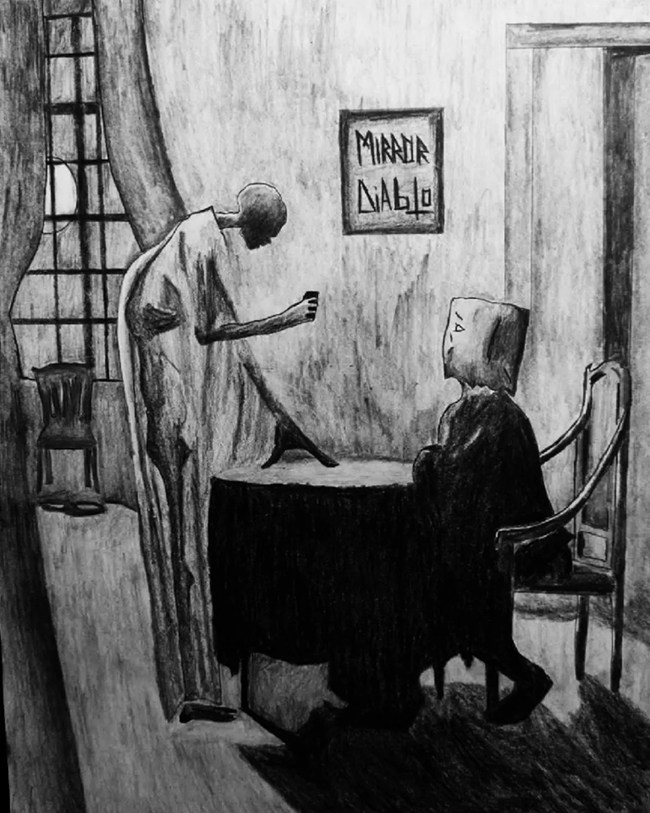
The domestic rooms in these drawings are equally unsettling. Tables, chairs, windows, and sofas normally suggest comfort and ordinary life, but Noctis transforms them into settings for silent confrontation. In one scene, a standing figure gestures toward a seated individual whose head is enclosed in a paper-like covering. Their interaction resembles an interrogation, consultation, or ritual. A framed inscription on the wall adds to the sense of coded meaning. Although the room is recognizable, communication within it appears fractured.
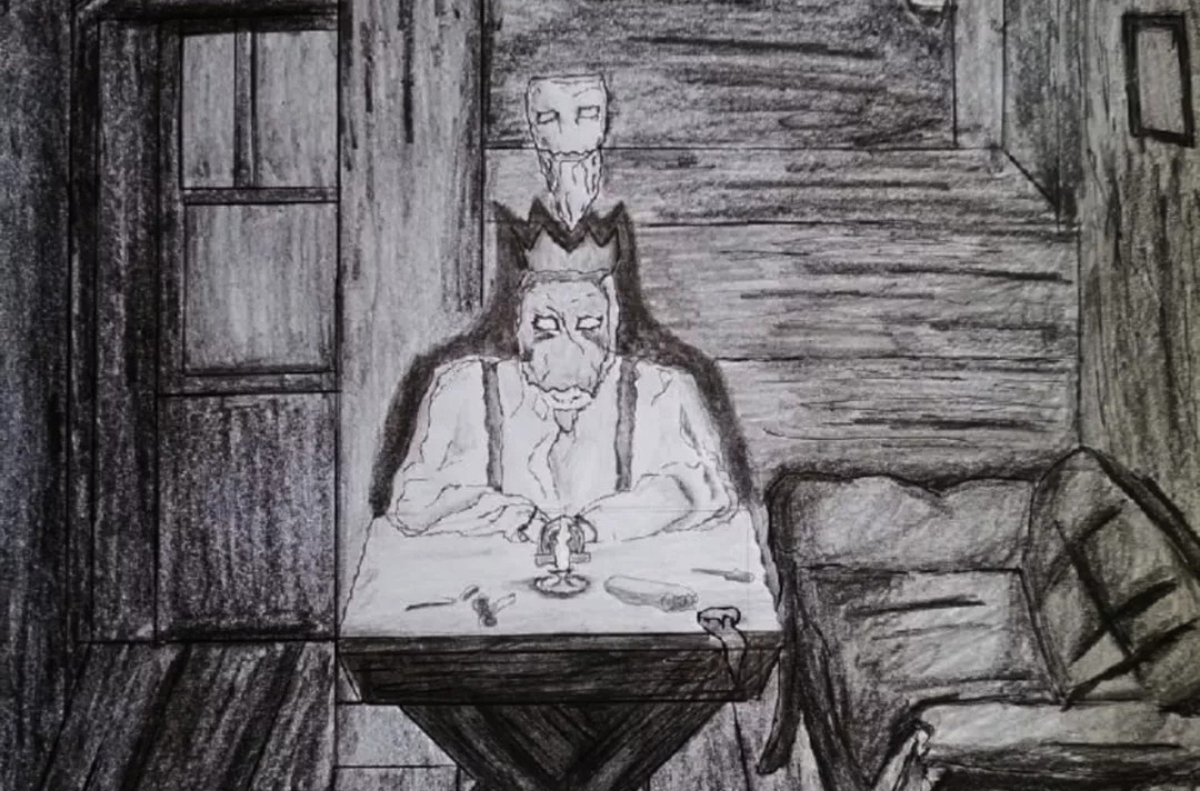
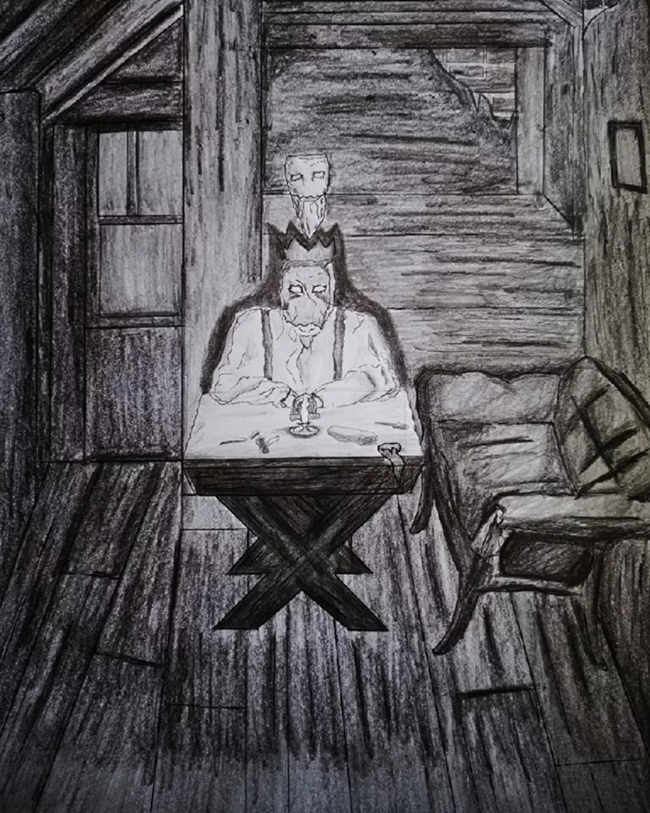
Elsewhere, a seated person occupies a dim interior while a skull-like presence rises behind the head. Small objects arranged across the table hint at a private ceremony or an act of contemplation. The doubling of the figures suggests that identity may contain multiple selves: the visible person and the concealed presence that watches, remembers, or controls. The skeletal form can be read as mortality, but it may also represent an earlier identity that refuses to disappear.
Noctis’s technique strengthens the emotional force of these subjects. Dense areas of graphite or charcoal-like darkness press against exposed sections of paper, creating a struggle between visibility and erasure. His rough textures prevent the scenes from becoming polished fantasies. They feel immediate, fragile, and psychologically raw, like visions recorded before they vanish.
Across these works, darkness is not simply an aesthetic choice. It becomes a condition through which hidden emotions can emerge. Salah Noctis invites viewers into spaces where the self is divided, memory is unreliable, and silence communicates what language cannot. His drawings do not resolve their mysteries. Instead, they leave us facing the uncomfortable possibility that the strangest figures in these shadowed rooms may be reflections of ourselves.
