



[ad_1]
Deborah Kass created the Art History Paintings out of frustration at not seeing herself in the halls of museums even as she fell in love with the work of the artists themselves. That contradictory dynamic of attraction and repulsion is what gives these paintings their power, as her biting critiques are tempered by her humor, and her formalist sensibility marries disparate parts to create searing attacks on the history of exclusion.
There’s a curious image of a headless, chestless, and armless Lucy van Pelt from the popular Peanuts comic strip that Kass reproduces à la Warhol on two of the dozen paintings in her current exhibition, The Art History Paintings 1989–1992 at Salon 94 gallery. Rendered as a simple white line on a black surface, the erasure makes the normally recognizable cartoon figure almost indecipherable, transforming it into something unfamiliar while pushing us to question the foundations of what we think we know.

“Puff Piece” (1991) pairs a black-and-white, Pollockesque splash with Superwoman or Supergirl (I’m not sure which) who blows a stream of air at the semen-like splurt. The whole series plays with David Salle’s well-known postmodernist painting series from the 1980s in which he juxtaposed images that we normally don’t associate with one another. In doing so, Kass collides the stylistic calling cards of prominent male artists with a new, more sexualized reading that turns splashes of paint into cum shots. She instills the painting with a more frank and illuminating sensibility, unlike Salle’s shadowy energy, that almost always ends up feeling like we just walked into the latter’s therapy appointment.
Perhaps it is because Salle’s series is less influential today than it was in the ’80s, and his artistic claim that meaning is often up to the viewer to define feels like just another repackaging for the marketplace, but Kass appears less interested in that game. Instead, she’s focused on the power of the systems that challenge us and can take away our agency in the act of viewing.

In “Untitled (First World, Third World)” (1990), the artist strikes at the Cold War language of the period, which placed the liberal democracies of the West against what we would call the Global South today. By combining a classic Cubist composition with an African landscape, Kass hints at Picasso’s influences that propelled his own experimentation with space. In the same way, Disney, as represented by the Dumbo franchise, is transported to the African savannah — a symbolic act of return? — as opposed to Florida, where the big-eared fella’s story normally takes place. While the African heritage of the Cubist work is more obscured, the placement of the beloved cartoon elephant, adorned with full circus makeup, in what may appear to be a more traditionally suitable landscape looks absurd — never mind that Dumbo is an Asian elephant with amorphous African elephant features, including huge ears and being almost hairless. African influence has migrated in many directions, leaving the indirect progeny of that continent in a conceptual limbo on the African plains. The paths of influence remain invisible, but intuitively we see them. The depopulation of an African landscape flattens the place into a silhouetted sunset scene in contrast to the spatial innovations of Cubism and the more articulated flying elephant — all of which mine Africa for different purposes.
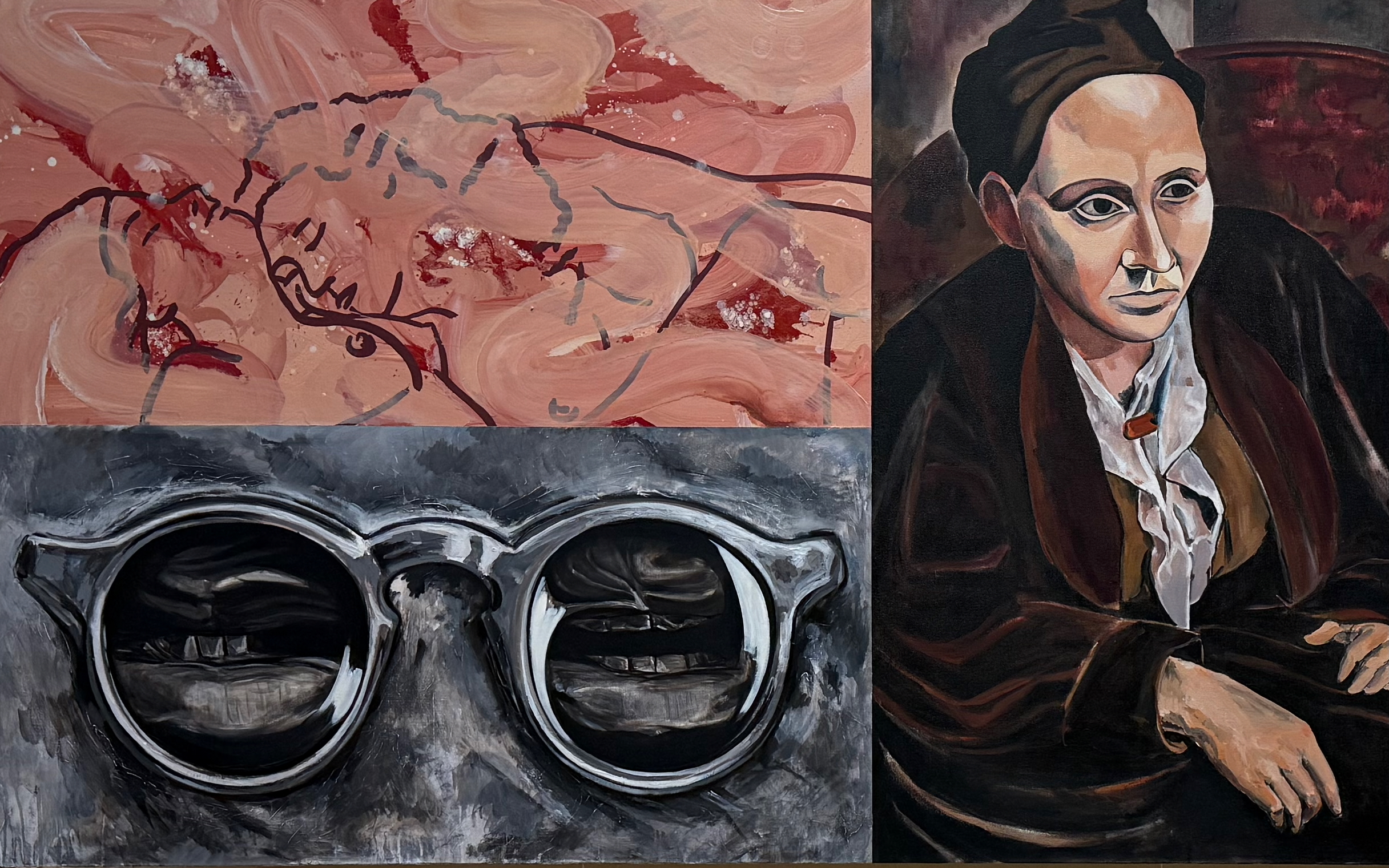
Kass’s work is most pointed when she focuses on lesbian or queer identity. Two of some of the most famous images of lesbians in Modern art are combined with a more fluid, all-over abstract style in “How Do I Look” (1991), along with Jasper Johns’s “The Critic Sees” (1961), in which Johns swaps a critic’s bespectacled eyes with mouths. The coital French women are drawn atop rosy swirls, as a serious Gertrude Stein looks out from her Picasso-painted portrait. Everything is rendered in high contrast, and the austere public persona of the Jewish-American intellectual dominates the portrayal of same-sex love. While Stein was openly lesbian at a time when prohibitions against being out existed, Johns has always been more coy about his own sexuality, even decades after Stein’s death. It also brings up the question: When we walk through a museum, do we even recognize queerness? This portrait of lesbian passion was painted by a straight man, yet it is the most identifiably LGBTQ+ image for the visitor. “Are we actually looking?” Kass asks, or, like Johns’s slam against critics, are we unable to see while we continue to speak?

Warhol, Pollock, Lichtenstein, Motherwell, Salle, Picasso, Johns, Courbet, and Walt Disney all receive their share of punches in the arena with Kass as she tears apart the pretentiousness of style and branding, while helping us focus on the unseen. Yet, there’s a deep sense of longing in the work, one that hints at the power dynamics of erasure.
In “Subject Matters” (1990), a letter “I” from an illuminated manuscript is central to the composition as a declaration of selfhood, though it also evokes Robert Morris’s renowned “I-Box” (1962) sculpture, where the capital I opens to reveal a nude Morris smiling at the viewer with a self-satisfied grin. The letter is flanked by the same semé of headless Lucy’s, and on the other side by Johns’s bespeckled critic, but this time stacked atop a pile of eyeglasses reminiscent of the haunting photograph from Auschwitz that she floods with the raking light found in Rembrandt’s “Three Crosses” (1653). The relationship between personhood and authorship is apparent. Who’s allowed to declare “I” openly and publicly? Who is allowed to obfuscate their identities in visual play while never rendering themselves vulnerable to dismissal or attacks?
This is the first time that a nearly complete sweep of the Art History Paintings is on view (minus one that currently hangs in the Dallas Museum of Art and another, a companion to “Emissions Control,” that couldn’t be added because of space limitations). Perhaps it’s human to want to belong, but Kass makes us feel like that urge might come at someone else’s expense. Is the artist a liberator or a performer dancing atop the labor, ideas, bodies, or histories of people who may be denied the opportunity to bask in the spotlight. I suspect the discomfort in the works is why they continue to resonate today, complete with their jocular humor, as we find no place to hide in the starkness of their message — they poke us into considering the in jokes that pack art history, and opening ourselves up to the question of whether we’re inside the temple of art ourselves and who we may be excluding in this revered space.

Deborah Kass: The Art History Paintings 1989-1992 continues at Salon 94 (3 East 89th Street, Upper East Side, Manhattan) through March 29. The exhibition was organized by the gallery.
[ad_2]
Source link
