


L. Scooter Morris creates paintings that are meant to be experienced rather than viewed from a single angle. Identifying herself as a sensory illusionist, she works between painting, sculpture, and installation to explore how perception changes through movement. Her Sculpted Paintings® combine acrylic with mixed media, producing surfaces that project outward through folds, ridges, embedded fragments, and accumulated layers. These physical details interact with the surrounding light, casting shadows and revealing new areas as the viewer changes position. From a distance, the compositions often read as spacious landscapes. A closer inspection reveals their intricate construction and material depth. This movement between overall image and individual detail is central to Morris’s practice. She wants the viewer to become physically involved in the act of looking. Rather than functioning as quiet background objects, her paintings establish a strong presence, creating experiences shaped by texture, atmosphere, history, and emotional response.
A Country Formed Through Land and Language
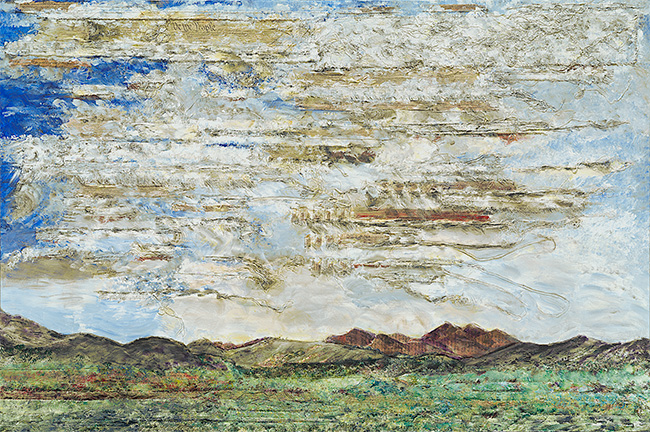
America Forever (2026) presents an expansive vision of the American landscape. Measuring 48 by 72 inches, the acrylic and mixed-media work extends horizontally, allowing the mountains and open sky to unfold across a broad field. A low range of peaks anchors the composition, while the atmosphere above becomes the painting’s most commanding element.
The sky is constructed from thick passages of white, blue, cream, gray, and subdued gold. These colors do not blend into a smooth atmospheric effect. Instead, they accumulate in visible layers, creating a surface that appears weathered, disrupted, and continually reshaped. The result brings several associations to mind: moving clouds, windblown terrain, geological formations, and aged material carrying the marks of time.
Morris allows the landscape to remain partly recognizable without describing it in a strictly realistic manner. The mountain range provides a clear horizon, but the sky moves toward abstraction. Its textures seem to expand beyond the limits of ordinary weather, becoming a visual record of energy, memory, and historical change.
Documents associated with the founding of the United States are incorporated into the work. Morris treats these texts as an essential component of the composition, reflecting their foundational role within the country itself. Written fragments travel through the painted surface, becoming visible in some areas before dissolving into the surrounding color and texture.
This integration prevents the documents from appearing like material added after the painting was completed. They belong to its construction. Paint covers, reveals, and alters them, establishing a relationship between written history and the land beneath it. The documents become part of the painting’s substance, joining physical geography with the ideas through which a nation defines itself.
The difficulty of reading every word also contributes to the work’s meaning. Language is present, but it cannot always be accessed immediately. Certain passages remain recognizable, while others are concealed beneath dense marks and pale washes. This uneven visibility recalls the ways historical ideas can be remembered, forgotten, debated, or understood differently across generations.
In Morris’s hands, history is not a distant account enclosed in an archive. It becomes something physical, with its own surface, weight, and vulnerability. By placing historic language within a contemporary landscape, she invites consideration of how founding ideals continue to exist within the present. They may remain influential, even when partially hidden beneath later experiences and interpretations.
The ground introduces a different kind of energy. Greens, dark browns, reds, and scattered points of brighter color create a densely worked foreground. Behind it, reddish peaks rise among darker mountain forms. These colors bring warmth to the lower section and offer a strong counterpoint to the pale, turbulent atmosphere above.
The mountains appear enduring, yet the surrounding surface refuses complete stillness. Every area contains evidence of motion and change. This contrast creates a sense that the land may persist across centuries while the society occupying it remains subject to continual revision.
The title America Forever suggests durability and belief, but Morris gives the phrase an open meaning. The painting does not offer a simple patriotic statement or a fixed definition of the country. Instead, it portrays America as a layered formation made from territory, written principles, collective memory, and ongoing experience. Its future depends partly on how that inheritance is seen and understood.
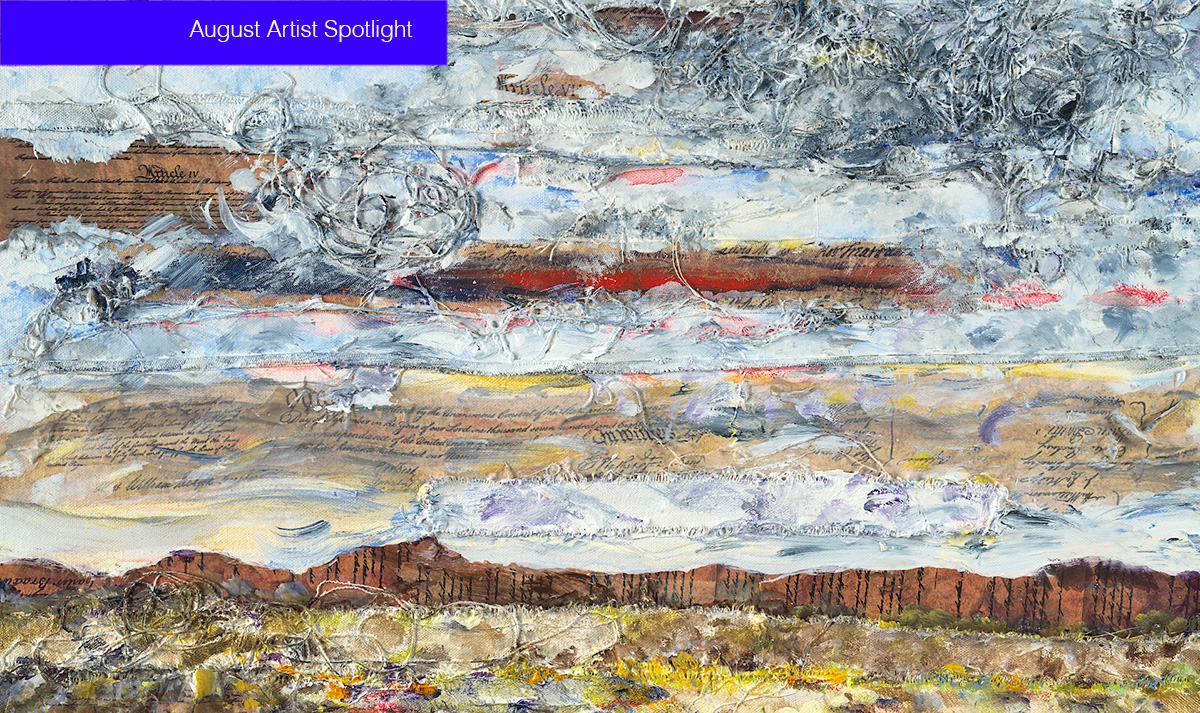
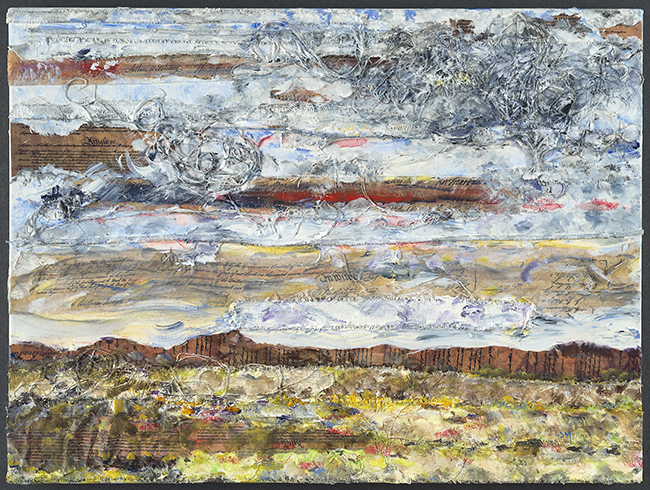
In What A Day (2026), Morris explores a related visual world on a smaller scale. The 20-by-26-inch acrylic and mixed-media composition feels condensed and intensely active. Strands of material twist across the upper section, while broad horizontal marks and passages of writing move through blue, gray, white, orange, red, and yellow.
The painting resembles a landscape overtaken by the emotional force of its atmosphere. A long ridge of red cliffs crosses the composition, giving the eye a stable line to follow. Below it, the foreground is broken into dense areas of earthy color, metallic reflections, and unexpected flashes of brightness. Above the cliffs, the sky gathers into tangled, almost sculptural masses.
These forms could be interpreted as clouds, wind, smoke, or fast-moving thoughts. They appear caught in motion, as if the painting has preserved a moment of unusual intensity. Rather than depicting one event, the surface gathers multiple sensations and fragments into a single compressed space.
The conversational title What A Day reinforces this sense of accumulated experience. It could express wonder, exhaustion, disbelief, or a combination of emotions. Morris does not determine which response is correct. The painting leaves viewers to bring their own memories to its restless textures and sudden changes in color.
Written elements appear throughout the work, connecting the immediacy of the day with the longer movement of history. The past is not placed behind the present. It remains woven into it, surfacing through fragments that coexist with the landscape and the painting’s contemporary materials.
Together, America Forever and What A Day demonstrate how Morris uses physical construction to deepen the act of viewing. The first opens outward with monumental breadth, while the second concentrates its activity within a closer, more personal format. In both, landscape and language are never fully settled.
Morris’s Sculpted Paintings® transform the canvas into a changing environment. Texture responds to light, documents merge with paint, and familiar landscapes shift toward abstraction. Her work asks viewers to slow down, move closer, and recognize that seeing is never entirely passive. Each painting unfolds through time, revealing itself gradually as both an image and a physical presence.
