



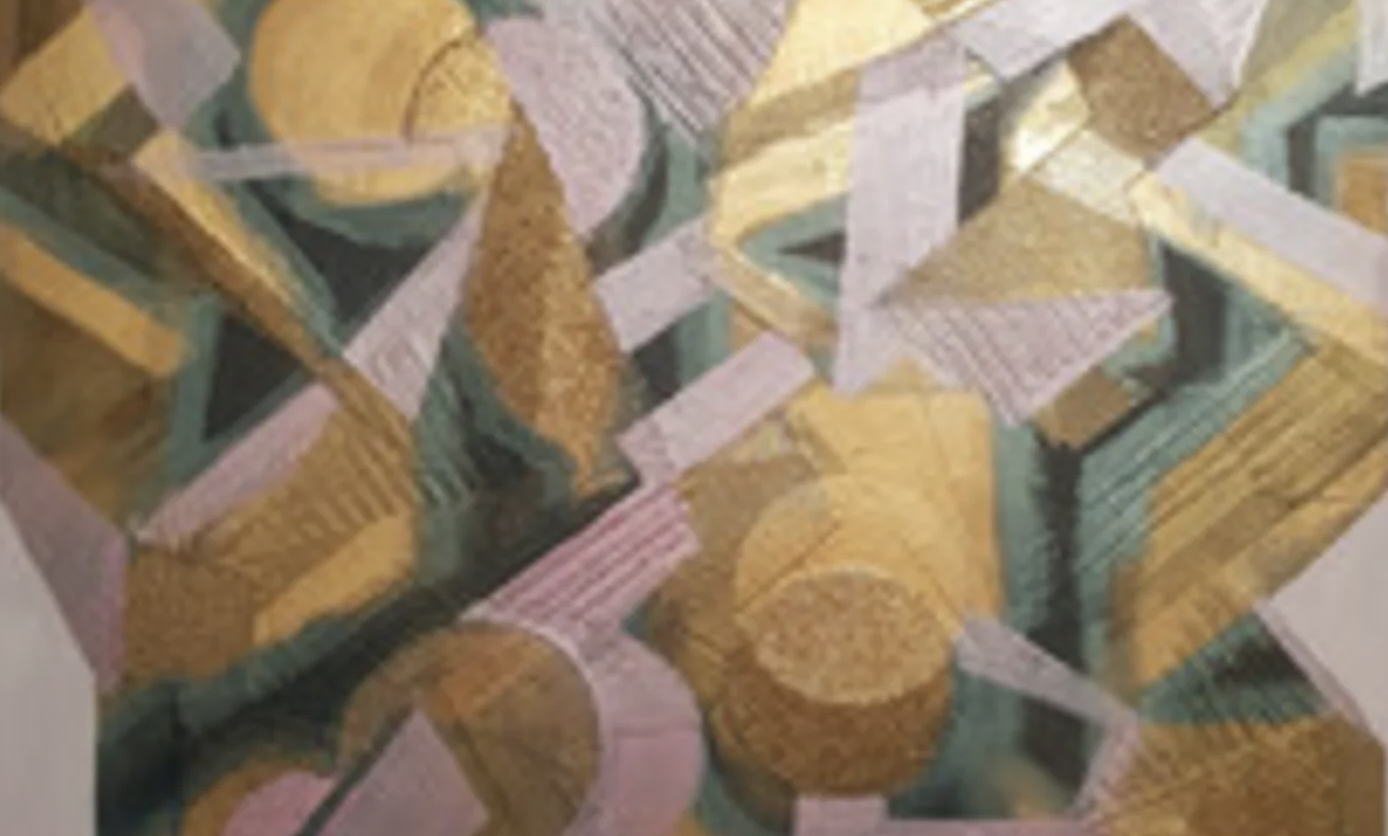
Born in East London, United Kingdom, Sara Twomey is a self-taught painter whose artistic practice is driven by an intuitive exploration of form, structure, and spatial relationships. Developing her visual language independently has allowed her to cultivate a distinctive abstract style that emphasizes geometry, movement, and layered compositions. Rather than depicting recognizable subjects, her paintings invite viewers into carefully constructed worlds where shapes, lines, and color interact to create rhythm and visual harmony.
Twomey’s growing recognition reflects the strength of her contemporary practice. In 2025, she was selected for the international online exhibition Light & Shadow, showcasing her work to a global audience. Her art will also be featured in Art Rising: 100 Global Talents 2026, highlighting emerging and established artists from around the world. Represented by Chrissy Moore Art Advisory, Twomey continues to expand her presence within the contemporary art scene through works that balance technical precision with expressive abstraction.
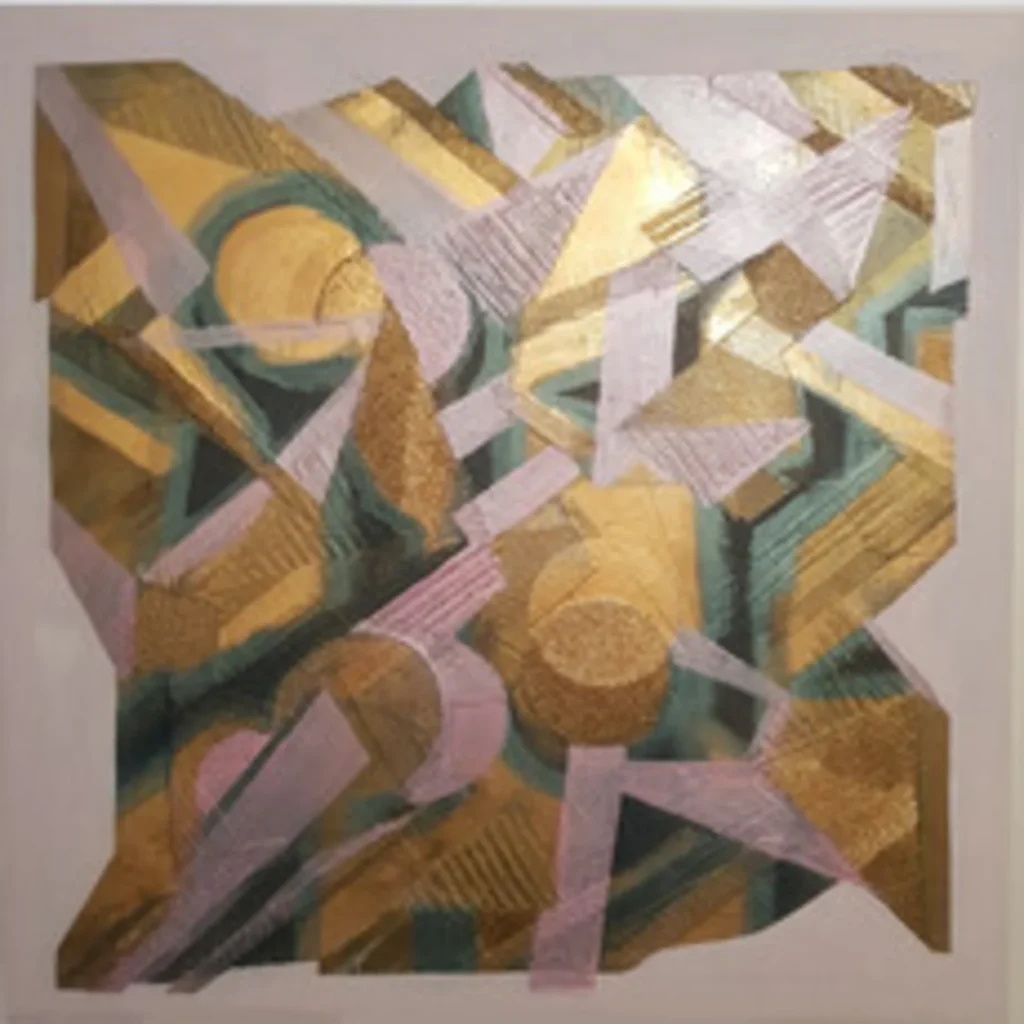
Building the Sun (2024)
In Building the Sun (2024), Sara Twomey constructs a compelling abstract composition that explores the relationship between architecture, geometry, and light. Rather than presenting a literal image of the sun, the painting imagines light as something assembled through intersecting structures, layered forms, and dynamic movement. The result is a work that feels simultaneously engineered and organic, where every geometric element contributes to a larger visual rhythm.
At first glance, the painting appears as an intricate network of overlapping circles, cylinders, triangular planes, and elongated beams. These forms intersect at varying angles, creating an illusion of depth while resisting traditional perspective. Instead of a fixed viewpoint, the composition encourages the eye to travel continuously across the canvas, discovering new relationships between shapes with every glance. This sense of perpetual movement gives the painting remarkable energy despite its carefully ordered construction.
Twomey’s use of geometry avoids the rigidity often associated with purely mathematical abstraction. Her circles seem to emerge from behind angular structures, while diagonal forms slice across the composition with confident precision. Cylindrical elements appear suspended between foreground and background, blurring the distinction between solid objects and imagined spaces. This ambiguity allows viewers to interpret the work freely, seeing architectural fragments, mechanical forms, celestial bodies, or entirely abstract relationships depending on their own perspective.
Color plays a significant role in shaping the painting’s atmosphere. Warm ochres, golden yellows, and earthy browns dominate the composition, evoking the glow of sunlight while maintaining a restrained, sophisticated palette. These warmer tones are balanced by muted teal greens and soft lavender hues that introduce cool contrasts without overwhelming the overall harmony. Rather than relying on bold color contrasts for impact, Twomey carefully orchestrates subtle tonal shifts that allow each geometric form to retain its individuality while remaining part of a unified whole.
One of the most striking aspects of Building the Sun is its treatment of light. Instead of painting light as an external source illuminating objects, Twomey embeds luminosity directly within the composition itself. Golden circular forms appear to radiate from inside the painting, while transparent overlapping planes create the impression that light is filtering through layered architectural structures. This approach transforms illumination into both a physical presence and a conceptual theme, suggesting that light is constructed through relationships rather than existing independently.
The painting also demonstrates Twomey’s sophisticated understanding of spatial complexity. Transparent layers allow multiple visual planes to coexist, producing an experience that changes as the viewer studies different sections of the work. Certain forms advance toward the picture plane while others recede into implied depth, creating an architectural environment that feels both expansive and compressed. This constant negotiation between flatness and dimensionality reflects one of the defining strengths of contemporary abstract painting, where illusion and surface remain in continuous dialogue.
Texture further enriches the composition. Fine linear patterns and carefully controlled brushwork animate many of the geometric elements, preventing large areas of color from becoming static. These delicate surface variations introduce rhythm without distracting from the painting’s overall clarity. The repeated use of parallel lines also reinforces the sense of construction suggested by the title, as though each element has been methodically assembled into a larger visual framework.
Although entirely abstract, Building the Sun possesses an emotional quality that extends beyond formal design. The upward movement of diagonal structures, combined with the warm radiance of its central circular forms, creates an atmosphere of optimism and growth. Rather than depicting a specific place or event, the painting communicates through balance, tension, and harmony, inviting viewers to experience abstract relationships on both intellectual and emotional levels.
The title itself encourages multiple interpretations. “Building the Sun” suggests an impossible yet imaginative act—the creation of something immense, life-giving, and universal. It transforms the sun from a distant celestial object into a symbol of creativity, construction, and human aspiration. Through this poetic title, Twomey reinforces the idea that abstraction is not detached from meaning but capable of expressing complex ideas through purely visual language.
Ultimately, Building the Sun exemplifies Sara Twomey’s ability to merge disciplined geometric composition with expressive artistic vision. By combining architectural precision, layered spatial construction, and luminous color harmonies, she creates a painting that rewards sustained observation. Each viewing reveals new alignments, hidden relationships, and shifting perceptions, demonstrating how abstraction can remain both intellectually engaging and visually captivating. The work stands as a thoughtful exploration of structure, light, and imagination, reflecting an artist who continues to refine a distinctive and sophisticated contemporary voice.
