



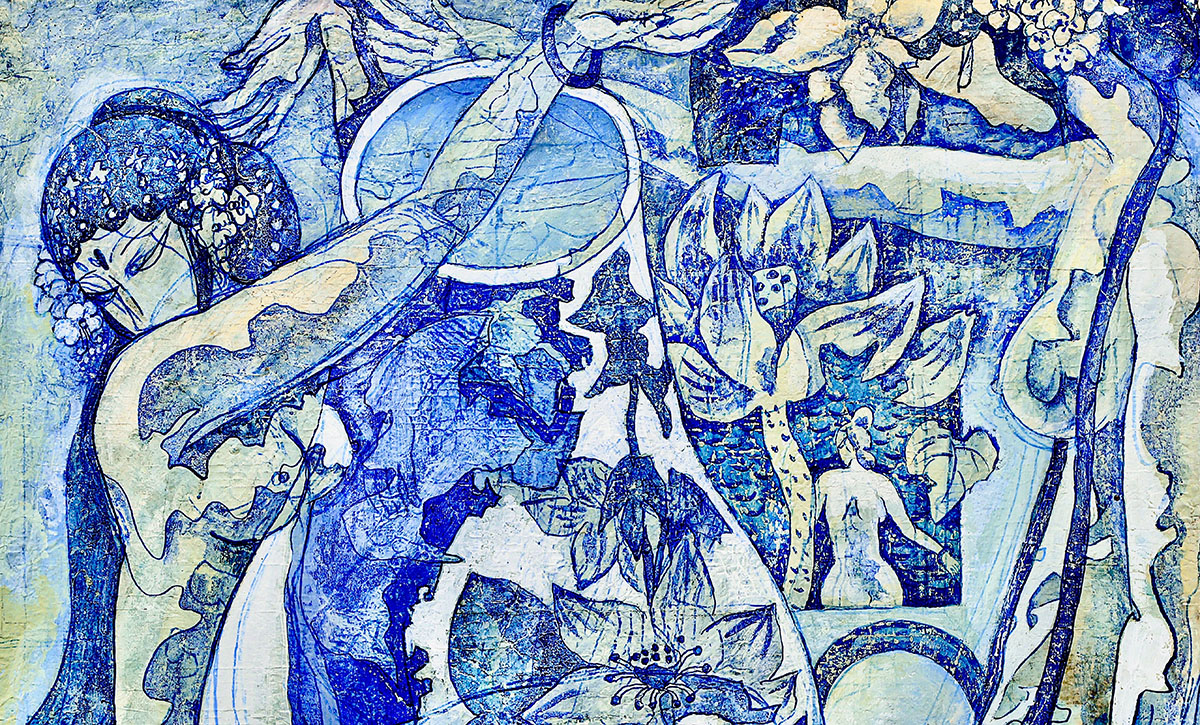
Huang YI Min came of age during a period of immense cultural and political transformation in China, experiences that continue to shape the way she interprets memory, history, and personal expression. Her paintings are not simply observations of the visible world, but layered reflections where emotion, lived experience, and imagination intersect. Over the years, Huang has developed a visual language rooted in careful observation—not only of physical environments, but also of the psychological atmosphere surrounding everyday life and social change.
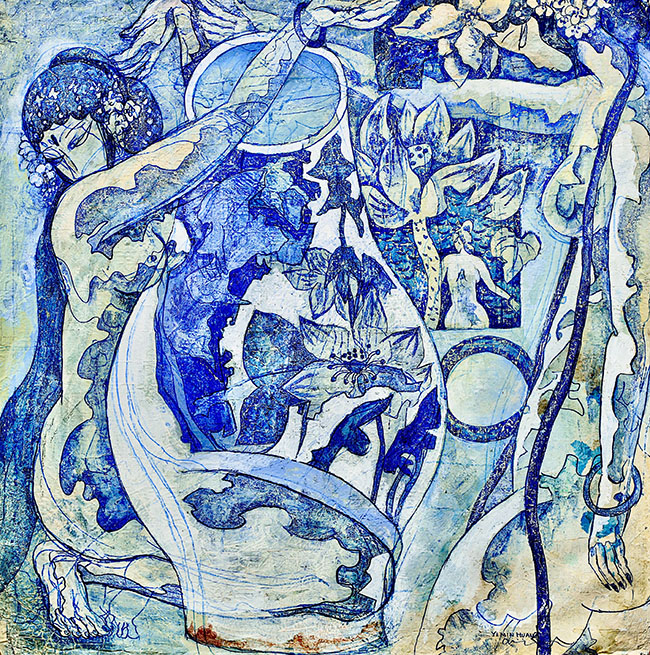
After studying fine arts at Beijing Normal University, Huang continued expanding her artistic direction through years of practice and reflection. In 1997, she relocated to the United States, carrying with her both academic training and the visual memory of the country she had left behind. That transition between cultures became an important part of her work. Her paintings often move between Eastern and Western references, between history and imagination, and between external reality and private thought. Instead of separating these influences, Huang allows them to merge naturally within the same visual space. The result is work that feels intimate yet historical, personal yet culturally resonant, grounded in tradition while open to reinterpretation.
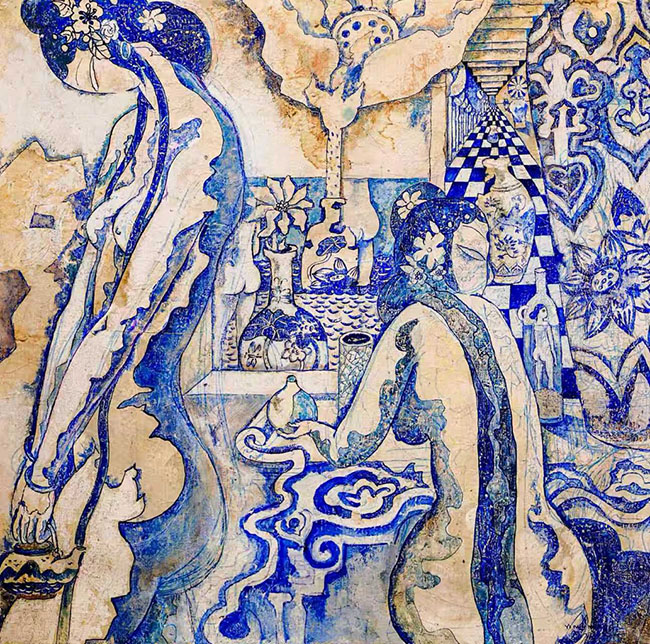
One of Huang’s most compelling bodies of work is the series Blue and White Life, created in New York between 2003 and 2006. Executed in mixed media on paper, the series explores the relationship between traditional Chinese blue-and-white porcelain and the female body. Through this concept, Huang examines how beauty, femininity, and cultural identity have been historically intertwined within Chinese visual culture.
The inspiration behind the series comes from an observation that Chinese attitudes toward the human body differ from many Western traditions of representation. In Western art history, the female nude has often been directly displayed and anatomically emphasized. Huang instead points toward a subtler tradition within Chinese aesthetics, where appreciation of the female form is expressed indirectly through objects, symbolism, and suggestion. In Blue and White Life, porcelain becomes a metaphorical extension of the body itself. The curves of ceramic vases echo the curves of the female figure, creating an association that feels both sensual and restrained.
Rather than presenting the body explicitly, Huang allows it to emerge through shape, contour, and visual rhythm. The porcelain vase becomes more than an object; it transforms into a symbolic presence carrying emotional and cultural meaning. This relationship between vessel and body reflects centuries of Chinese artistic sensibility, where beauty is often conveyed through implication rather than declaration. Huang’s interpretation feels contemporary while remaining deeply connected to historical forms.
The blue-and-white porcelain motif also carries strong cultural associations. Porcelain occupies an important place within Chinese history, representing refinement, craftsmanship, domestic life, and cultural continuity. By pairing this imagery with the female form, Huang bridges personal identity with collective memory. The paintings suggest that the body, much like porcelain, can contain history, fragility, endurance, and transformation all at once.
Visually, the series moves between figuration and abstraction. Some compositions appear dreamlike, with bodies dissolving into decorative patterns and flowing blue forms. Others feel more grounded, where the structure of porcelain vessels becomes immediately recognizable. Huang uses layered textures, fluid line work, and soft tonal transitions to create compositions that feel suspended between memory and imagination. The surfaces often resemble fragments recalled from another time, as though the paintings themselves are shaped by recollection rather than direct observation.
There is also a quiet tension running through the work. Porcelain is beautiful but fragile. The female figure in Huang’s paintings carries a similar sense of delicacy, though never weakness. Instead, the works suggest resilience beneath refinement. The body and the porcelain object both become carriers of experience, surviving across generations while absorbing cultural expectations and emotional histories.
Living in New York during the creation of this series added another layer to Huang’s perspective. Distance from China appears to have intensified her reflection on Chinese identity and visual tradition. Rather than reproducing cultural symbols nostalgically, she reexamines them through the lens of migration and memory. The paintings therefore operate not only as aesthetic studies, but also as meditations on displacement, continuity, and belonging.
What makes Blue and White Life particularly engaging is its ability to communicate through atmosphere rather than direct narrative. Huang does not force interpretation or symbolism onto the viewer. Instead, she creates visual spaces where associations emerge gradually. The works invite contemplation, encouraging viewers to notice subtle relationships between form, history, and emotion.
Throughout her career, Huang YI Min has continued to blur the boundary between reality and imagination, personal memory and cultural history. In Blue and White Life, that balance becomes especially refined. The series transforms porcelain into a language of the body and transforms the body into a vessel of cultural remembrance. Through quiet imagery and layered symbolism, Huang creates paintings that feel deeply reflective, carrying both the intimacy of personal thought and the broader resonance of cultural memory.
