



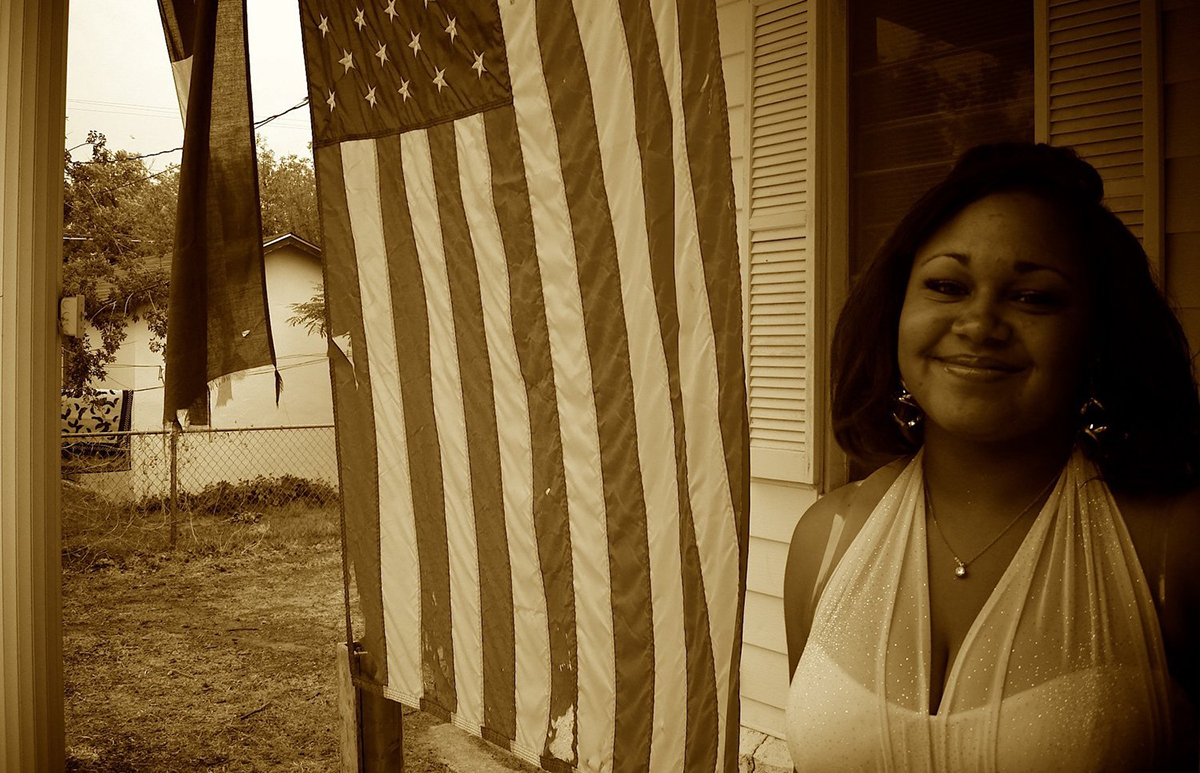
Camille Ross is an American photographer born in 1964 in San Francisco, California. Growing up between the radical, progressive environment of Berkeley in the 1970s and the rural South of Mississippi, Ross experienced two worlds that couldn’t have been more different. Her biracial heritage, with Cherokee ancestry, added another layer to her understanding of identity and place. These experiences would later shape her work as a photographer, pushing her to explore issues of segregation, race, and cultural identity.

Ross’s curiosity about the world around her led her to pursue higher education, earning a degree from Goddard College and an MFA from Cranbrook Academy of Art in 1991. Along the way, her work caught the attention of several organizations, including the New Mexico Council on Photography, the Tucson Council on the Arts, and the International Women’s Foundation of Marfa, Texas. She received a one-year fellowship from the latter, which played a pivotal role in her ongoing exploration of marginalized communities.

Ross’s photography has always been about documenting lives that are often overlooked. Her interest in social justice and cultural identity runs deep, and her images are as much about understanding the human condition as they are about aesthetic composition. For Ross, photography is a tool for storytelling, a way to preserve and share experiences that might otherwise be forgotten.
During her fellowship at the International Women’s Foundation of Marfa, Ross focused on capturing the lives of those native to the small West Texas town. Marfa has become an artist’s haven over the years, known for its connection to Donald Judd and his minimalist installations scattered across the desert landscape. But for Ross, Marfa was more than just an art-world curiosity. It was a place where culture, class, and history intersected in complex ways.

Marfa’s reputation as an art destination started with two key moments: the filming of Giant—the epic movie starring Rock Hudson, Elizabeth Taylor, and James Dean—and the establishment of Judd’s installations, massive concrete boxes set against the seemingly endless West Texas desert. Judd’s work drew art enthusiasts and hipsters from New York and Brooklyn who flocked to the town looking for inspiration or perhaps an escape from urban life.

But Marfa was never just a blank canvas. The town had a long-standing community of ranchers, Latino families, and white working-class folks who had lived there for generations. Ross became fascinated by this divide—between the people who had always called Marfa home and the outsiders who came chasing art-world clout.
Her photography during her time in Marfa focused on the locals—ranchers, families of folk musicians, and young couples attending fairs. She documented poverty and resilience, wealth and isolation, and the way these contrasts played out against the vast, open landscape of West Texas. What she found was a community defined by its roots, often at odds with the transplants who seemed more interested in the town’s aesthetic appeal than its cultural reality.
Ross saw the new wave of transplants as outsiders who rarely, if ever, engaged with the people who lived in Marfa before it became an art destination. The wealth disparity between those who moved to Marfa for the art scene and those who were born and raised there was stark. To Ross, it felt like two different worlds coexisting but rarely intersecting. Her photographs aimed to capture that tension, focusing on the beauty and resilience of the locals rather than the curated aesthetics that drew people to Marfa in the first place.
Despite her frustration with the art tourists who parachuted into Marfa and left just as quickly, Ross found herself captivated by the landscape. The sparse, flat terrain stretched endlessly, framed by a sky so blue it seemed otherworldly. Marfa’s minimalist beauty was undeniable, even if it sometimes felt co-opted by those who didn’t understand the place beyond its surface appeal.
During her residency, Ross spent time with a group known as The End Of The Earth Gang. A mix of locals and transplants, they would ride their bikes through town and out into the desert, exploring the land that so many found irresistible. There was a sense of freedom in those rides, a break from the constraints of identity and expectation. For Ross, it was a rare moment of unity, a glimpse of what Marfa could be if people were more willing to see past their own biases.
Ross’s work from this period remains focused on the people of Marfa who call it home. Her images highlight the quiet beauty of daily life, the relationships that form despite cultural and economic divides. Her photography isn’t about making statements—it’s about asking questions. What does it mean to belong? Who gets to define a place’s identity? And how do we reconcile the past with the present?
Camille Ross continues to document marginalized lives, using her camera as a tool for understanding. Whether she’s capturing the high desert landscapes of West Texas or the segregated communities of her childhood, her work remains rooted in a desire to make the unseen visible.
