


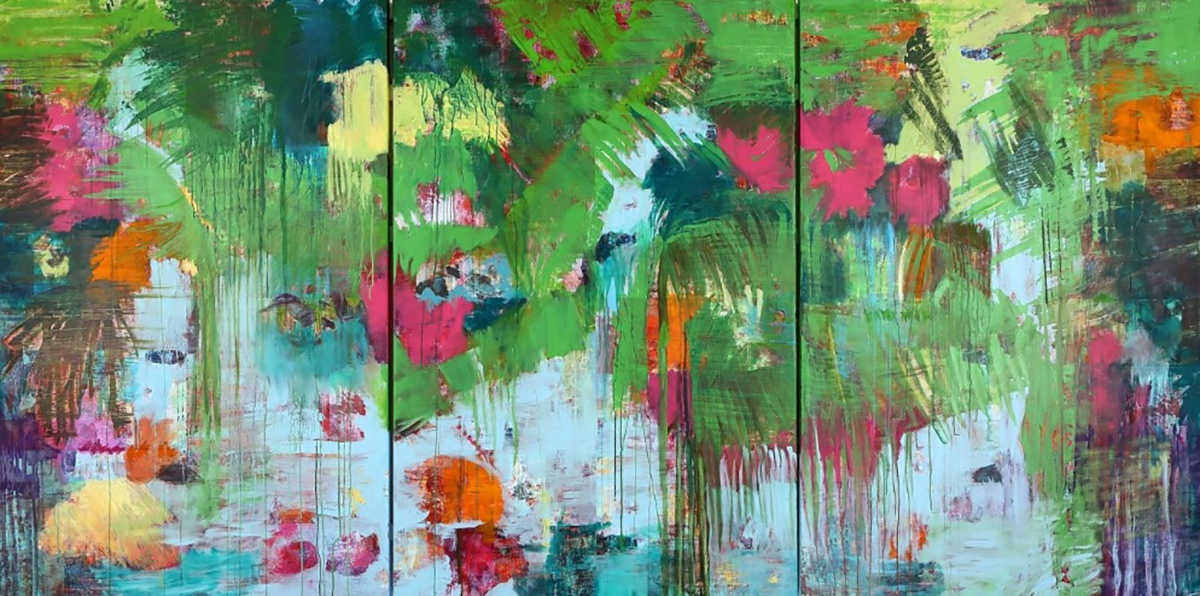
Sonja Kalb creates abstract paintings shaped by the changing rhythms, structures and energies of nature. Born in Stuttgart and now based in Düsseldorf, Germany, she earned a Dipl. Ing. degree in Textile and Applied Design. Her education developed her understanding of materials, patterns, surfaces and composition, all of which continue to influence her artistic practice. Kalb began by exploring photography, natural subjects, portraiture and the human figure before turning toward collage and abstraction. This progression allowed her to move beyond recognizable imagery and develop a more intuitive language based on colour, texture, movement and atmosphere. Her work has appeared internationally in museums, galleries, art associations and art fairs across Germany, Italy, France, the United Kingdom, the United States, Japan and South Korea. This September, Kalb’s paintings will be shown with sculptures by Kurt Grimm in MEET THE ARTISTS: Sonja Kalb & Kurt Grimm. The exhibition opens Friday, September 18, from 6 to 8 p.m.
Translating Nature into Abstraction
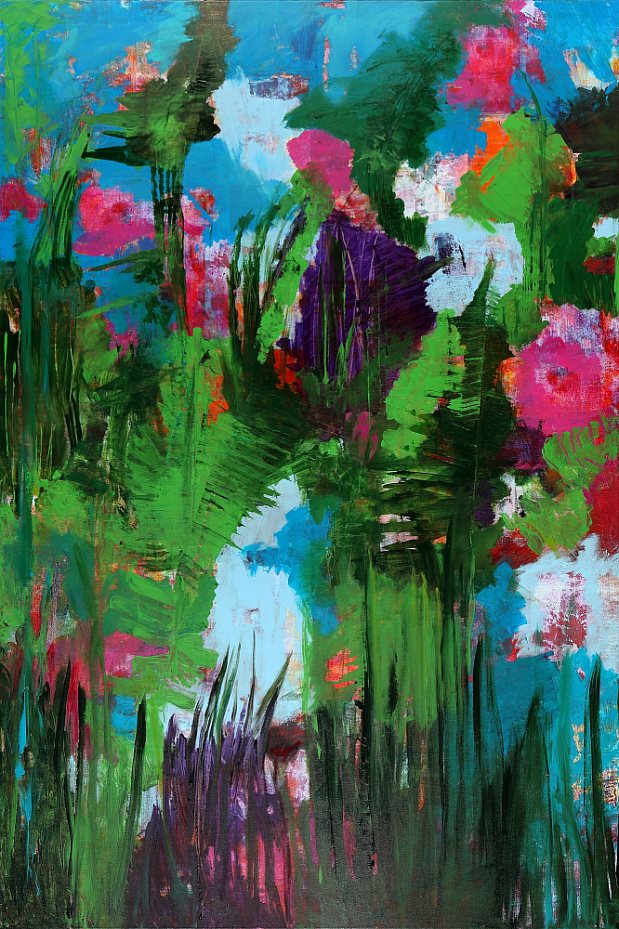
Nature provides an enduring foundation for Sonja Kalb’s work, although her paintings are not intended to portray it literally. Rather than reproducing a particular flower, landscape or body of water, she draws upon the sensations and forces found throughout the natural environment. Changing light, organic growth, seasonal cycles and the gradual transformation of living forms all contribute to the development of her compositions.
Kalb reduces these observations to their visual and emotional essence. Through abstraction, recognizable subjects give way to gestures, colours and shapes that suggest nature without defining it. A sweeping line may evoke the direction of wind, while a cluster of forms might recall foliage or a landscape viewed from a distance. These associations remain deliberately open, giving viewers the freedom to interpret the work through their own memories and experiences.
Transformation appears to take place directly across the surfaces of her paintings. Forms emerge and disappear, colours move into one another and painted gestures create a feeling of continual motion. Some areas are dense and highly concentrated, while others remain transparent, quiet or spacious. The contrast between these passages creates a visual rhythm that shifts between intensity and calm.
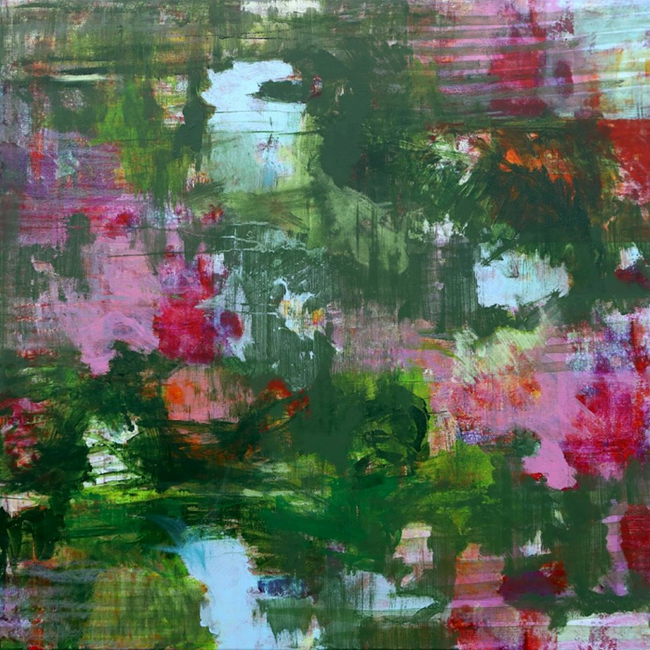
Rather than presenting a frozen image, Kalb’s paintings often suggest an environment still in the process of becoming. Nothing feels entirely permanent. Shapes appear to change as the viewer looks at them, while layers of colour reveal different relationships depending on distance, lighting and perspective.
Layering is fundamental to this experience. Kalb builds her compositions gradually, allowing each stage to influence what follows. Paint may be added, covered, scraped back or partially removed. Earlier colours sometimes remain visible beneath later applications, creating fragments that offer glimpses into the history of the painting.
These concealed and exposed layers give the work a sense of time. The finished image does not erase the process that created it. Instead, traces of previous choices remain present: an interrupted line, the edge of an earlier form or a transparent area through which another colour can still be seen. Each detail becomes part of the painting’s visual memory.
Kalb does not always begin with a predetermined outcome. Her method depends upon an active exchange between the artist and the evolving surface. One colour may suggest the placement of another, while an unexpected mark can redirect the entire composition. The painting develops through observation, adjustment and experimentation.
Although intuition guides much of this process, the final results are not uncontrolled. Kalb carefully considers the balance between movement and stillness, complexity and openness. Every gesture must function within the composition as a whole. The work is complete when its different elements establish a convincing visual relationship.
Her background in Textile and Applied Design remains evident in the way she approaches materials and structure. Textile design requires sensitivity to repetition, pattern, texture and the interaction of separate elements. Kalb applies this knowledge to painting, using rhythm and surface variation to organize compositions that may initially appear spontaneous.
Structure, however, never becomes restrictive. Ordered passages are interrupted by expressive marks, while repeated shapes may be challenged by a sudden change in scale or direction. Precise decisions coexist with accidental effects. This exchange between control and freedom gives the paintings both stability and vitality.
Colour is among the most important elements in Kalb’s practice. It does more than create visual appeal or identify a subject. Colour carries weight, energy and emotional force. Saturated tones can push forward, while darker or more translucent areas appear to recede. Contrasting colours generate tension, whereas related tones may create gradual, meditative transitions.
The emotional atmosphere of each painting develops from these relationships. Certain combinations can feel energetic and expansive; others suggest silence, reflection or uncertainty. Kalb leaves these responses open rather than attaching the work to a single narrative. What one viewer experiences as harmony may feel mysterious or unsettled to another.
Perception can also change over time. A painting viewed quickly may initially be understood through its dominant colours and largest gestures. With longer observation, quieter details begin to emerge. Subtle textures, partially hidden forms and variations in transparency reveal a more complex experience beneath the immediate impact of the composition.
Kalb frequently works in series, allowing one subject or visual question to unfold across several paintings. Each work offers a different response through changes in palette, gesture, surface and spatial organization. This approach enables her to investigate an idea without forcing it into one definitive conclusion.
She may also return to a theme after several years. Time brings new experiences, new materials and different ways of seeing. When Kalb revisits an earlier subject, she does not simply repeat its original appearance. Instead, she discovers how the idea has changed and what new possibilities it can offer.
This continuing process reflects the natural cycles that inspire her work. Themes disappear and return, familiar forms take on different meanings and previous ideas become the foundation for new discoveries. Each painting belongs to a wider artistic conversation that continues to develop throughout her practice.
The physical act of painting is always visible. Broad movements, textured surfaces and scraped passages preserve the actions that occurred in the studio. The pressure of a brush, the direction of a mark and the removal of a layer all become part of the finished image. These qualities give the paintings a strong material presence.
Such physicality becomes particularly significant at a time when art is frequently encountered through small, quickly viewed digital images. Kalb’s paintings encourage a slower and more direct experience. From across a room, the viewer may notice the overall flow of colour and movement. Up close, the work reveals delicate shifts in texture, overlapping edges and fragments of underlying paint.
Her compositions do not ask viewers to discover one correct meaning. Instead, they create spaces for contemplation, personal association and sensory engagement. Opposing qualities can exist together within them: spontaneity and order, transparency and density, stillness and movement.
Through this balance, Sonja Kalb transforms her observations of nature into a distinctive abstract language. Her paintings do not reproduce the visible world. They express its continual movement, its changing energies and the subtle passage between appearance and disappearance.
Sonja Kalb’s Upcoming September Exhibition
MEET THE ARTISTS: Sonja Kalb & Kurt Grimm
Opening: Friday, September 18, from 6 to 8 p.m.
Meet the Artists: Both artists will be present for an engaging evening of conversation.
