



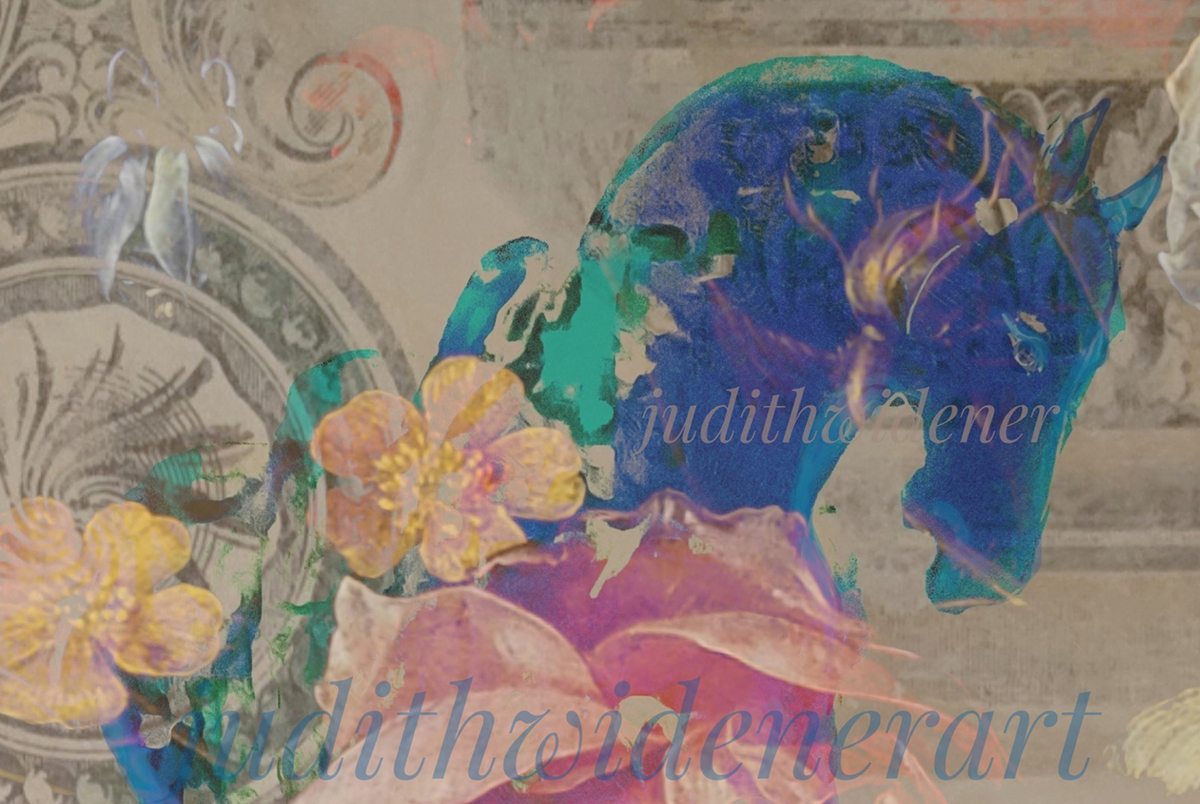
Judy Widener is an American artist whose relationship with art began at the age of five. Since then, brushes and color have remained essential tools through which she interprets the world and gives visual form to imagination, memory, and emotion. Her work moves freely across subjects, finding beauty and expressive possibility in both animals and people. Rather than limiting herself to a single visual language, Widener draws upon a broad range of experiences and materials, allowing each composition to develop its own character. Her approach brings recognizable imagery together with layered surfaces, unexpected colors, and decorative details. The resulting works are not merely representations of their subjects. They are atmospheric encounters shaped by feeling and personal reflection. Through this openness, Widener transforms the canvas into a space where different moments, images, and impressions can meet, overlap, and continue evolving.
A Lyrical Passage Through Time
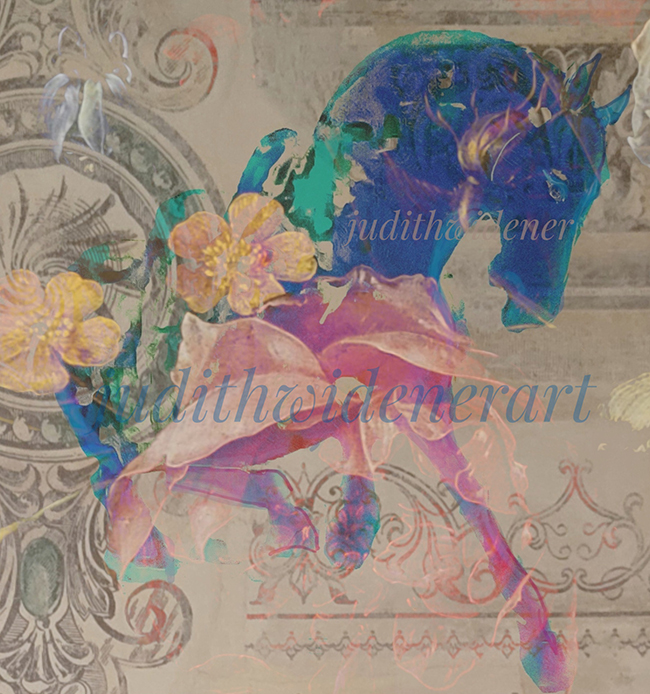
In this untitled multimedia work on canvas, measuring 22 by 20 inches, Judy Widener uses overlay and color to suggest different eras and the gradual passage of time. The composition brings together the striking figure of a horse, delicate flowers, ornamental patterns, fragments of architectural imagery, and faded decorative elements. These separate components occupy the same visual space like memories resurfacing simultaneously. Rather than arranging them into a conventional narrative, Widener allows them to overlap, creating a poetic relationship between past and present.
The horse immediately commands attention. Its head and curved neck are formed through vivid shades of deep blue, turquoise, violet, and green. These intense colors distinguish the animal from the muted beige and grey background while also giving it an imaginative, almost dreamlike presence. Widener does not present the horse with strict realism. Its body appears to dissolve into the layers around it, moving between clarity and transparency. Certain areas are sharply defined, while others seem incomplete or partially erased. This shifting treatment suggests that the horse may belong as much to memory as to the physical world.
The animal’s lowered head contributes a feeling of gentleness and quiet reflection. There is grace in the curve of its neck and restraint in its posture. It does not appear restless or forceful. Instead, the horse seems suspended within a private moment, surrounded by visual traces of other places and periods. Its contemplative pose slows the viewer’s attention and encourages a more careful exploration of the composition.
Across the horse’s body, translucent passages of pink, coral, red, and violet introduce warmth and movement. The colors flow through the image rather than remaining contained within precise outlines. This layered application makes the figure feel alive and constantly changing. Blue and turquoise may suggest distance, intuition, or contemplation, while the warmer tones bring vitality and emotional immediacy. Their interaction creates a visual rhythm that supports Widener’s desire for the piece to feel lyrical.
Flowers appear beside and across the horse, further enriching this rhythm. Their soft yellow and peach petals provide moments of light against the cooler colors of the animal. Flowers often evoke beauty, renewal, and the brief nature of life. Within a work concerned with time, their presence carries particular meaning. They bloom brightly, yet their delicacy reminds us that every stage of life is temporary. By combining the lasting symbolic strength of the horse with the fragility of flowers, Widener creates a subtle dialogue between endurance and change.
The surrounding imagery deepens the work’s sense of history. Circular forms resembling architectural medallions or fragments of old illustrations emerge from the background. Scrollwork, patterned borders, and faded ornamental lines recall aged wallpaper, textiles, archival documents, or decorative objects preserved across generations. These elements are never presented with complete clarity. They fade into one another and are partially concealed, as though time has worn away parts of their original appearance.
Overlay is therefore more than a formal technique in this composition. It becomes Widener’s way of expressing how time is experienced. The past is not placed neatly behind the present. Instead, earlier moments remain visible beneath current ones, shaping how new experiences are understood. Some memories are vivid, while others survive only as fragments. The artist’s layered surface reflects this uneven process of remembering.
The relatively restrained background allows the brighter colors to rise forward, but it also gives the work an aged atmosphere. Its weathered neutrals suggest distance and accumulated time. Against this setting, the horse appears almost like an apparition entering from another era. Yet the colorful figure is firmly integrated into the decorative field, linking the contemporary energy of the palette with the historical qualities of the surrounding imagery.
Widener’s composition does not follow a rigid structure. The viewer’s eye travels in curved paths, moving from the horse’s bowed head to the blossoms, through the flowing body, and into the ornamental details below. Repeated curves connect the animal, flowers, and decorative patterns. This continuous movement gives the artwork its musical quality. Like a melody, it develops through repetition, variation, pauses, and shifts in intensity.
Through multimedia, overlay, and expressive color, Judy Widener creates a work that feels both intimate and expansive. It speaks about time without illustrating one specific event. Instead, it presents time as a layered emotional experience in which beauty, memory, history, and imagination remain intertwined. The horse becomes a guide through these layers, carrying the viewer into a place where images from different eras can coexist. In this visually lyrical composition, the past does not disappear. It continues to move beneath the surface, quietly shaping the present.
