

Marco Bedoni creates vivid, imaginative artworks inspired by visions of parallel worlds. Rather than depicting ordinary reality as it appears, he constructs alternative spaces populated by fragmented faces, watchful eyes, hybrid figures, and unfamiliar beings. These characters gather closely together, overlapping and merging until their individual identities become part of a larger visual presence. Bright colors and dark outlines give the compositions an immediate energy, while the unusual arrangements invite viewers to search for connections among the figures. Bedoni’s worlds feel distant yet strangely recognizable. They suggest communities, memories, dreams, and encounters taking place beyond the boundaries of everyday experience. His art does not offer a fixed explanation of these mysterious scenes. Instead, it opens a passage into a personal universe where human features can be rearranged, identities can shift, and several realities appear to exist at once.
Faces from Another Reality
The human face is central to Bedoni’s visual language. Across the artworks, faces appear in groups rather than as isolated portraits. They lean into one another, occupy the same space, and sometimes become difficult to separate. A profile may emerge from behind another figure, while an eye appears in an unexpected position. These arrangements create the impression that the subjects belong to a shared organism or collective consciousness.
The faces are simplified but expressive. Their wide eyes, angular noses, small mouths, and sharply defined profiles communicate curiosity, surprise, calm, uncertainty, and quiet observation. Some figures look directly toward the viewer, while others turn away or stare beyond the edges of the composition. This variety of gazes makes the scenes feel active, as if several conversations and thoughts are unfolding simultaneously.
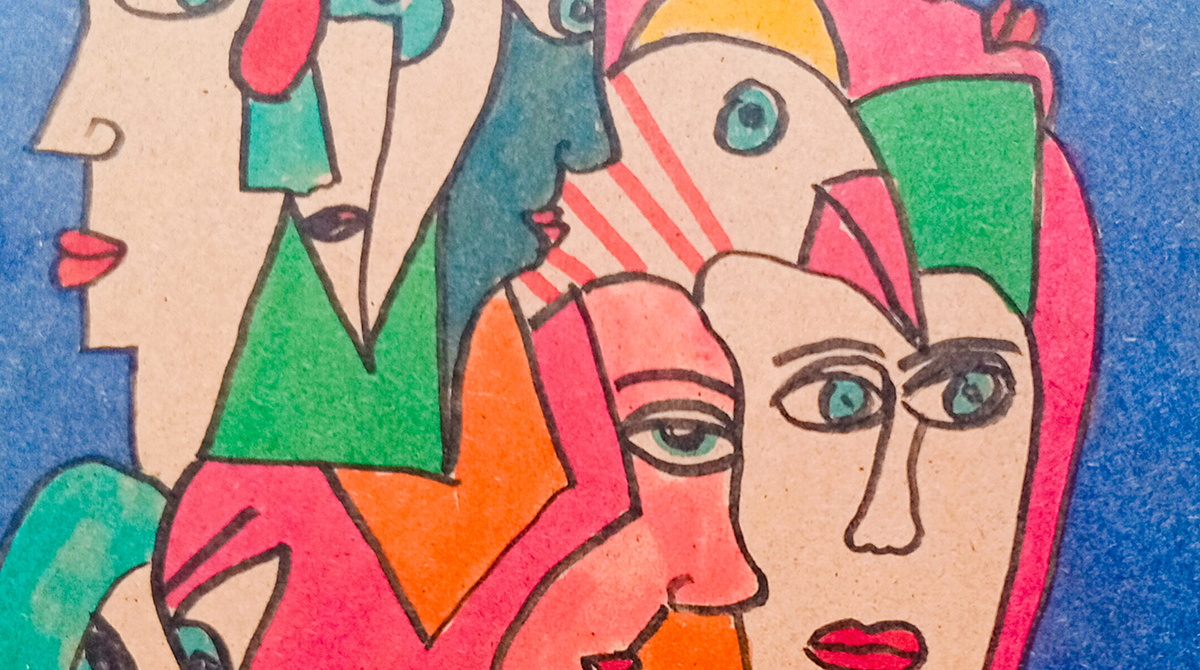
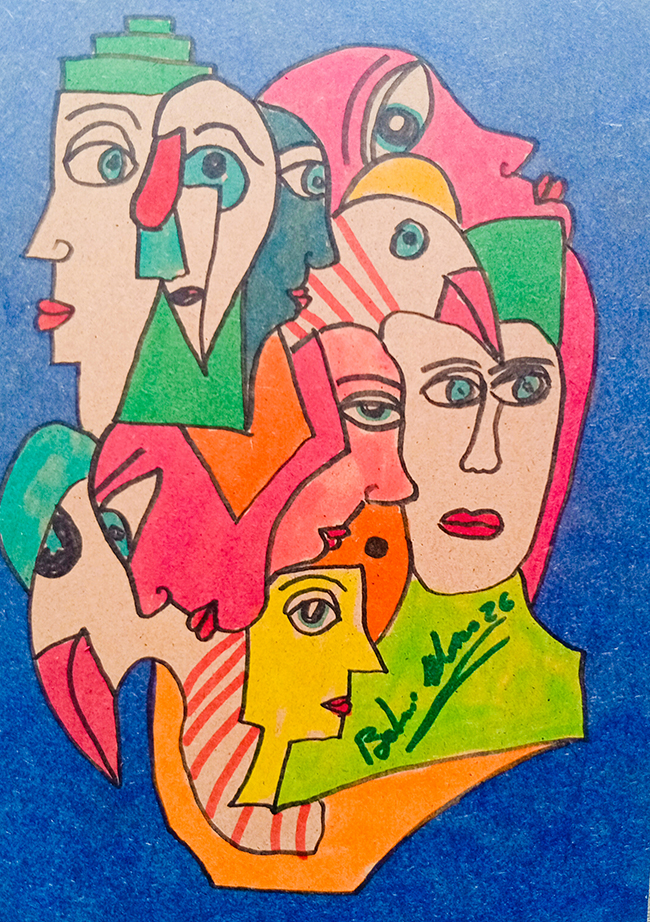
One work presents an especially dense gathering of figures against a deep blue background. Faces in pink, green, yellow, orange, and cream overlap inside a compact form. Individual bodies are largely absent, allowing the heads and facial features to become the entire subject. The composition can be understood as a crowd, a family, a gathering of spirits, or different sides of a single personality. Bedoni leaves these possibilities open.
Color plays an essential role in shaping this alternative reality. Bright red, turquoise, green, orange, pink, and blue appear in bold combinations. These colors are not used to describe natural skin tones or realistic environments. Instead, they separate the figures, establish emotional contrasts, and give each presence its own visual identity. A red face may sit beside a blue one, while striped areas introduce movement between larger sections of solid color.
In another composition, a group of mask-like faces is enclosed within a dark central shape and surrounded by a brilliant red field. The figures are tightly arranged, almost as if they have gathered for a communal portrait. Their expressions range from cheerful to serious and contemplative. Although each character is visually distinct, the surrounding shape connects them. The result suggests unity without uniformity: many different identities occupying a single world.
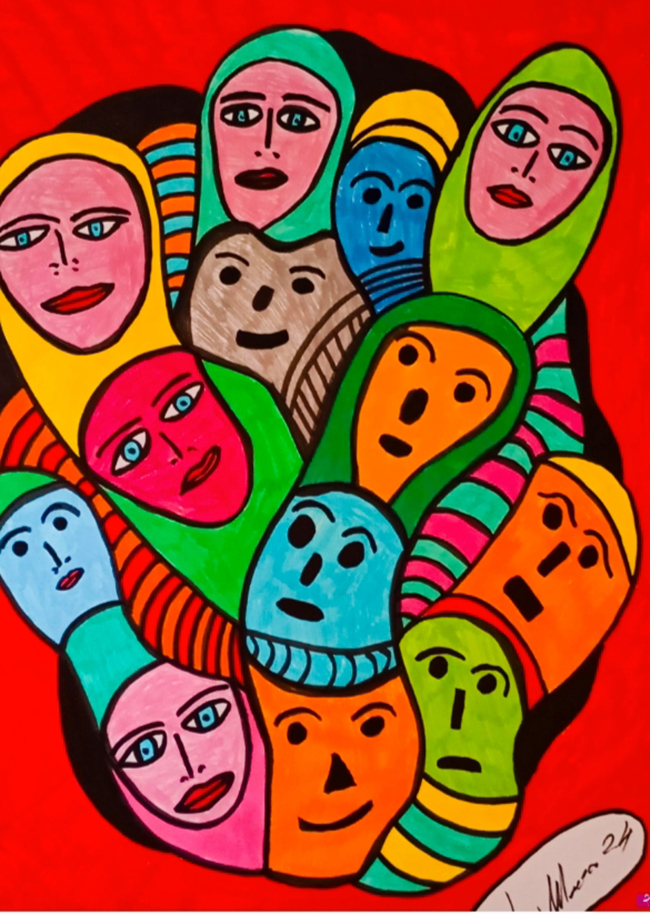
Bedoni’s use of strong outlines adds clarity to these crowded arrangements. The dark contours define each face while also creating a network of lines across the surface. These lines guide the eye from one figure to another, transforming the composition into a visual map. Curved outlines soften the angular facial features, while repeated stripes, eyes, and mouth shapes establish rhythm.
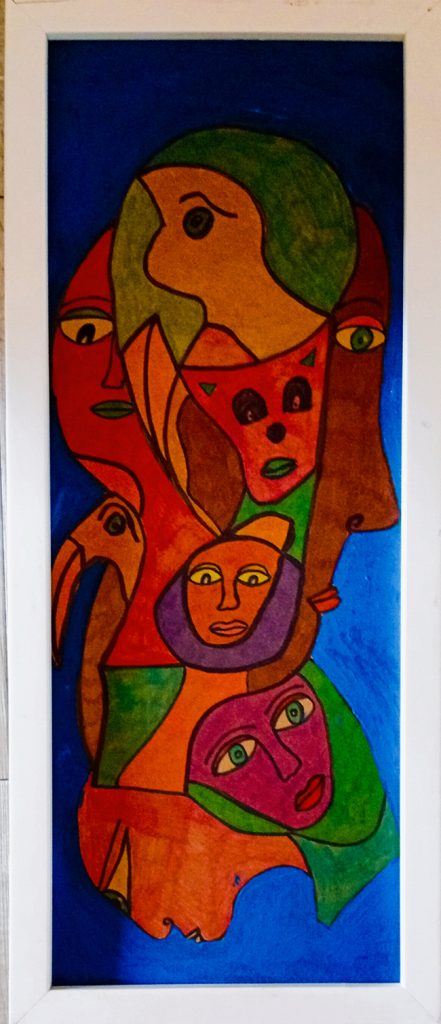
The tallest of the presented works expands this approach vertically. Human faces are joined by forms resembling birds, masks, or creatures from an imagined mythology. One large face becomes the foundation for several smaller beings, creating a layered structure that feels almost architectural. The composition appears to contain multiple levels of existence, with each figure occupying a different position within the same mysterious environment.
The presence of animal-like forms broadens Bedoni’s imagined universe. Human and nonhuman identities coexist without a clear division between them. A bird may overlap with a face, while another creature appears to emerge from within a larger figure. These combinations suggest transformation and the possibility that life in Bedoni’s parallel worlds follows unfamiliar rules. Identity is flexible, and the boundaries between person, animal, mask, and spirit remain uncertain.
Despite their otherworldly inspiration, the artworks also carry a strong sense of social connection. The figures rarely appear alone. They gather, touch, overlap, and share the limited space available to them. This closeness can convey community and belonging, but it can also suggest the complexity of living among many personalities. Each face maintains its own expression, even while becoming part of the larger group.
There is also a dreamlike quality to Bedoni’s approach. Dreams often combine familiar elements in unexpected ways, altering proportions and dissolving ordinary boundaries. His compositions operate through a similar logic. Eyes remain recognizable as eyes and faces as faces, yet their placement disrupts conventional expectations. Viewers understand the individual elements while sensing that they belong to a reality governed by different principles.
Marco Bedoni’s art invites us to consider what another world might look like, and whether that world could already exist within imagination, memory, or the unconscious. Through color, repetition, and closely interwoven figures, he creates scenes that are playful, mysterious, and psychologically suggestive. His parallel worlds are not empty landscapes. They are crowded with presences, each watching, remembering, and waiting to be discovered.
