


Kholod Uymaz is a Syrian-Turkish visual artist whose practice is rooted in a continual investigation of reality and the unseen forces that shape human experience. Rather than presenting direct representations of the world, she turns to abstraction, symbolism, and intuition as a means of inquiry. Her artworks function as visual reflections on perception, consciousness, and identity, inviting viewers into spaces where certainty dissolves and questions become more important than answers.
For Uymaz, art is both a mirror and a method of exploration. The creative process allows her to examine experiences that are difficult to articulate through language alone. Through layered forms, recurring symbols, and organic structures, she creates compositions that exist between the familiar and the unknown. Her work encourages contemplation, asking viewers to consider how reality is constructed and how personal perception influences what we understand to be true. By embracing uncertainty and intuition, Uymaz transforms the act of making art into a journey of discovery, revealing hidden connections between the inner self and the wider universe.
The Language of the Unseen
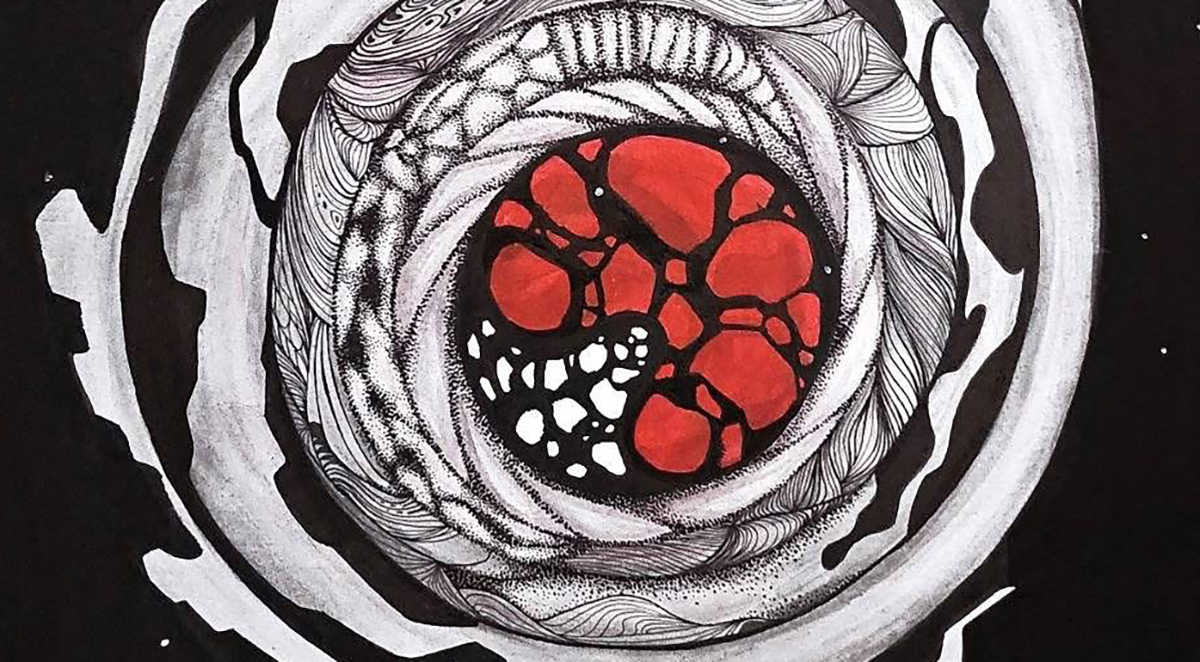
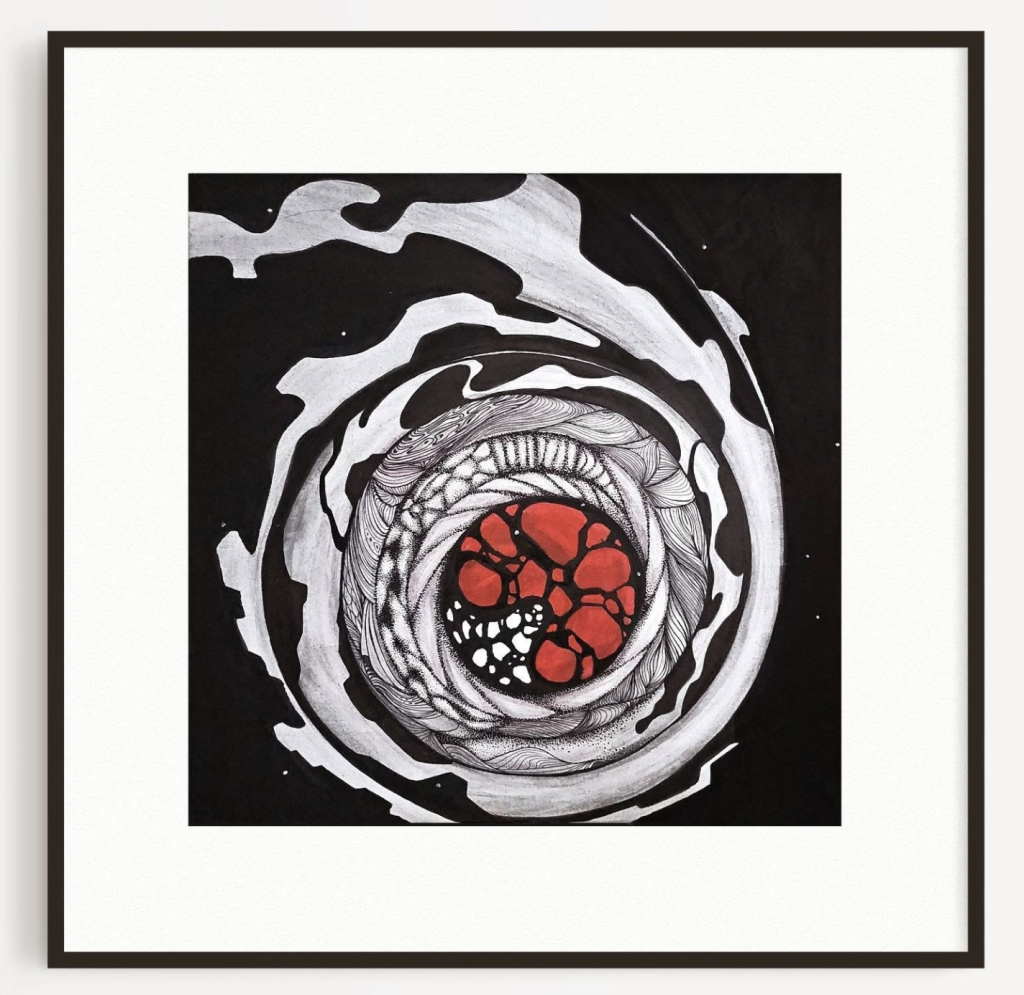
The artwork Shunya, created in mixed media on canvas, offers a compelling introduction to Kholod Uymaz’s artistic approach. At first glance, the composition appears abstract, yet it immediately evokes associations with cosmic phenomena, cellular structures, and psychological landscapes. The image centers on a vivid red form surrounded by intricate black-and-white patterns that spiral inward, drawing the eye toward the core of the composition.
This tension between abstraction and recognition is central to Uymaz’s work. She does not provide a fixed narrative or a clear explanation of meaning. Instead, she creates visual environments where multiple interpretations can coexist. The viewer may see a microscopic organism, a celestial body, a portal, or even a symbolic representation of consciousness itself. The ambiguity is intentional, allowing personal experiences and perceptions to shape the encounter with the artwork.
A Dialogue Between Chaos and Order
One of the most striking qualities of Shunya is its balance between structure and unpredictability. The composition contains carefully rendered patterns that suggest order, repetition, and control. Delicate linework creates textures reminiscent of natural growth, geological formations, or biological systems. These highly detailed areas contrast with the broader, flowing shapes that surround them, introducing an element of movement and spontaneity.
This relationship between order and chaos reflects a recurring concern within Uymaz’s practice. Reality itself often appears structured on the surface while remaining fundamentally uncertain beneath. Scientific systems, social constructs, and personal identities can feel stable, yet they are constantly shifting and evolving. Uymaz captures this paradox through visual contrasts, using pattern and fluidity to suggest the coexistence of certainty and mystery.
The swirling forms surrounding the center create a sense of motion, as though the composition is simultaneously expanding and collapsing. This dynamic energy prevents the artwork from feeling static. Instead, it appears suspended in a state of transformation, reflecting the artist’s interest in processes rather than fixed outcomes.
Symbolism Beyond Language
The title Shunya introduces another layer of complexity. Derived from a Sanskrit term often associated with emptiness, void, or boundless potential, the title opens the work to philosophical interpretation. Rather than suggesting absence, it points toward a space where possibilities emerge and conventional definitions dissolve.
Uymaz does not appear interested in providing definitive answers. Instead, she invites viewers to sit with uncertainty. The title can be interpreted as a challenge to conventional expectations about meaning and purpose, encouraging a more open engagement with experience. By removing the pressure to arrive at a single interpretation, the work creates space for intuition and contemplation.
The red center becomes particularly significant in this context. Surrounded by monochromatic tones, it functions as a focal point of energy and attention. Red is often associated with life, emotion, vitality, and transformation. Here, it appears almost protected within layers of intricate forms, suggesting a hidden source of existence or awareness. Whether interpreted as a symbol of consciousness, creation, or emotional intensity, the red form anchors the composition while remaining enigmatic.
Nature as a Source of Visual Thought
Although abstract, Uymaz’s imagery often recalls structures found in nature. The detailed patterns in Shunya resemble cellular networks, organic tissues, flowing water, or geological formations. This connection to natural systems reflects an understanding that reality operates through interconnected relationships rather than isolated elements.
Nature provides a visual vocabulary through which the artist can explore broader philosophical questions. By drawing inspiration from organic forms, she creates images that feel both ancient and contemporary. The work suggests that the same underlying principles may exist across vastly different scales, from microscopic life to cosmic structures.
This sense of interconnectedness is reinforced by the circular composition. Circular forms frequently symbolize cycles, continuity, and unity. In Shunya, the circular movement guides the viewer inward while simultaneously implying expansion beyond the frame. The result is an image that feels contained and infinite at the same time.
Art as Inquiry
Kholod Uymaz’s work is not concerned with delivering conclusions. Instead, it embraces art as a form of inquiry. Through abstraction, symbolism, and intuitive mark-making, she creates spaces where viewers can engage with questions about perception, identity, and existence.
In Shunya, every line, shape, and contrast contributes to a visual meditation on the nature of reality. The artwork invites prolonged observation, revealing new relationships and meanings over time. Rather than directing the viewer toward a predetermined interpretation, Uymaz encourages a personal encounter with uncertainty, reminding us that some of the most meaningful discoveries emerge not from answers, but from the willingness to explore the unknown.
To explore more of Kholod Uymaz’s work, visit her online portfolio: https://kholoduymaz.myportfolio.com
