



Canadian artist Allan Wesaquate approaches painting as a place where inner experience can take visible form. Memories, dreams and encounters become starting points for images that move between recognition and uncertainty. His use of colour, texture and simplified shapes allows emotion to guide the composition without requiring a literal account of its source. What emerges is a visual language in which personal associations remain open to interpretation. A form might suggest something familiar, then dissolve into another possibility as the eye moves across the surface. This shifting quality gives his paintings a psychological dimension: they invite attention to the ways thoughts accumulate, feelings interrupt one another and recollections change over time. Wesaquate brings these concerns into an expressive practice that connects private experience with broader questions. His paintings offer spaces to consider how the world enters our thoughts, and how those thoughts find their way back into the world through paint.
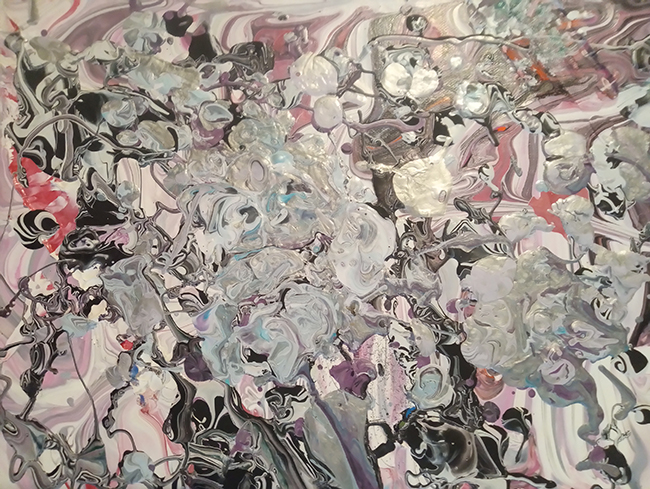
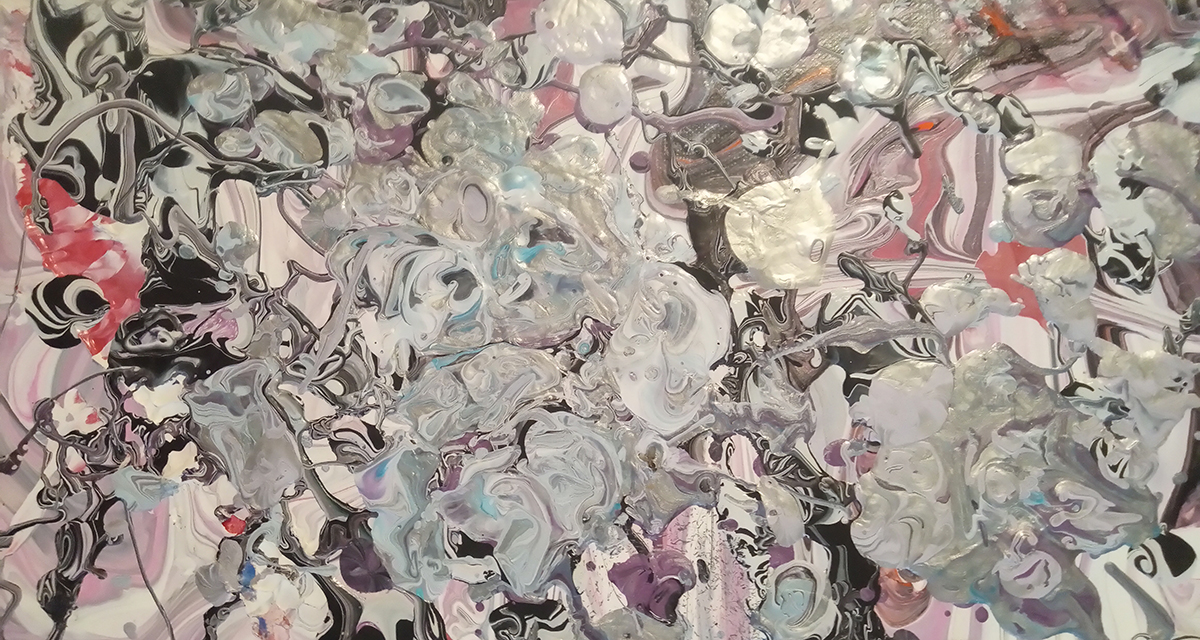
Made in September 2026, the painting shown here addresses a moment when accumulated pressure becomes difficult to contain. Wesaquate describes its theme as “tension exploding,” connecting the work to clashing ideas, exhausted patience and the demand to be understood. His explanation also places these feelings within the experience of witnessing war: the frustration of watching violence, theft and killing carried out in pursuit of greed. The painting translates that distress into a surface crowded with competing movements.
Across the canvas, pale grey, white, muted pink and lavender mingle with black passages and occasional touches of red and blue. These colours do not settle into clearly separated territories. They curl, overlap and break into one another, creating an unstable relationship between lighter areas and darker interruptions. The restrained palette makes the agitation especially interesting. Much of the painting appears almost delicate in colour, yet its internal movement gives little sense of rest.
Rounded deposits of paint sit among thin, winding lines and marbled passages. Some areas appear gathered into clusters, while others stretch outward in narrow streams. The eye encounters a succession of interruptions rather than a straightforward route through the composition. A curve leads toward another shape, only to meet a dark opening or a thicker patch of paint. This experience of being redirected gives a visual counterpart to the artist’s description of ideas colliding.
The surface also suggests different kinds of pressure operating simultaneously. Broad swirls establish movement across larger areas, while small loops and tangled marks produce a more concentrated nervous energy. There is no single point from which the entire disturbance seems to originate. Instead, agitation appears distributed throughout the painting. Read alongside Wesaquate’s statement, this can suggest frustration that has built through repeated encounters: another report of destruction, another argument, another failure to acknowledge suffering.
Black shapes introduce depth and friction within the pale surrounding colours. At times they resemble gaps opening beneath the surface; elsewhere, they form twisting contours that bind neighbouring passages together. Small red accents interrupt this network with a different urgency. They may bring associations of alarm or injury, although the painting leaves those connections unresolved. Its emotional weight develops through the relationship between these elements, allowing viewers to experience unease before assigning a specific meaning to it.
Wesaquate’s reference to war provides a context for this unrest without turning the canvas into a depiction of a particular battle. There are no clearly described armies or locations. The painting instead offers a way to consider the psychological consequences of watching conflict from a distance. News of violence can enter ordinary life repeatedly, producing anger, helplessness and disbelief. Here, the crowded surface can be understood as an image of consciousness struggling to accommodate what it sees.
The demand to be understood adds another dimension. Understanding requires time and attention, yet the composition seems filled with forms competing for both. Nothing receives an entirely separate space. Each passage exists in contact with others, sometimes merging and sometimes resisting. That uneasy proximity makes the painting relevant to disagreements beyond warfare, including the smaller conflicts through which patience is gradually depleted.
For all its agitation, the painting remains carefully absorbing. Its textures encourage close looking, revealing subtle transitions within what first appears chaotic. Wesaquate gives frustration a material presence through these accumulated marks. The result holds a difficult feeling in view: the strain of wanting recognition and humane action while confronting a world that repeatedly seems to move in the opposite direction. Rather than resolving that strain, the painting sustains it, asking viewers to remain with its discomfort long enough to consider the experiences behind it.
