



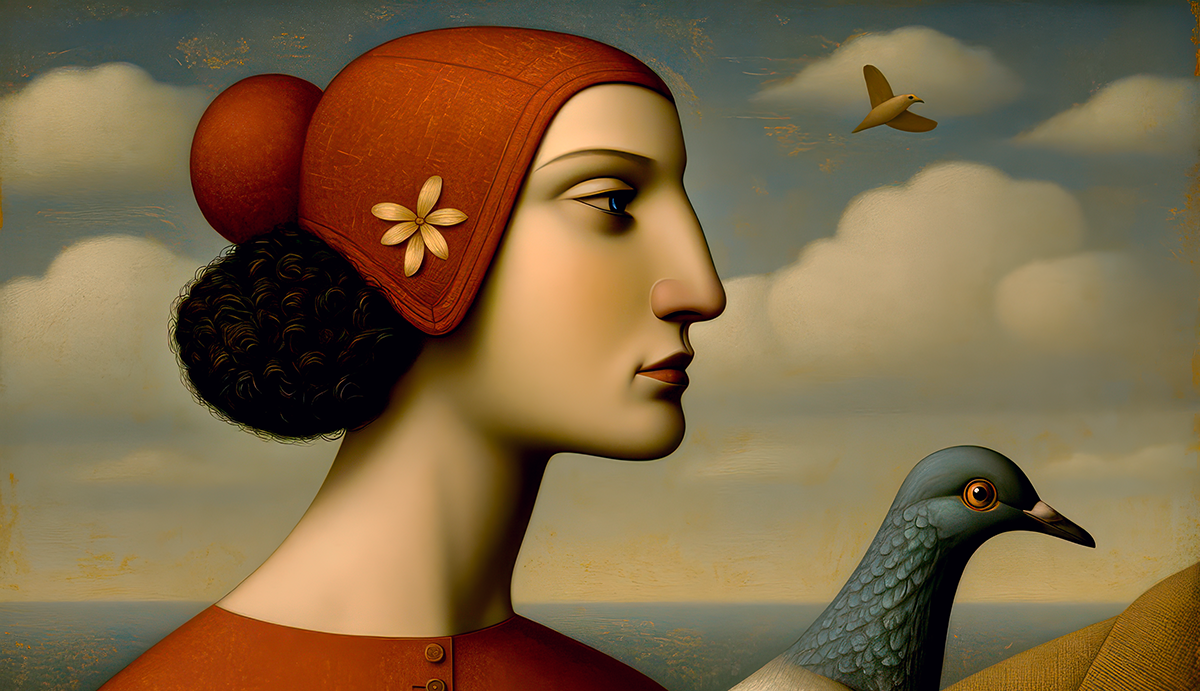
Alan Brown’s interest in art took shape in a darkroom, where he watched photographs emerge gradually beneath a red light. The experience asked for patience: an image could not be hurried into view, and small changes in light and timing could alter what appeared. Brown learned more than a photographic process there. He began to pay attention to the moment when something familiar becomes newly visible. That way of looking offers an entry into Sympathies, a quiet image of a woman and a pigeon facing the sea. Brown gives the two creatures a shared direction but leaves their connection undefined. A cube and a sphere sit nearby, adding another set of forms to consider. There is no event to explain the scene and no clear answer waiting beyond the horizon. Instead, the picture invites the viewer to spend time with its stillness and notice how much can pass between two figures who never turn toward each other.
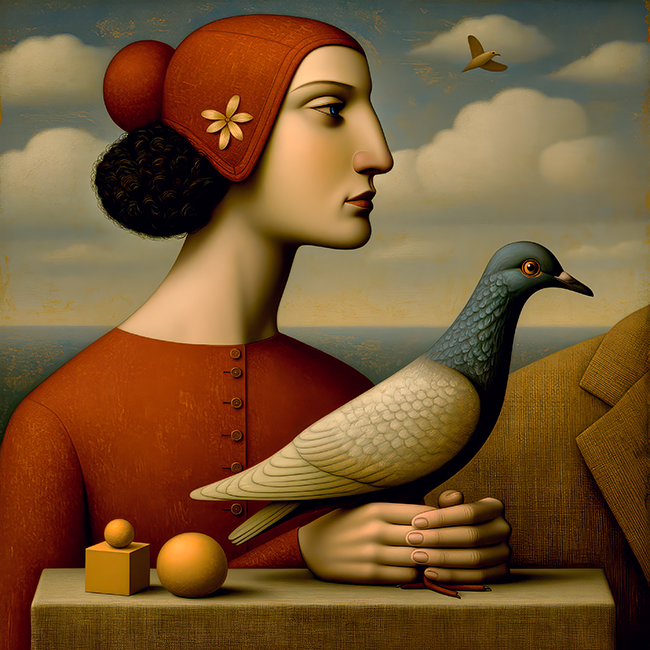
In Sympathies, a woman and a pigeon occupy the same view. Seen in profile, they look out to sea, their attention drawn toward something beyond the edge of the picture. A cube and a sphere rest on a table nearby. These few elements provide all the scene needs. The longer one looks, the more the relationship between them begins to change.
At first, the woman and the bird seem an unlikely pair. One might expect the pigeon to be a passing detail, a small interruption in a scene centered on the human figure. Brown gives it more presence than that. By placing them in the same posture and turning them toward the same horizon, he makes their separate acts of looking feel connected. They do not touch or acknowledge each other. Their closeness comes from sharing a moment.
The title, Sympathies, suggests a feeling that passes between beings, though the picture offers no proof of what either one feels. Perhaps the woman finds comfort in the bird’s company. Perhaps each is simply occupied with the sea. The title opens a possibility without settling it. Brown allows a viewer to sense a bond while also recognizing how little can be known from appearances alone.
The pigeon brings an everyday life into the scene. It is a bird people often pass without a second glance, yet here it receives the same calm attention as the woman. Their matching profiles make it possible to see the pigeon as another creature with a point of view. The image does not need to make the bird behave like a person to grant it a place beside her. Its presence is enough.
The sea draws both figures outward. A horizon can mark a boundary, but it can also encourage the eye to travel past what the picture shows. We cannot see what the woman and pigeon see, if they are looking at anything in particular. Their gaze may be directed toward the distance, or they may simply be resting there. Brown keeps that uncertainty intact, letting the open view hold thoughts the figures do not reveal.
On the table, the cube and sphere offer a quieter pairing. Their shapes differ, yet each is a complete, familiar form. Unlike the woman and bird, they cannot look outward; they remain where they have been placed. Still, their presence affects the scene. They give the eye somewhere to return after following the shared gaze toward the sea. The viewer moves between the near objects and the distant horizon, between things that can be described easily and feelings that cannot.
The forms may suggest choices, memories, or ideas left unfinished, but they do not have to stand for any one thing. Brown’s scene works because its details remain specific even when their meanings stay open. A table holds two objects. A woman sits or stands beside a bird. Both face the water. From those simple facts, a viewer can begin to imagine companionship, solitude, curiosity, or a pause in an ordinary day.
Very little happens in Sympathies. That stillness gives the picture its pace. There is time to notice the space between the figures and to consider whether looking in the same direction brings them together. Brown does not supply a story about where they came from or what happens next. He holds them in the present, where company can exist without conversation.
The image recalls the patience of watching a photograph appear in a darkroom. Its details are available at once, but their relationship becomes clearer slowly. By the end, the woman and pigeon may seem less like two subjects placed side by side and more like two lives briefly aligned. Brown leaves their shared feeling unnamed, allowing the viewer to meet them in that quiet interval.
