



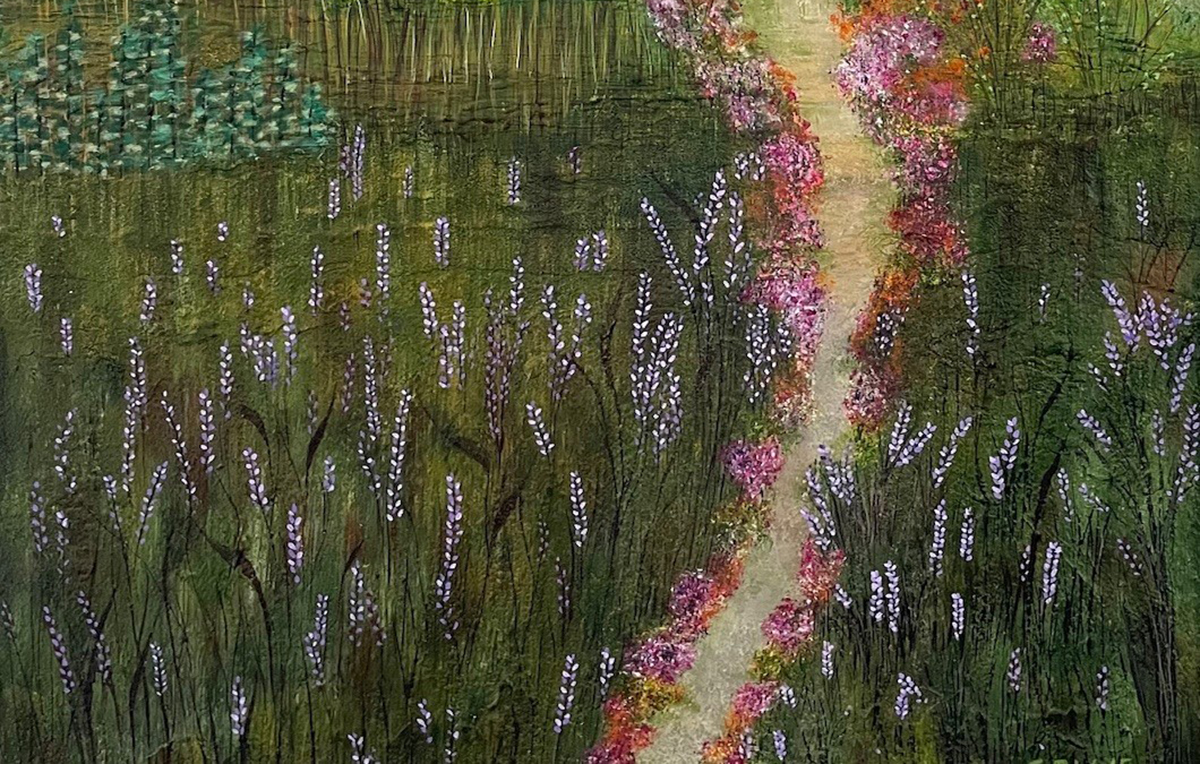
Born in 1956 beneath the warm Californian sun of Santa Monica, Susie Rosso Wolf, also known as SR Wolf, has followed a creative path shaped by courage, discovery, and a lasting devotion to art. Her early artistic development began at the California Institute of the Arts, where she encountered an environment of experimentation and creative freedom. However, it was far from the energy of Los Angeles, amid the quiet landscapes of rural Montana and the Pacific Northwest, that she found a deeper connection to her artistic voice. Wolf’s work is rooted in memory, nature, and the defining experiences that remain with us across a lifetime. Through richly layered surfaces, expressive color, and intuitive mark-making, she transforms personal history into visual narratives. Her paintings are not simply representations of places; they are emotional records of moments that altered the direction of her life and continued to call her home.
The Hidden House on Highway 20
In 1980, Susie Rosso Wolf’s father placed her on a Greyhound bus departing Los Angeles for Oregon. She was traveling to visit her oldest brother, Big Mike, and his family in Blodgett, a small rural community along Highway 20. At the time, they lived in a 101-year-old farmhouse situated on eighty acres of former dairy land. For a young woman raised in Los Angeles, the surrounding landscape revealed an entirely different rhythm of life.
Across the narrow two-lane road stood magnificent rolling hills. Wolf spent her days sitting on the farmhouse porch, quietly absorbing the view. The open countryside offered a sense of space and stillness unlike anything she had previously experienced. It was not simply beautiful; it awakened her to another way of living and seeing.
During the visit, Wolf and her brother walked together along a forest trail that he had gradually formed with his own footsteps. Big Mike would climb to a favorite place, settle onto the earth, and look across the Willamette Valley. There, surrounded by trees and open sky, he meditated in peace, love, and harmony. These walks became treasured moments between brother and sister, giving Wolf the opportunity to experience nature as a source of emotional clarity.
At that time, she imagined her future centered on a singing career. Yet her week in Oregon quietly changed something within her. She took as many walks along the forest trail as possible before returning to California. When departure day arrived, leaving felt unexpectedly painful. Her brother waited in the car, sounding the horn because they needed to reach the Corvallis bus station. Still, Wolf found it difficult to pull herself away.
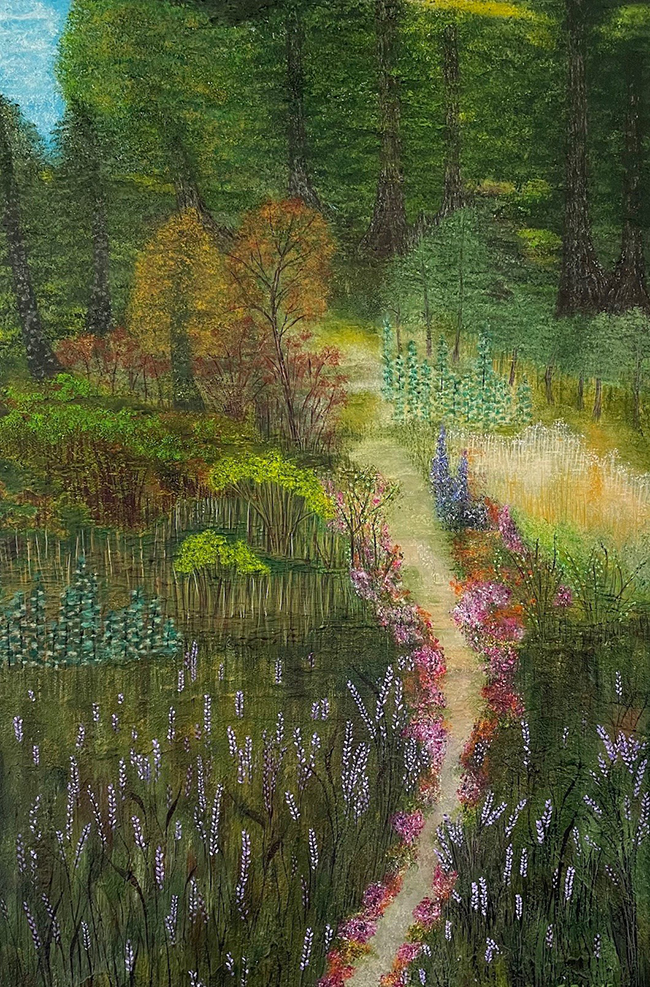
As she reached the bottom of the trail, she turned for one final look. Towering conifers climbed the hillside, delicate flowers bordered the pathway, and the old farmhouse remained partly concealed within the landscape. Wolf removed a small Kodak camera from her purse and took a single photograph. It was a simple, spontaneous act, but the image would become an enduring connection to a place that had transformed her.
After returning to Los Angeles, she enlarged the photograph to eleven by fourteen inches, framed it, and mailed it to her sister-in-law, Anita Rosso. She also made a private promise that she would someday return to Oregon. That promise was fulfilled when she later found a small cabin for rent deep in the woods. While working as a waitress at the Crazy Horse Saloon in Corvallis, she met Kurt Wolf, a live-band sound engineer. They married in 1982, beginning a partnership that has lasted more than four decades.
With time, the photograph acquired even greater emotional significance. Big Mike, Anita, and their son all passed away. Following Anita’s death, Wolf was asked whether she wanted anything from her sister-in-law’s belongings. She requested only the photograph of the hills, trees, and hidden farmhouse on Highway 20. When it arrived a month later, she placed it in a beautiful frame and hung it in her home, where she continues to see it every day.
Years later, Wolf made another promise: she would paint the scene. The opportunity finally came when she discovered a large gallery canvas measuring twenty-four by forty-two inches. Using fine acrylics and oils, she stood before her wall easel and began translating the photograph into something more intimate than a literal landscape.
Her brushes and palette knives became instruments of remembrance. Through paint, she returned to the forest trail, the conifers, the flowers, and the quiet house beyond the road. The resulting work carries the tenderness of family, the sorrow of loss, and gratitude for a landscape that redirected her life. It is both a tribute and a homecoming.
Although Wolf remains connected to California and Montana, the hidden house in Blodgett occupies a singular place in her story. Her painting preserves more than its appearance. It holds the feeling of discovering beauty, belonging, and possibility for the first time. By transforming one cherished photograph into art, Wolf ensures that the path, the house, and the people connected to them continue to live.
