



Jurek Jakowicz was born and raised in the historic city of Łódź, Poland. His path into art began with a classical education at the Government College of Art and later at the University of Łódź, where he studied sculpture, drawing, art history, and architectural design. These early studies shaped his methodical, grounded approach to sculpture—an approach rooted in European tradition. But Jurek’s story doesn’t end in Poland. He eventually moved to the United States, carrying with him both the weight of his past and the drive to reinterpret his identity through art. His sculptures are grounded in classical form, yet carry a deeply personal thread—often touching on themes of movement, transformation, memory, and place. As an immigrant artist, Jurek’s work bridges two worlds: the precision of his European training and the emotional rawness of his American experience. The result is work that feels both anchored and searching.
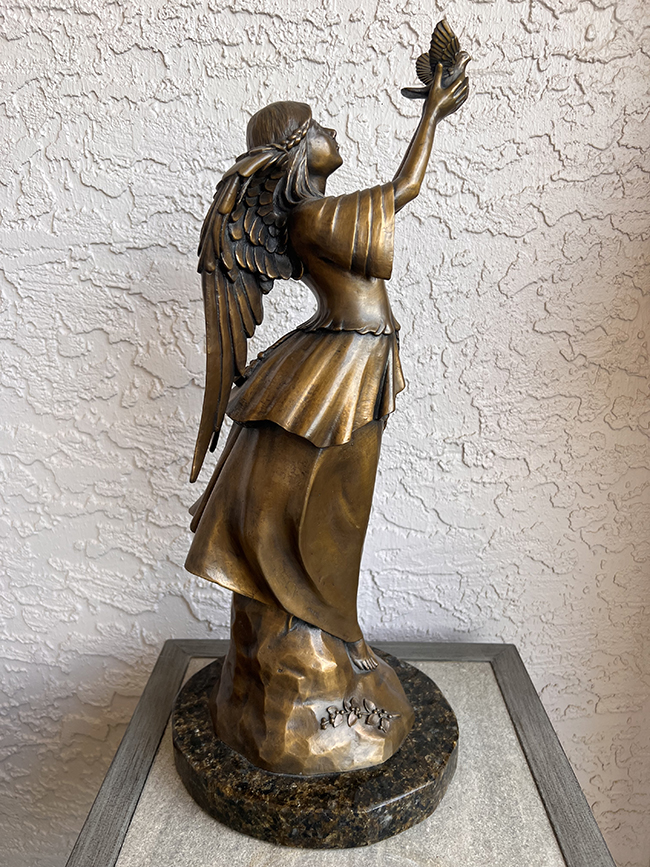
One of Jurek Jakowicz’s most heartfelt sculptures is Angel of Peace. He created it over a year ago, during a time when headlines were flooded with images of war, suffering, and unrest. The world didn’t feel steady, and Jurek responded to that unease the only way he knew—through bronze, form, and intention.
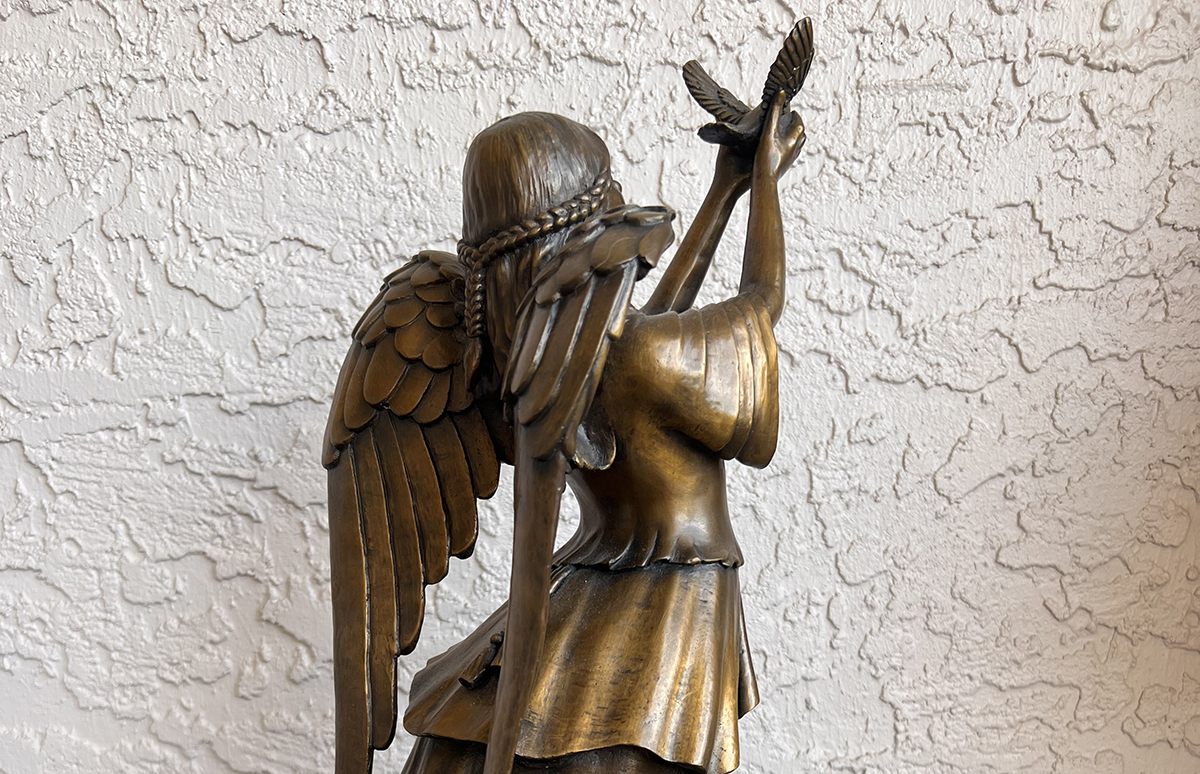
At first glance, Angel of Peace seems calm. But there’s tension just below the surface. The angel is captured mid-movement, stepping off a rough-hewn rock. Her arms are stretched forward, releasing a dove. The symbolism isn’t subtle—it doesn’t try to be. Jurek wanted something direct. The dove is peace, of course, and in the angel’s release, there’s a sense of letting go, of sending something fragile into the world and hoping it will survive.
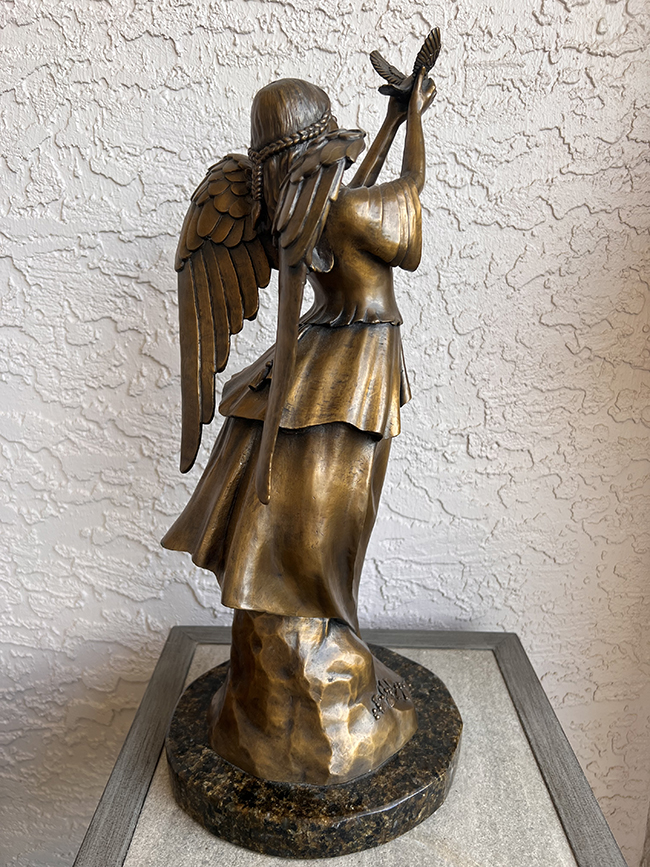
The angel herself is lean and dignified, almost solemn. There’s no exaggerated beauty or flourish. She’s grounded, real. You get the feeling that she’s been watching quietly from the sidelines and finally decided to act. There’s a quiet courage in her posture. She’s not floating or flying. She’s walking toward us.
Jurek sculpted an olive branch by the angel’s feet. Again, a clear symbol: peace, prosperity, hope. But it’s not in her hand—it’s at her feet. Maybe that’s intentional. Maybe it says peace is something that needs to be picked up, stepped over, chosen. It’s there, but we have to claim it.
The piece weighs around 25 pounds, standing 24 inches tall and stretching 7 inches wide by 10 inches deep. It’s a solid presence. Not something you overlook on a shelf or in a corner. It has the feel of permanence, like something meant to outlast its time.
What’s special is how much the sculpture says without being loud. There’s no dramatic gesture, no overstated message. It just stands—quietly, firmly—suggesting that peace is something worth stepping toward, even when everything else feels like it’s unraveling.
In talking about the piece, Jurek mentions that he made it during a time when the world felt heavy. That matters. Angel of Peace isn’t abstract or detached. It’s rooted in a real emotional space. It came out of watching conflict unfold, seeing loss, and wanting to believe that peace is still possible. The angel is part dream, part plea.
This piece also says something about Jurek himself. He’s not just a sculptor of forms—he’s a sculptor of meaning. His work doesn’t just rest on technical skill, though that’s certainly there. It’s about what he brings to the process: memory, grief, hope. His own experience of migration and change shapes what he makes.
Angel of Peace is a response, but also a reminder. In a fractured world, it holds space for something better. It doesn’t scream, it doesn’t demand. It just offers—an angel, a dove, a branch. And it asks quietly: will we accept them?
Jurek may have grown up in Łódź, studying the old masters and learning the rules of classical sculpture, but with Angel of Peace, he shows how those rules can still speak in today’s chaos. His work doesn’t pretend to fix anything. But it believes. And that belief—steady, weighty, bronze-cast—is sometimes enough.
