



Born and raised in Milwaukee, Wisconsin, Jarron Carter has developed an artistic journey shaped by creativity, determination, and an enduring passion for visual expression. From his beginnings in the American Midwest to having his artistic journey reach the prestigious Louvre Museum in Paris, Carter’s story reflects the extraordinary possibilities that emerge when imagination meets perseverance. His creative practice embraces both traditional artistic techniques and contemporary digital methods, allowing him to explore new dimensions of beauty, emotion, and surrealism.
Through his mixed-media compositions, Carter transforms recognizable subjects into imaginative visual experiences that invite viewers to reconsider the relationship between reality and fantasy. His work celebrates artistic freedom while exploring the expressive potential of the human form, decorative ornamentation, and dreamlike environments. Rather than simply creating visually appealing images, Carter seeks to establish an emotional connection with his audience. Each composition becomes an opportunity to discover beauty beyond conventional boundaries, revealing a distinctive artistic language that brings elegance, imagination, and contemporary creativity together.
Flourish Series 1: A Celebration of Grace, Transformation, and Surreal Beauty
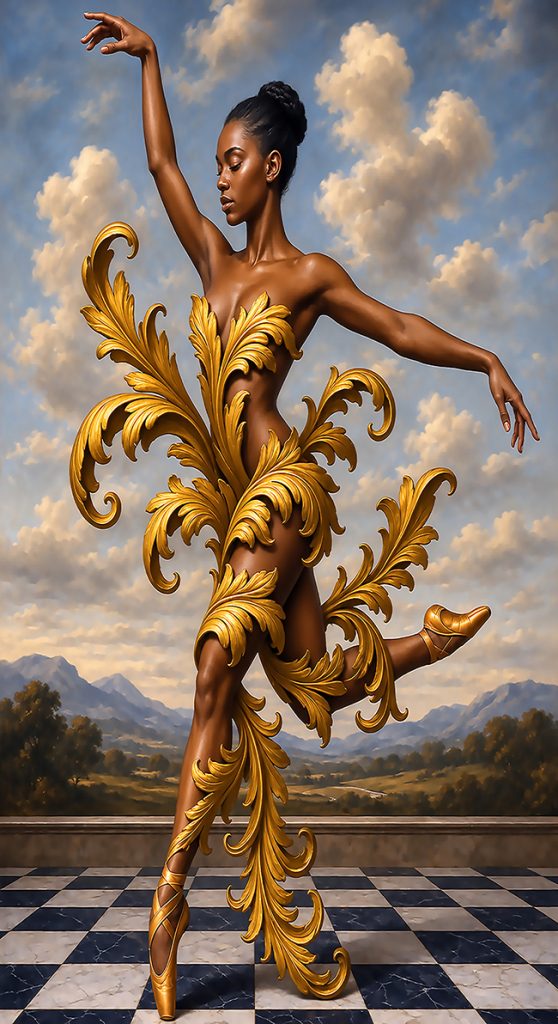
In Flourish Series 1, Jarron Carter presents a captivating exploration of movement, elegance, and imaginative transformation. Combining traditional artistic approaches with digital techniques, the mixed-media composition reveals his ability to create a visual world where classical refinement encounters contemporary surrealism. The artwork celebrates the beauty of the human form while introducing fantastical elements that challenge the boundaries between physical reality and artistic imagination.
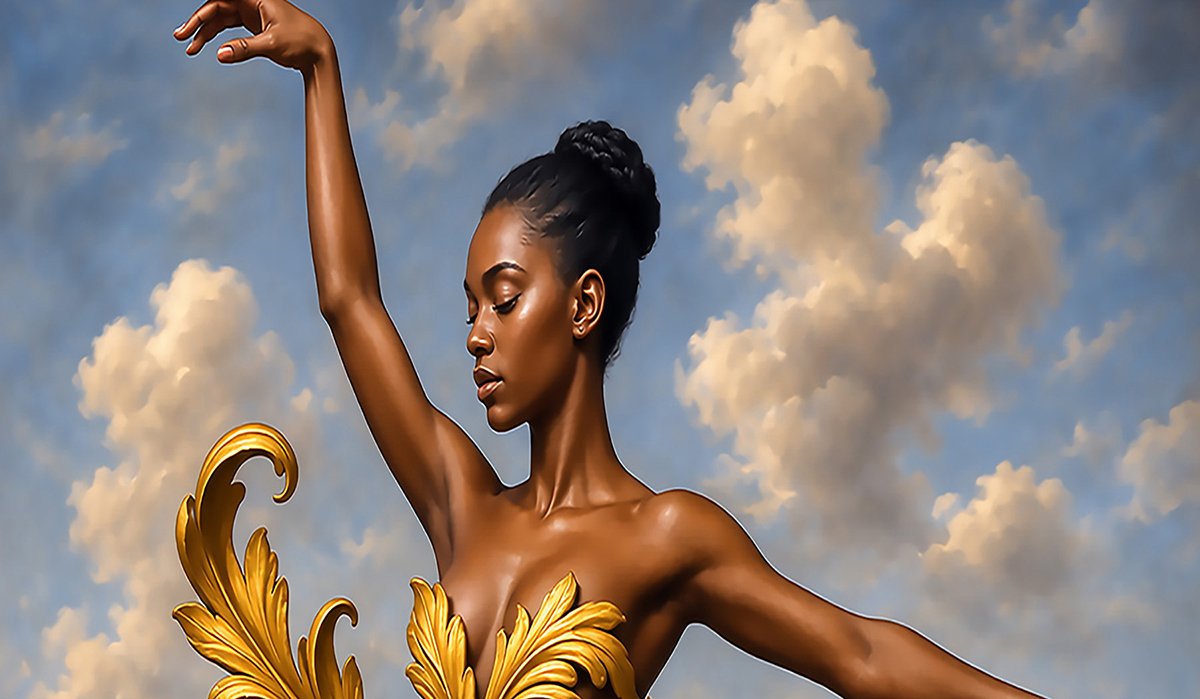
At the center of the composition stands a graceful ballerina, her body extending into an expressive pose that conveys both strength and delicacy. One arm reaches upward toward the sky while the other stretches outward, creating a fluid sense of balance and movement. Her poised figure appears suspended in a fleeting moment of performance, suggesting the discipline, dedication, and emotional intensity associated with classical dance.
What distinguishes the composition is Carter’s imaginative treatment of the dancer’s attire. Rather than presenting a conventional ballet costume, he surrounds the figure with elaborate golden botanical ornaments that seem to emerge organically from her body. These decorative forms resemble curling leaves, sculptural flourishes, and intricate Baroque embellishments. Their luminous surfaces create a striking contrast against the dancer’s rich skin tones, establishing a visual dialogue between natural beauty and ornamental extravagance.
The golden elements appear almost alive, extending outward in graceful curves that echo the dancer’s movements. They blur the distinction between clothing, sculpture, and living vegetation, transforming the figure into something simultaneously human and fantastical. This surreal transformation suggests growth, renewal, and the limitless possibilities of creative expression.
Carter’s use of gold contributes significantly to the artwork’s emotional atmosphere. Traditionally associated with luxury, achievement, and magnificence, gold becomes a symbol of empowerment and individuality within the composition. Its radiant presence elevates the dancer beyond an ordinary portrait, presenting her as an embodiment of confidence, artistic freedom, and self-expression.
The background further enriches the visual narrative. Expansive clouds drift across a luminous blue sky, while distant mountains and a tranquil landscape establish an atmosphere of openness and serenity. The setting recalls the idealized landscapes of classical European painting, creating a sense of timeless beauty. Yet the theatrical presentation of the central figure introduces a contemporary sensibility that prevents the scene from becoming purely historical.
Beneath the dancer’s feet, a black-and-white marble floor provides a structured geometric foundation. Its carefully arranged pattern contrasts with the flowing organic shapes of the golden ornaments. This juxtaposition of order and spontaneity strengthens the composition’s visual rhythm, allowing the viewer’s eye to travel between the architectural precision of the setting and the expressive movement of the figure.
The relationship between these contrasting elements reveals Carter’s sensitivity to visual balance. The dancer’s extended limbs create diagonal lines that guide the composition, while the decorative flourishes introduce circular movements that soften its geometry. Together, these elements establish a dynamic harmony between control and freedom.
Surrealism plays an essential role in the artwork’s expressive character. Although the dancer’s anatomy and surroundings maintain a recognizable sense of realism, the impossible integration of golden foliage transforms the scene into a dreamlike vision. Carter does not abandon reality entirely; instead, he reshapes it, encouraging viewers to imagine a world where beauty can emerge in unexpected forms.
This approach reflects his broader artistic intention to create compositions that are aesthetically compelling while provoking emotional responses. The dancer’s elegant posture may evoke feelings of aspiration, liberation, or personal achievement, while the flourishing golden forms suggest transformation and the unfolding of individual potential.
The title Flourish Series 1 reinforces these interpretations. To flourish is to grow, thrive, and reach a state of fulfillment. Within the artwork, this idea becomes visible through the dancer’s upward-reaching gesture and the ornamental forms that expand around her. The figure appears to transcend ordinary limitations, embodying the possibility of becoming something greater through creativity and determination.
Ultimately, Flourish Series 1 demonstrates Jarron Carter’s ability to unite classical influences, contemporary techniques, and surreal imagination within a singular artistic vision. By transforming a familiar subject into an extraordinary visual experience, he invites viewers to appreciate beauty not merely as an external quality, but as an expression of movement, resilience, and personal transformation.
Through its harmonious interplay of elegance, symbolism, and fantasy, the artwork becomes a celebration of the human spirit and its capacity to flourish beyond expectation.
