



Born in 1949 and raised in California’s Bay Area, Deborah K. Tash is a painter and poet whose creative practice explores cultural heritage, spirituality, and humanity’s relationship with nature. Identifying as Mestiza, she draws inspiration from her mother’s Mexican ancestry and her father’s Celtic roots, bringing together different cultural traditions within her artistic expression. Her work reflects an interest in mythology, ancestral memory, and the connections between physical existence and spiritual experience. Through painting and poetry, Tash examines themes of identity, transformation, grief, and renewal, often allowing symbolic imagery to communicate emotions beyond conventional language. Her compositions combine expressive colors, layered textures, and imaginative forms, creating spaces where recognizable subjects interact with abstract surroundings. Rather than separating personal history from the natural world, Tash explores how these experiences influence one another, encouraging viewers to consider the deeper relationships between human consciousness, cultural memory, and the environment.
Mask Series/Forest Deva Mask Study: The Spiritual Presence Within Nature
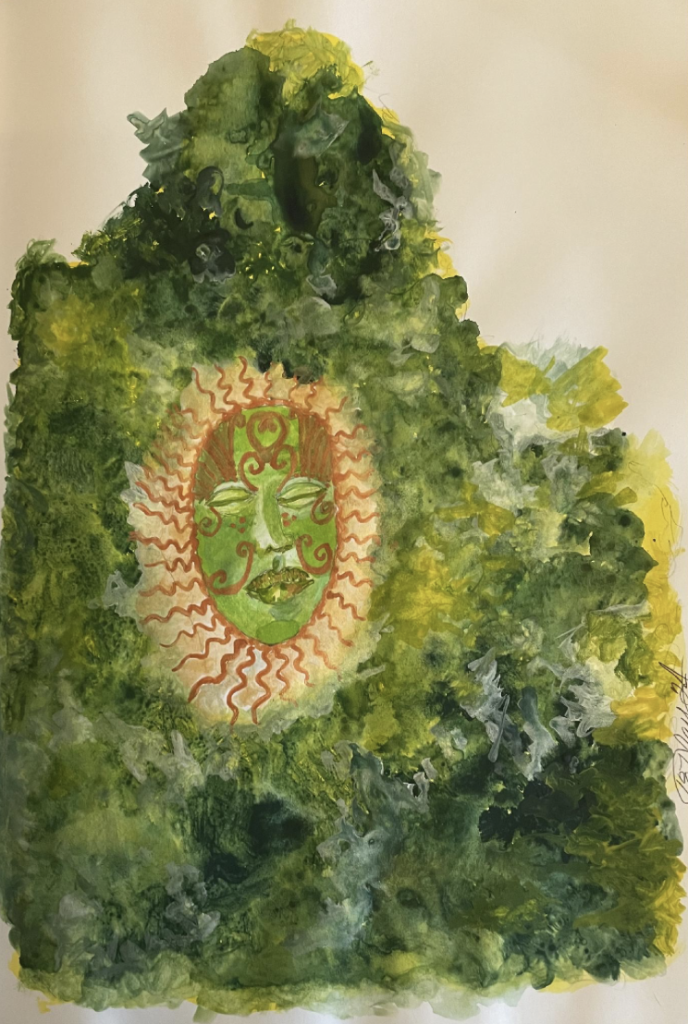
In Mask Series/Forest Deva Mask Study, Deborah K. Tash creates an imaginative composition that explores the relationship between the natural environment and spiritual identity. A vibrant green mask emerges from an intricate arrangement of foliage, textured surfaces, and organic shapes. Surrounded by deep greens, yellow highlights, and translucent passages, the central face appears to exist within the forest itself, suggesting an intimate connection between human expression and the living landscape.
The painting immediately draws attention to its unusual combination of recognizable imagery and abstraction. The mask occupies the central portion of the composition, while the surrounding environment expands outward through irregular layers of color and texture. Dark green areas resemble dense vegetation, while lighter passages suggest leaves, moss, and natural growth. These elements create an atmosphere that feels both mysterious and familiar, encouraging viewers to imagine a hidden presence within the forest.
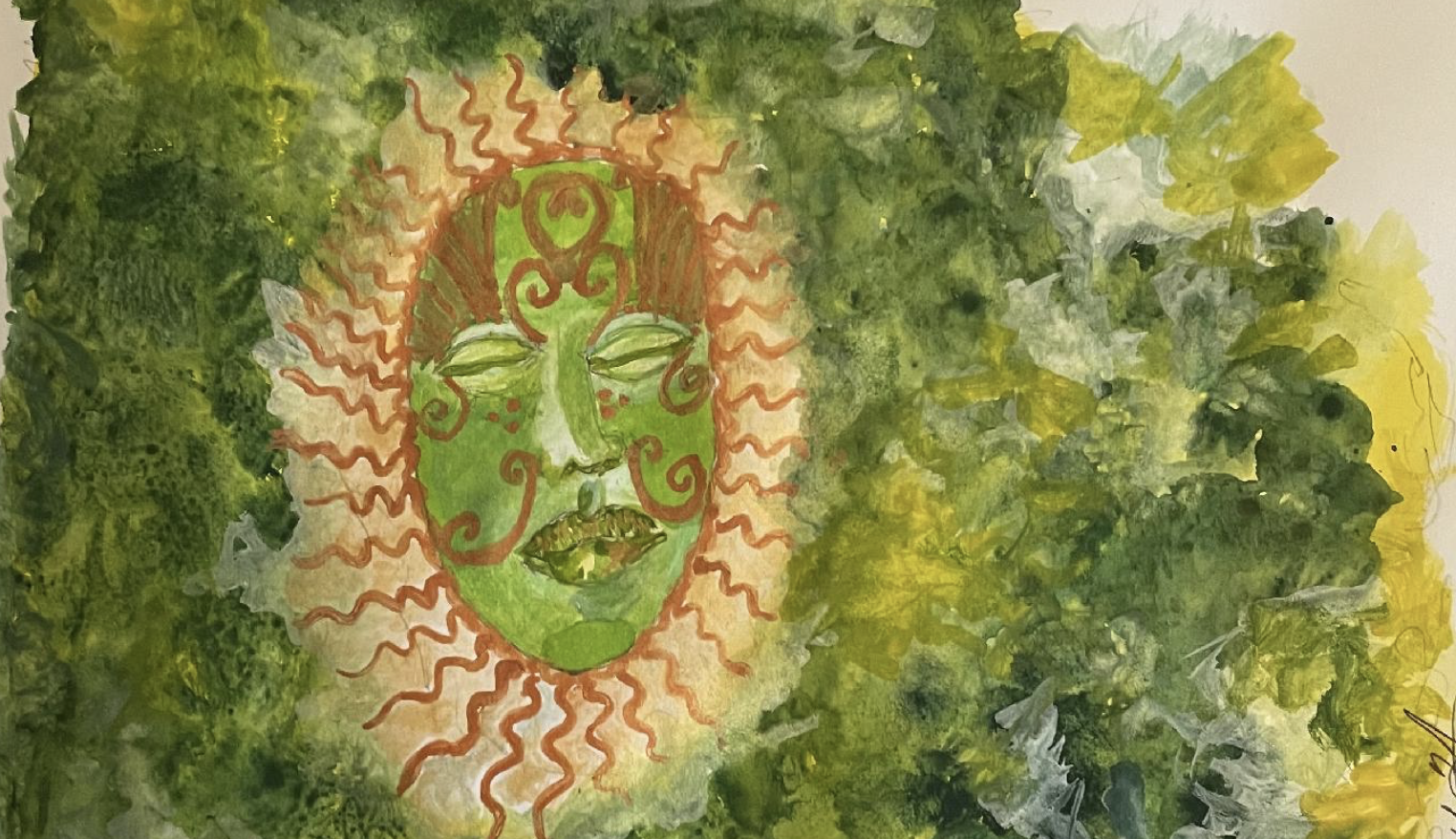
The mask features an expressive arrangement of decorative patterns. Curving reddish lines extend across its forehead, cheeks, and chin, forming intricate shapes that resemble ornamental markings or symbolic inscriptions. Its eyes appear gently closed or lowered, giving the face a contemplative expression. The carefully arranged features contrast with the surrounding vegetation, establishing a visual relationship between structure and spontaneity.
Radiating around the face are warm orange lines that resemble sunlight, flames, or waves of energy. These markings introduce movement and warmth into the predominantly green composition. Their rhythmic arrangement creates the impression that the mask possesses an internal vitality, as though an invisible force extends outward into the surrounding environment.
The title introduces an additional spiritual interpretation. In various religious and mythological traditions, devas are associated with celestial or divine beings. Within the context of this painting, the forest deva may be understood as an imagined guardian or spiritual presence connected to nature. The mask becomes a visual representation of this possibility, suggesting that the forest contains forms of consciousness beyond ordinary human perception.
Tash’s treatment of the natural environment is especially interesting because the vegetation does not simply function as background scenery. Instead, it becomes an essential component of the central image. The boundaries between the face and surrounding foliage remain uncertain, allowing the mask to appear as though it has grown organically from the landscape.
This blending of forms encourages reflection on humanity’s relationship with the natural world. Rather than presenting human identity as separate from nature, the painting suggests a shared existence in which living forms remain interconnected. The mask may symbolize an ancestral spirit, an embodiment of the forest, or an imagined expression of nature’s enduring vitality.
Color strengthens this interpretation. The many shades of green evoke growth, regeneration, and the continuous cycles of life. Yellow accents suggest illumination and renewal, while darker areas introduce depth and mystery. The warm decorative markings provide contrast, guiding attention toward the central face without diminishing the surrounding textures.
The painting also demonstrates Tash’s interest in material expression. Layers of pigment create variations in density and transparency, producing surfaces that appear both delicate and substantial. Some passages resemble natural formations, while others dissolve into abstract patterns. This interplay between controlled imagery and freely developing textures gives the composition its distinctive atmosphere.
Through Mask Series/Forest Deva Mask Study, Tash invites viewers to reconsider the forest as more than a physical setting. Her composition offers an imaginative encounter with nature as a source of memory, spiritual reflection, and transformation. The mysterious green face becomes a point of connection between visible forms and unseen possibilities, leaving viewers with an open invitation to contemplate the living world’s deeper meanings.
