



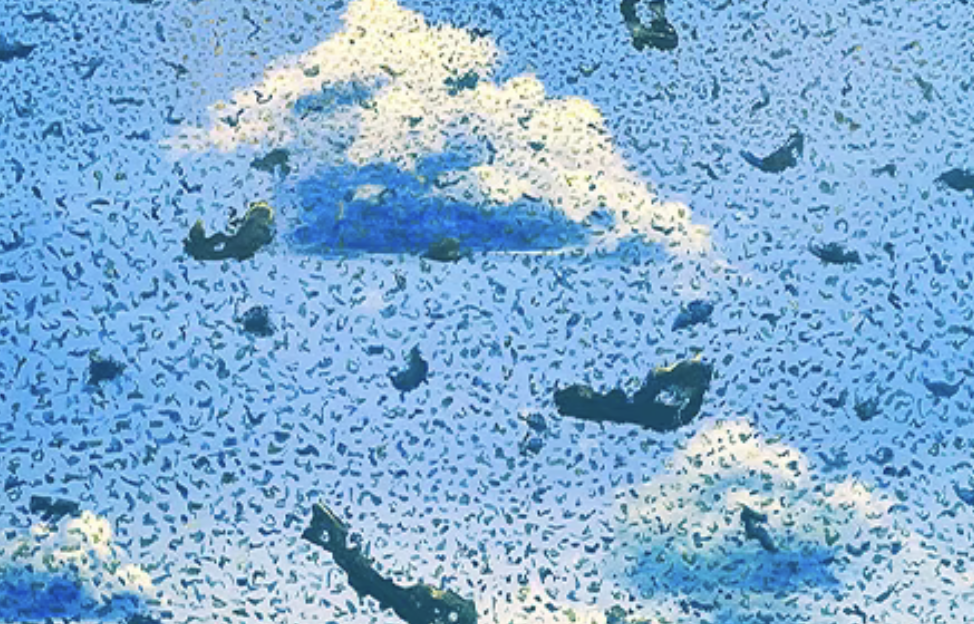
Edward A. Burke is an American visual artist whose practice explores the fragile relationship between humanity and the natural environment. Working across painting, drawing, and digital media, he creates works that examine the realities of climate change, ecological imbalance, and the lasting impact of human activity on the world around us. Rather than presenting environmental issues through direct documentation, Burke develops symbolic visual narratives that encourage contemplation and dialogue. His compositions balance moments of beauty with subtle tension, reminding viewers that nature is both resilient and vulnerable. Through layered surfaces, carefully considered textures, and evocative imagery, his work raises questions about responsibility, adaptation, and the future of the planet. While environmental concerns remain central to his artistic vision, Burke also leaves room for optimism, suggesting that awareness, imagination, and collective action can inspire meaningful change. His art invites audiences to reflect not only on the landscapes they inhabit but also on the choices that continue to shape the Earth’s future.
Between Beauty and Uncertainty
Edward A. Burke’s artworks transform environmental themes into poetic visual experiences that move beyond literal representation. His paintings do not simply illustrate climate change or ecological disruption. Instead, they create atmospheric spaces where familiar natural elements become symbols of a world in transition. Through abstraction and suggestion, Burke encourages viewers to interpret the emotional and environmental narratives unfolding within each composition.
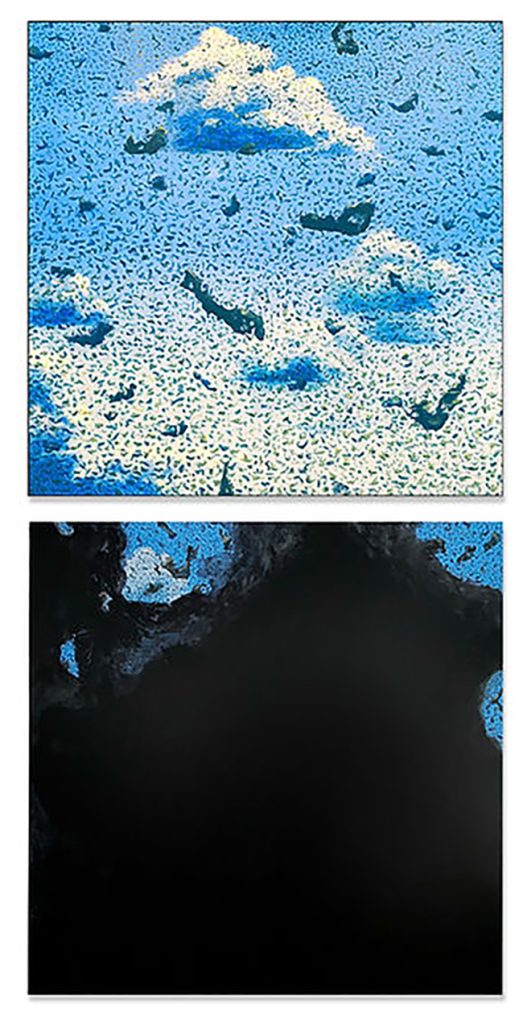
The upper painting immediately draws attention through its expansive field of luminous blue. Floating white clouds appear suspended within a sky that initially feels peaceful and open. On closer observation, however, countless small marks create a textured surface that introduces complexity beneath the calm atmosphere. Dark, irregular forms drift throughout the composition, interrupting the serenity of the sky and suggesting pollution, debris, or fragments carried by invisible environmental forces. These contrasting elements create a visual dialogue between beauty and disturbance, inviting reflection on how delicate natural systems are increasingly influenced by human activity.
Burke’s use of repetition is particularly significant. The countless small marks covering the surface resemble particles, seeds, microorganisms, or fragments of matter, creating an intricate network that suggests the interconnected nature of ecosystems. Every element appears connected to something larger, reinforcing the idea that even seemingly insignificant actions can contribute to widespread environmental consequences. Rather than overwhelming the viewer with direct statements, the artist allows these subtle visual relationships to communicate a deeper ecological message.
The lower painting introduces a dramatically different emotional atmosphere. Dominated by a vast black space, the composition feels quiet, mysterious, and almost immeasurable. The darkness is framed by expressive passages of blue and white along the edges, creating the impression that light and life remain present even as they are partially obscured. This contrast between openness and enclosure can be interpreted as a metaphor for uncertainty, environmental loss, or the unknown future facing the natural world.
Although minimal in composition, the painting possesses remarkable emotional depth. The expansive black area functions not as emptiness but as a space of contemplation. It invites viewers to pause, reflect, and consider what lies beyond immediate visibility. Burke demonstrates that absence can communicate as powerfully as presence, allowing silence and negative space to become active participants in the visual narrative.
Color plays a vital role throughout both works. The vivid blues evoke associations with sky, water, and the vitality of Earth’s natural systems. At the same time, the surrounding darkness introduces a sense of vulnerability, emphasizing the delicate balance between environmental stability and disruption. Rather than presenting these colors as opposites, Burke allows them to coexist, reflecting the complexity of contemporary ecological realities where hope and concern often exist simultaneously.
Texture further strengthens the expressive qualities of the paintings. Layered surfaces, scattered marks, and varied densities create movement across each composition, encouraging prolonged observation. As viewers spend more time with the works, additional details emerge, rewarding careful attention and reinforcing the idea that environmental understanding also requires patience and close observation.
While Burke’s work addresses serious global issues, it avoids becoming pessimistic or didactic. Instead of delivering definitive conclusions, he creates open-ended visual experiences that invite personal interpretation. Each viewer may discover different meanings within the floating forms, expansive spaces, and evolving textures. This openness reflects the complexity of environmental conversations themselves, where solutions require curiosity, dialogue, and collective engagement rather than simple answers.
Ultimately, Edward A. Burke’s paintings remind us that art has the power to make invisible concerns visible through metaphor, emotion, and imagination. His work transforms environmental reflection into a deeply human experience, encouraging audiences to reconsider their connection to the natural world. By balancing moments of tranquility with subtle signs of disruption, Burke creates thoughtful compositions that acknowledge both the challenges facing our planet and the enduring possibility for renewal, resilience, and hope.
