



Born in Innisfail, Queensland, Sebastian Di Mauro is an Australian multidisciplinary artist whose career spans more than three decades. Working between Brisbane and the United States, he explores relationships between material, memory, cultural identity, and history through painting, sculpture, textiles, and installation. His distinguished career includes more than 45 solo exhibitions and participation in over 100 group exhibitions internationally.
His works are held in major Australian collections, including the Queensland Art Gallery | Gallery of Modern Art and the Art Gallery of Western Australia. Significant exhibitions include GREENBACK (2019), Always and Altered, and Personal Structures – Reflections during the 2022 Venice Biennale. His recent exhibitions, Collective Labour (2024) and Unsettled Ground (2026), demonstrate his continued artistic evolution. An Adjunct Associate Professor at Griffith University’s Queensland College of Art, Di Mauro continues to investigate the intersections of cultural heritage, contemporary experience, and historical interpretation.
Seam (2026): Reconsidering Australia’s Colonial History
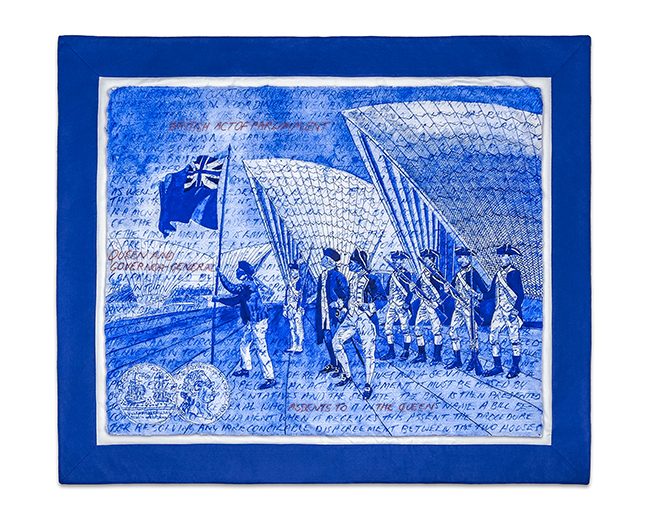
Artwork: Seam, 2026
Medium: Digital print on Twill Waratah fabric, hand-stitched blended yarn, blue felt border
Dimensions: 65 × 77.5 inches
In Seam (2026), Sebastian Di Mauro presents a compelling examination of Australia’s colonial history through an imaginative combination of historical imagery, contemporary symbolism, and textile-based techniques. The artwork challenges conventional interpretations of national identity, encouraging viewers to reconsider how the past continues to influence the cultural landscape of modern Australia.
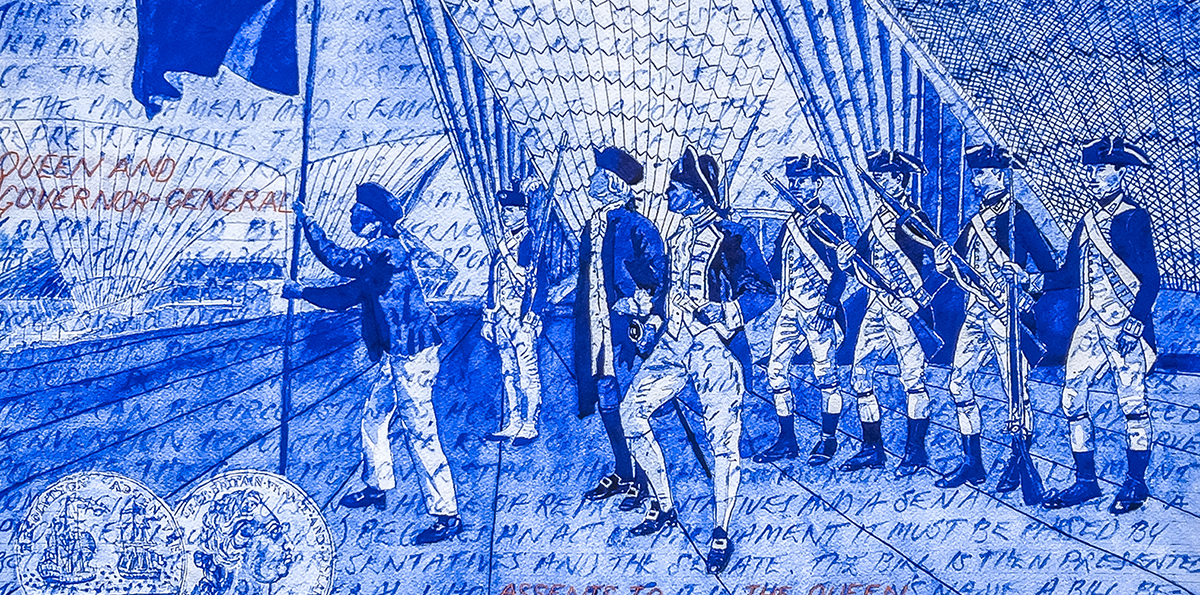
Originally created as a watercolour in 2025, the composition depicts Captain James Cook overseeing the raising of the British naval flag on the forecourt of the Sydney Opera House. This deliberately impossible encounter between eighteenth-century colonial history and twentieth-century architecture establishes a striking visual contradiction. By placing these historically distant elements together, Di Mauro suggests that colonial narratives remain deeply embedded within Australia’s contemporary identity.
The Sydney Opera House, internationally recognised as a symbol of Australian creativity and cultural achievement, becomes an unexpected setting for a ceremony associated with British authority. This juxtaposition raises questions about the relationship between national independence, historical inheritance, and cultural belonging. Rather than presenting history as a sequence of completed events, Di Mauro reveals its continuing presence within contemporary society.
One of the artwork’s most distinctive features is its intense blue palette. The colour unifies the historical figures, architectural elements, handwritten inscriptions, and surrounding textile surface. Its association with oceans and maritime exploration establishes a subtle connection to the voyages that shaped Australia’s colonial history. At the same time, the monochromatic treatment creates an atmosphere of distance and uncertainty, transforming the scene into something resembling a fragmented historical memory.
The handwritten passages distributed throughout the composition introduce another dimension of interpretation. These overlapping inscriptions suggest the complexity of historical documentation, where different voices, perspectives, and experiences contribute to collective understanding. By combining text with imagery, Di Mauro challenges the idea that history can be represented through a single authoritative narrative.
Equally significant is the artwork’s physical construction. The original watercolour has been digitally transferred onto Twill Waratah fabric, creating a foundation for the artist’s hand-stitched interventions. The blended yarn introduces a tactile dimension, interrupting the printed image while connecting its various visual elements.
Stitching becomes a particularly meaningful metaphor within the composition. Traditionally associated with repair, preservation, and connection, the act of sewing suggests an attempt to bring together fragmented histories. However, the visible threads also draw attention to the divisions that remain unresolved. Through this process, Di Mauro transforms an ordinary textile technique into a powerful expression of historical complexity.
The blue felt border further reinforces the relationship between material and meaning. Its substantial presence frames the composition, emphasising the artwork’s identity as both an image and a physical object. This combination of traditional craftsmanship and contemporary digital processes reflects Di Mauro’s broader interest in challenging established artistic boundaries.
Beyond its historical references, Seam explores how cultural symbols acquire new meanings when placed in unfamiliar contexts. The British flag, colonial figures, and Sydney Opera House each carry distinct historical associations. When brought together, they generate a visual dialogue about authority, identity, and the construction of national memory.
The artwork also encourages reflection on the relationship between personal and collective experience. The hand-stitched surface introduces evidence of the artist’s physical involvement, suggesting that historical interpretation is never entirely detached or impersonal. Each intervention becomes part of an ongoing conversation between inherited narratives and contemporary perspectives.
Ultimately, Seam demonstrates Sebastian Di Mauro’s ability to transform complex historical questions into a visually engaging and intellectually layered artwork. Through its unexpected imagery, evocative colour, and carefully considered materials, the composition invites audiences to examine the enduring influence of colonial history on contemporary Australian culture.
Rather than offering definitive answers, Di Mauro creates opportunities for reflection, encouraging viewers to recognise that national identity remains an evolving narrative shaped by history, memory, and cultural transformation.
