



Jane Gottlieb transforms photographs into places where memory, imagination, and color meet. Born and raised in Southern California, where she continues to live, she brings a sensibility shaped by her surroundings to images gathered around the world. Her relationship with France began in her early twenties, when she traveled alone to Paris as a young professional. Photographs from that first journey, along with images from later visits, became a lasting source of inspiration. Across the decades, she has returned to these scenes, reshaping them as her ideas and photographic tools have changed. Her work combines photography, painting, and Photoshop. Through this approach, familiar settings acquire unexpected colors and fresh emotional qualities. Gottlieb’s France is filtered through a distinctly Californian imagination: exuberant, luminous, and open to reinvention. Her pictures invite viewers to experience a place through the possibilities she discovers within it, beyond its immediately recognizable appearance.
With an artistic career spanning more than fifty years, Gottlieb has developed an enduring conversation between the camera and the imagination. A photograph provides the foundation, but its original appearance does not determine the finished artwork. Buildings, gardens, trees, and architectural details become material for further exploration. Through changes in color and composition, she gives these subjects a different atmosphere while retaining their connection to the places she photographed.
Travel supplies much of this visual material. Her photographs preserve encounters with locations that continue to interest her long after a journey ends. Returning to an image allows her to reconsider what first drew her attention, whether a shape, a spatial relationship, or the feeling of a particular setting. Each new treatment becomes another way of understanding the photograph and the memories associated with it.
France occupies a special place within this process. Rather than presenting its landscapes and architecture through a conventional travel perspective, Gottlieb interprets them through her own visual language. Her colors move beyond natural appearances, allowing a familiar scene to become something more personal. The resulting images hold together two experiences: the physical location recorded by the camera and the imagined place created through her artistic decisions.
Her Southern California background offers a useful context for this approach. The brightness and exuberance of her palette suggest an affinity with intense light and expansive color. When applied to French subjects, that sensibility creates an unexpected meeting of environments. The location remains rooted in the photograph, while its atmosphere takes on the warmth, energy, and freedom of Gottlieb’s interpretation.
Earlier in her practice, she worked directly on Cibachrome prints, applying paint to photographic images. This method brought the physical act of painting into conversation with the descriptive detail of photography. The photograph supplied textures, perspective, and recognizable forms; her painted additions altered their relationships and emotional character. A recorded scene could become a space governed by an entirely different sense of color.
As photographic technologies changed, Photoshop expanded the ways she could revisit her images. Digital tools offered further opportunities to adjust, explore, and transform. Throughout these changes, the central impulse remained consistent: to bring the image closer to her vision. Technology serves that purpose, providing another means of developing the imaginative possibilities already present in her practice.
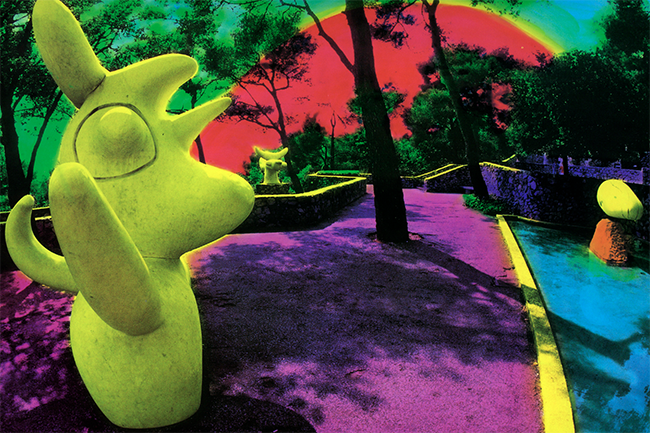
An exhibition at the UC Santa Barbara Art, Design & Architecture Museum explored her engagement with France through examples of this process. It brought together hand-painted Cibachromes and Photoshop transformations of the same imagery, allowing viewers to consider how a photograph could take different forms. Such comparisons reveal the continuing life of an image within her practice, where returning to earlier material can lead to fresh discoveries.
Color is central to the pleasure Gottlieb wants her artwork to offer. Yet its effect depends on composition as much as intensity. The placement of a bright area, the balance between neighboring hues, and the rhythm of shapes guide the eye through each scene. These relationships give her images coherence, allowing their exuberance to unfold through a considered visual structure.
Her artwork has appeared in private and corporate collections, museums, public spaces, galleries, and international art expos. It has also been represented in permanent collections, magazines, books, and online articles. Across these settings, her practice remains grounded in a personal pursuit: finding new possibilities within photographs she knows intimately. By repeatedly revisiting her images, Gottlieb shows how an encounter with a place can continue to generate ideas for decades.
Miro’s Playground: A Garden Transformed by Imagination
Miro’s Playground, 1992, painted 1989
Archival hand-painted Cibachrome print
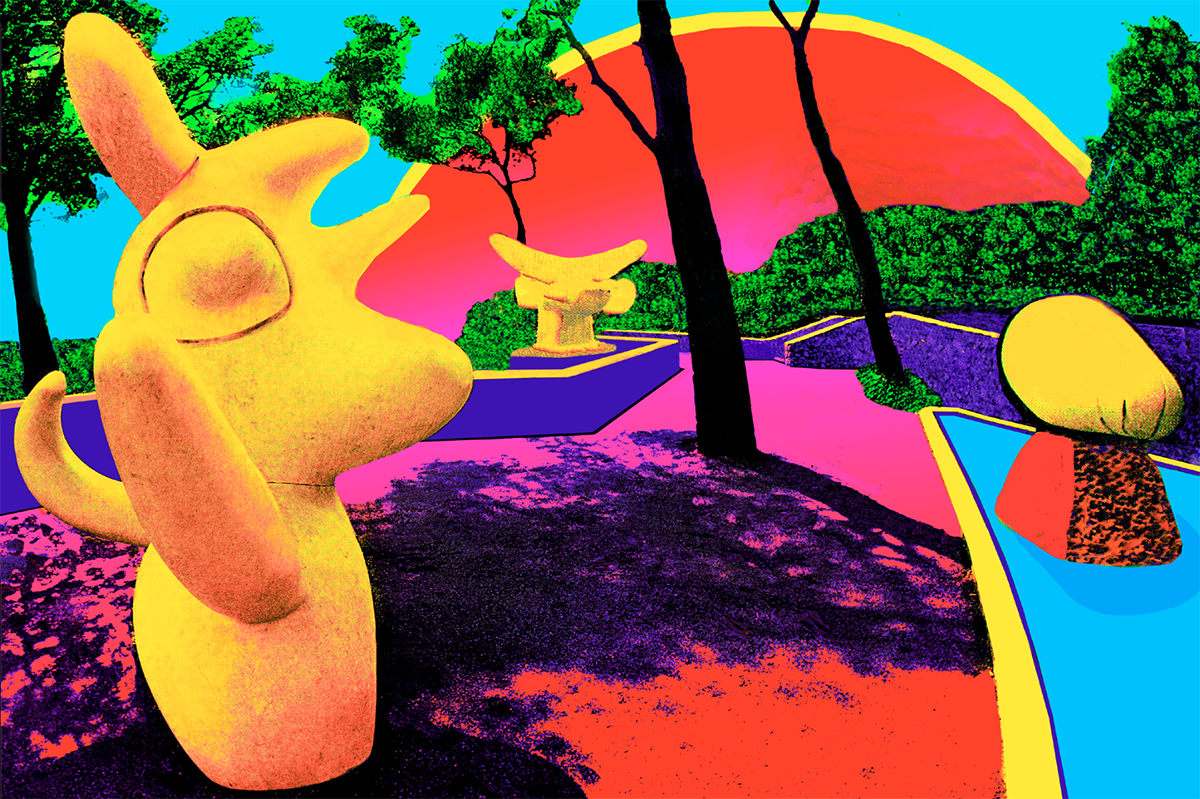
In Miro’s Playground, Jane Gottlieb transforms a sculptural garden into a vivid environment where color changes the experience of space. A large yellow sculptural form occupies the left foreground, its rounded body and upward extensions giving it an animated presence. Behind it, dark trees rise across a brilliant red and pink sky. Purple pathways, green foliage, and turquoise water establish a setting that feels simultaneously recognizable and dreamlike. The photograph retains the textures and spatial details of an outdoor scene, while the painted colors introduce an imaginative atmosphere.
The foreground sculpture provides the composition’s strongest point of entry. Its yellow surface stands apart from the darker vegetation and shadows surrounding it. Curving projections suggest ears, limbs, or other bodily features without settling into a single identity. A rounded outline near its upper center adds another ambiguous detail. These forms encourage viewers to make associations, reading the sculpture as a character as well as an object. Its proximity to the camera gives it a commanding role within the garden.
Gottlieb balances this large form with smaller sculptural elements farther away. Near the center, another yellow shape appears beyond a low wall, creating a visual connection with the foreground. At the right, a yellow oval rests above an orange support beside the water. These repeated touches of yellow lead the eye across the image. Their changing scale also helps establish depth, drawing attention from the nearest sculpture toward the more distant areas of the setting.
The pathways contribute another kind of movement. Their pink and purple surfaces extend through the garden, passing between walls and tree trunks. These routes invite the viewer to imagine walking into the scene, although the intense coloring makes that journey feel removed from everyday experience. Low stone boundaries organize the space into distinct areas. Yellow accents along their upper edges bring these divisions into focus, creating lines that connect the garden’s different features.
Dark trees interrupt the bright colors with a network of trunks, branches, and leafy silhouettes. A thick trunk near the center anchors the composition, while finer branches spread across the sky. Their irregular shapes contrast with the smooth curves of the sculptures. They also preserve a sense of the original photograph’s detail. Through these darker passages, the garden maintains visual complexity, allowing the brighter colors to appear within a textured environment rather than an entirely flattened field.
The sky offers one of the artwork’s most unexpected transformations. Red and pink dominate its open areas, edged in places by yellow and surrounded by green and turquoise tones. This departure from natural sky color changes the mood of the whole scene. Against it, the trees become dramatic silhouettes, and the yellow sculptures seem even more luminous. The turquoise water at the right introduces a cooler area, balancing the warmer colors elsewhere.
As a hand-painted Cibachrome print, the artwork brings photographic observation and painted interpretation into direct contact. The camera records surfaces, shadows, and perspective; Gottlieb’s color decisions reshape how those details are experienced. This combination gives the image its particular tension between physical place and imagined world. Viewers can follow the garden’s layout while responding to an atmosphere that belongs to the artist’s treatment.
The title’s reference to a playground finds an echo in the scene’s visual character. The sculptures appear companionable, the paths suggest exploration, and the colors encourage curiosity. Gottlieb allows an outdoor setting to become a place of imaginative encounter. Its appeal develops through the interaction of forms, textures, and unexpected hues, offering viewers the pleasure of discovering how much a familiar world can change when seen through another person’s imagination.
